
Introduction
Many first-time clothing brands compare fast fashion and custom manufacturing by one number: unit price. In real production, that is rarely the full story. We have seen brands save money on paper, then lose more through excess inventory, inconsistent quality, and products that feel too generic to build repeat sales.
From our experience as a clothing manufacturer, the bigger risk for many startups is not paying a little more per piece. The bigger risk is ordering too much, moving too fast, and ending up with products that feel generic or sell slower than expected.
That is why this decision matters early. The production model you choose affects your MOQ, sampling process, lead time, product control, and long-term brand positioning.
Fast fashion and custom manufacturing can both work. The right choice depends on what kind of brand you want to build, how much risk you can carry, and how much control you need over the product.
What Is Fast Fashion Manufacturing?
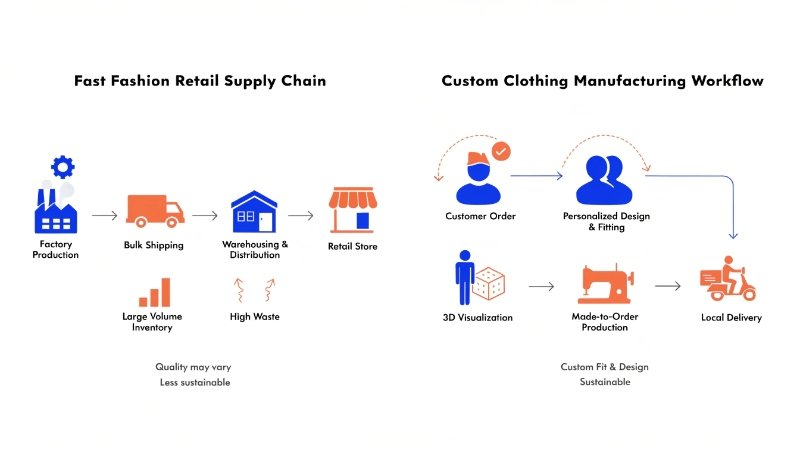
Fast fashion manufacturing is a production model designed to turn new styles into sellable products quickly. Brands using this approach react to trends, produce at scale, and aim to keep the per-unit cost low.
If you’re comparing suppliers, it helps to separate the model from the partner. A capable manufacturer can still offer transparency, consistent QC, and realistic timelines—even when the goal is speed.
In practice, fast fashion manufacturing often relies on standardized patterns, simplified construction, and suppliers that can move fast across sourcing, cutting, sewing, and shipping. The advantage is speed and responsiveness.
It’s also a model where volume matters. The economics typically improve when you can order larger quantities, keep factories running efficiently, and spread setup costs across many units.
In practice, fast fashion is less about “bad quality” and more about speed-first decision-making. The faster the cycle, the less room you usually have for deep customization, repeated fit correction, or premium finishing.
Main Advantages of Fast Fashion Manufacturing
Speed to market. Fast fashion manufacturing is built around short product cycles. If your business wins when you launch quickly, that’s a real advantage.
Lower unit cost can be real, but usually only when the order size is large enough to spread development, fabric, and setup costs. For a small brand, chasing a low unit price sometimes means taking on more inventory than the market can absorb.
Fast trend response. If your product strategy is to chase demand spikes, speed matters more than originality. Fast fashion manufacturing supports that approach.
Main Drawbacks of Fast Fashion Manufacturing
Less originality. When the supply chain is optimized for speed, it’s harder to build truly distinctive products. Many brands end up competing on price and marketing rather than design.
Higher inventory risk. Trends move fast, and production is still physical. If you commit to large quantities and demand shifts, you’re left with cash tied up in stock.
Lower brand differentiation. If your product looks similar to what’s already in the market, it’s harder to justify premium pricing. That can compress margins over time.
Possible quality inconsistency. Speed and scale can expose weak specifications and QC processes. If standards aren’t clearly documented and enforced, defects and returns can climb.
| Factor | Fast Fashion Manufacturing | Custom Manufacturing |
|---|---|---|
| Speed | Faster production cycles and quicker market response | Slower due to development, sampling, and approvals |
| Cost | Lower unit cost at higher volumes | Higher upfront development cost and often higher unit cost at low quantities |
| MOQ | Usually better suited to larger order volumes | Can be more flexible, but depends on fabric, trims, and construction details |
| Customization | Limited customization, often based on standard styles or simplified changes | High level of customization in fit, fabric, trims, branding, and construction |
| Quality Control | Can be consistent, but weak specifications may lead to quality variation | Easier to control when tech packs, samples, and standards are clearly defined |
| Branding Flexibility | Basic branding options, usually with less room for detail | Strong branding flexibility, including labels, packaging, trims, and signature details |
What Is Custom Manufacturing?
Custom manufacturing in the clothing industry means producing garments based on your brand’s specifications. You define the design, fit, fabrics, trims, construction details, and branding elements.
This model is common for private label brands and quality-focused labels because it gives you control. You’re not just choosing from what already exists; you’re building a product that represents your brand.
Custom apparel production usually includes development steps like tech packs, pattern making, sampling, and iterative revisions. That upfront work is the trade for long-term consistency and differentiation.
In our experience, custom manufacturing works best when a brand knows which details truly matter. Not every garment needs a custom zipper, special wash, contrast tape, and multiple trims in the first order. Good customization is focused, not excessive.
Main Advantages of Custom Manufacturing
Better brand identity. When you control fabric, fit, and details, your product can look and feel like “you.” That’s how brands earn repeat customers.
Greater product control. Custom clothing manufacturing lets you specify measurements, stitching, finishing, labeling, and packaging. You can tighten quality where it matters most to your customer.
More flexibility in fabric, fit, trims, and details. You can choose a heavier GSM, a specific wash, branded trims, or a unique silhouette. Those decisions shape your pricing power.
Better for long-term brand building. Once a style is dialed in, reorders become more predictable. You’re building a repeatable product system, not restarting from scratch each season.
Main Drawbacks of Custom Manufacturing
Longer development process. Sampling and approvals take time. If you need product in hand in a few weeks, custom may feel slow.
Sampling takes time (and budget). You’ll pay for samples and revisions. It’s normal to do more than one round before production is ready.
Unit cost may be higher at low quantities. Small runs can’t always achieve the same economies of scale. The key is whether the higher cost buys you better sell-through and fewer returns.
Fast Fashion vs Custom Manufacturing: Key Differences
If you’re searching “fast fashion vs custom manufacturing,” you’re likely not looking for theory. You want to know what changes in cost, speed, and risk when you pick one model over the other.
Below is a criteria-by-criteria comparison you can use as a sourcing checklist.
Speed and lead times
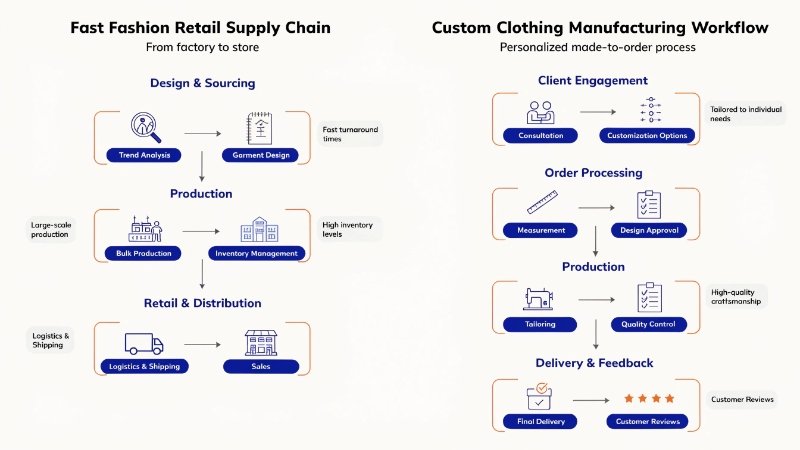
Fast fashion manufacturing is designed to compress timelines. It often uses existing materials, simplified specs, and quick decision cycles.
Custom manufacturing depends on how much is being developed from scratch. New patterns, custom fabrics, complex trims, and multiple fitting rounds add time.
If you want a practical breakdown of what affects timelines, this overview of what affects garment production lead times is a useful reference for planning.
MOQ and flexibility
MOQ in clothing manufacturing isn’t just a “factory preference.” It’s often tied to upstream minimums: fabric dye lots, printing setup, embroidery setup, and trim suppliers ordering in bulk.
Fast fashion programs tend to work better when you can order higher volumes. Custom manufacturing can be flexible, but the real minimum often depends on the fabric and color choices you make.
For a plain-English primer, Sewport’s guide to MOQ (minimum order quantity) basics explains why minimums vary so much.
For a more detailed view of how many factors can affect minimums (fabric, construction, prints), Hook & Eye UK also breaks down what drives MOQs in clothing manufacturing.
Cost structure and budgeting
Fast fashion manufacturing can look cheaper because the unit price is low at scale. The problem is that a low unit price doesn’t protect you from unsold inventory.
Custom clothing manufacturing can carry higher upfront development costs (sampling, revisions). But it can also reduce downstream costs like returns, discounting, and constant style churn.
NetSuite’s overview of how garment costing is typically calculated is helpful if you want to separate unit cost from true landed cost.
Design originality and IP risk
Fast fashion is optimized for trends, so originality is often limited. Many brands end up selecting from similar supplier options or following market patterns closely.
Custom apparel production is where you can build signature details: a specific fit block, custom wash, proprietary fabric hand-feel, or distinctive trims. Those elements support higher perceived value.
Quality control and consistency
Fast programs can be consistent when specs are tight and QC is disciplined. But speed can punish vague requirements.
Custom manufacturing is typically easier to control because your tech pack, measurements, and construction details become the shared “contract” between your brand and the factory.
If you care about repeatability, ask any private label clothing manufacturer about:
- Pre-production sample (PPS) process
- Inline vs final inspection
- How defects are defined and measured
- Whether they use AQL standards
Inventory risk and cash flow
Fast fashion usually means you commit to larger runs to get pricing. That can increase inventory risk if demand shifts.
Custom manufacturing can help you manage risk by starting with smaller test runs, tightening sell-through, then reordering based on real data. It’s not always low MOQ, but it’s often more “test-and-learn” friendly.
Branding opportunities
Fast fashion manufacturing can include basic branding, but it often prioritizes speed over detail. You might get limited options for trims, packaging, and special finishes.
Custom manufacturing is where branding becomes part of the product. Labels, hang tags, packaging, embroidery placement, and finishing can be designed to match your positioning.
Long-term scalability
Fast fashion scales quickly when you have strong demand and reliable forecasting. It’s a volume engine.
Custom manufacturing scales well when you have a stable product foundation. Once your patterns, BOM, and QC checkpoints are set, scaling is about capacity planning rather than re-inventing the product each season.
| Comparison Point | Fast Fashion Manufacturing | Custom Manufacturing |
|---|---|---|
| What It Prioritizes | Speed, fast launches, and trend response | Product control, brand identity, and long-term consistency |
| How It Usually Works | Faster development with simplified processes and less product refinement | Slower development with sampling, revisions, and more detailed approvals |
| Lead Time | Shorter in many cases | Longer because more decisions are confirmed before bulk production |
| MOQ Reality | Often works better when order quantities are larger | Can be more flexible, but real MOQ is often driven by fabric, trims, and color choices |
| Cost Logic | Lower unit cost can be achieved at scale | Higher upfront cost, but sometimes better control over total business risk |
| Product Originality | Often more limited | Easier to create distinctive products with recognizable details |
| Fit and Construction Control | Less room for repeated fit improvements | Better control through custom patterns, samples, and spec confirmation |
| Quality Stability | Depends heavily on how clear and simple the specifications are | Usually easier to manage when product standards are locked in early |
| Branding Potential | Suitable for simple branding | Better for labels, trims, packaging, finishing, and stronger product identity |
| Inventory Pressure | Higher when brands order large quantities to chase lower pricing | Lower when brands start with focused styles and test more carefully |
| Best for Startups? | Better for trend-driven sellers with strong sell-through ability | Better for startups building a real brand and testing product-market fit |
| Long-Term Value | Works when speed is the advantage | Works when the product itself is the advantage |
Which Option Is Better for Startups?
For startups, the “best” model is the one that matches your cash flow and your product strategy. The wrong model isn’t just inefficient; it can trap you in inventory or force you into products you can’t defend.
Fast fashion manufacturing can work when your differentiation comes from marketing and distribution rather than product. Custom clothing manufacturing tends to win when your differentiation is the product itself.
A useful way to decide is to be honest about your advantage. Are you better at spotting trends and selling fast, or at building a product people will reorder and recommend?
If your plan includes private labeling, confirm what your partner can do beyond a basic logo. A true private label clothing manufacturer should be able to support consistent labels, care tags, packaging, and repeatable specs across reorders.
When fast fashion may work better
Fast fashion can be a fit when you’re:
- Running a trend-driven resale or drop model
- Testing low-differentiation basics where speed matters more than signature details
- Confident you can sell through quickly (and you have channels to do it)
Even then, pay attention to inventory risk. A “cheap” unit price can still be expensive if you have to discount 40% of the order to clear space.
When custom manufacturing may work better
Custom manufacturing is often a better fit when you’re:
- Building a brand that needs a distinct look, fit, or fabric story
- Selling at a premium (or trying to protect margin with quality)
- Planning reorders and long-term SKUs, not just one-off drops
- Trying to reduce inventory risk with smaller pilots and controlled reorders
If you’re a clothing manufacturer for startups, your strongest value isn’t speed alone. It’s helping founders make fewer expensive mistakes in sampling, specs, and order planning.
Best Choice for Trend-Driven Sellers
If your brand wins by moving fast, consider a fast fashion manufacturing partner that can:
- Quote quickly with clear, itemized costs
- Offer reliable bulk lead times
- Handle fast replenishment without quality drops
You’ll still want basic guardrails. Clear size specs, fabric approvals, and a simple QC checklist can prevent “fast” from turning into “rework.”
Best Choice for Brand-Building Startups
If you want a product people can recognize and trust, custom clothing manufacturing is usually the safer bet. It gives you the control to make improvements that customers notice.
Start small, keep the first collection focused, and treat sampling as a learning process. That’s how independent brands build repeatable winners.

Cost, MOQ, and Profit Margin: What Brand Owners Should Really Look At
Most founders compare models using one number: unit price. That’s understandable, but it’s also incomplete.
Your real profit comes from a chain of decisions: product-market fit, sell-through, returns, reorders, and how often you need to discount. Manufacturing model affects every link.
Why a lower unit cost doesn’t always mean higher profit
A lower unit cost helps if you can sell most of what you produce at full price. If you can’t, the leftover inventory becomes the most expensive “cost” on your P&L.
Fast fashion manufacturing can push you toward larger orders to get the pricing you want. That can work, but it increases the stakes.
Custom apparel production may have a higher unit cost at low quantities, but it can improve profitability by reducing:
- Excess inventory
- Quality-related returns
- Customer churn caused by inconsistent fit
Hidden costs that quietly erode margin
Beyond unit price, watch for costs that show up later:
- Sampling and revisions (time + money)
- Fabric and trim minimums (especially per color)
- Testing and inspections (for performance fabrics or compliance needs)
- Rework, defects, and returns
- Packaging and labeling that doesn’t match your positioning
- Freight, duties, and landed cost surprises
How MOQs affect startups in real life
For a startup, MOQ is really a cash-flow decision. It determines how much money you lock into one style and how many bets you’re making at once.
You can often keep MOQ manageable by limiting variables:
- Fewer colors for the first drop
- Shared fabric across multiple styles
- Shared trims (same labels, drawcords, zipper types)
- Simpler construction while your fit block is still being refined
A more useful way to compare costs
Instead of “Which is cheaper?” ask “Which lets me control risk?” That usually means comparing cost and margin together, not separately.
| Cost Factor | Fast Fashion Manufacturing | Custom Manufacturing |
|---|---|---|
| Unit Cost | Lower unit cost is easier to achieve when order volume is high | Unit cost is often higher at smaller quantities |
| Sample Cost | Usually lower when fewer custom changes are needed | Higher because development, fit revisions, and approvals take more time |
| MOQ Pressure | Often higher if better pricing depends on larger runs | Can be more manageable when the first order is kept simple and focused |
| Inventory Risk | Higher if the brand commits to large quantities before sales are proven | Lower when the brand starts with smaller pilots and reorders based on real demand |
| Branding Value | Limited when the product feels similar to many others in the market | Stronger because the product can carry more unique fit, fabric, and branding details |
| Margin Impact | Lower cost can be offset by discounting, slow sell-through, or excess stock | Higher cost can be justified by better perceived value, stronger pricing, and more controlled stock levels |
How to Choose the Right Manufacturing Model for Your Clothing Brand
If you want a simple clothing brand manufacturing guide, focus on five decisions: your product strategy, your risk tolerance, your cash flow, your quality bar, and your timeline.
If you’re working with a clothing manufacturer for startups, ask for a clear “first production plan” that includes sampling milestones, MOQ assumptions, and what happens if you need a fast reorder.
A good production choice isn’t just about today’s launch. It’s about whether you can repeat success and scale without losing control.
Here are practical questions to answer before you commit:
- Do you want to build a real brand, or mainly sell trends?
- Do you need unique product details, or will a standard product work?
- Can you handle large inventory risk if sell-through is uncertain?
- Is speed more important than originality for your customer?
- Do you need flexible MOQ in clothing manufacturing to test responsibly?
Key Takeaway: If you don’t have reliable demand yet, prioritize models that let you learn with smaller financial bets.
Choose Fast Fashion Manufacturing If…
Fast fashion manufacturing is a practical choice if:
- Your catalog changes frequently and you don’t expect long reorders
- Your customers buy based on trend + price, not signature fit and details
- You can consistently sell through within a short window
- Your operations can handle rapid product turnover
If you go this route, protect yourself with tighter specs than you think you need. Speed is unforgiving when the details are vague.
Choose Custom Manufacturing If…
Custom clothing manufacturing is usually the better choice if:
- Your differentiation comes from fit, fabric, construction, or brand details
- You want consistent reorders and stable hero SKUs
- You need better control over quality and finishing
- You want to reduce inventory risk with smaller pilots and data-driven reorders
If you’re evaluating factories, a good sign is a partner that asks for your tech pack, size specs, and target price, then explains trade-offs clearly.
For example, Easson Apparel outlines its custom and private label capabilities on the Easson Apparel site, and shares a practical shortlist process in its guide to Chinese clothing manufacturers for startups.
Final Thoughts
Fast fashion vs custom manufacturing isn’t a moral question. It’s a business decision about speed, control, and risk.
Fast fashion manufacturing can be a strong fit for trend-driven models that win on rapid launch cycles and high-volume efficiency. It can also create expensive inventory problems when forecasting is wrong.
Custom manufacturing takes more upfront work, but it helps brands build products they can defend. For many startups and independent labels, that usually means stronger brand identity, tighter quality control, and better long-term scalability.
If you’re building a clothing brand and want more control over quality, branding, and product details, working with an experienced custom clothing manufacturer can help you make better long-term decisions—especially when you’re planning sampling, MOQs, and your first production run.
If you want a concrete example of how customization shows up in real products (fabric options, finishing, and details), Easson’s polo shirt manufacturing page is a helpful reference point.
If you’re weighing your options and want guidance on sampling or MOQ planning, reach out to a custom clothing manufacturer and ask for a realistic sampling timeline and a first-order plan. A good partner will walk you through trade-offs before you spend money on bulk production.