
Many hoodie ideas look strong on screen, but fail in sampling when they are not production-ready.
A good hoodie design is not only good-looking. It should fit the target customer, work in real production, keep cost under control, and support repeat orders.
I have worked with hoodie orders for fashion brands, schools, gyms, creators, and gift sellers. The best designs are usually clear before production starts: buyer, fabric weight, fit, decoration method, and order plan. When these points are clear, sampling moves faster and cost is easier to control.
Graphic Hoodie Design Ideas for Prints, Logos, and Illustrations
Graphic hoodie designs get attention fast, but they also create the most production questions.
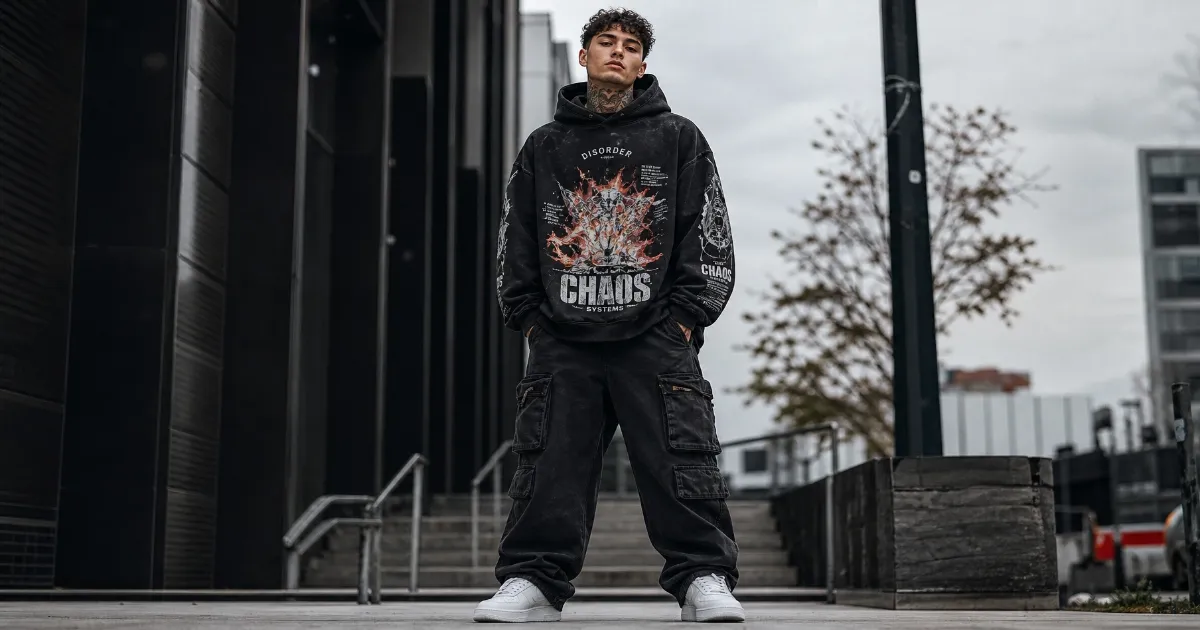
Graphic hoodies work best when the artwork, placement, print method, and fabric are planned together. For a first drop, I often suggest one main graphic, one brand logo, and one strong color story.
1. Minimal Chest Logo Hoodie
A small logo on the left chest gives the hoodie a clear brand mark without making it hard to wear. It works well for startup brands, gyms, creator merch, and premium basics.
Embroidery, screen print, or silicone print can all work. Cost and placement risk are easier to control because the artwork is small. The logo should still be readable from a normal viewing distance.
2. Oversized Back Graphic Hoodie
This idea is common in streetwear, music merch, and creator collections. The front can stay clean, while the back carries the main story.
A large back graphic gives strong visual impact, but the artwork size must be checked carefully. Screen print works well for bold colors. DTG can work for complex images, but hand feel and wash result should be tested first1.
3. Typography Hoodie
Typography hoodies are strong when the message is clear and easy to read. A slogan, brand message, city name, team name, or short phrase can become the full design.
Spacing is the key. A phrase that looks good on a laptop may look too small or too wide on a real hoodie. I suggest printing the artwork at real size before sampling, especially for chest, back, sleeve, or hood placement.
4. Mascot Illustration Hoodie
Mascot hoodies work well for creator brands, youth brands, and campus merch. A mascot gives the hoodie a friendly identity and can return in future collections.
The risk is artwork detail. Too many thin lines, shadows, and small color areas can raise cost or reduce print stability. A simplified mascot is usually safer for the first production.
5. Hand-Drawn Graphic Hoodie
A hand-drawn graphic gives a hoodie a personal and original feeling. It suits art brands, creative studios, and limited drops.
Before production, line thickness needs to be checked. Very thin lines may break or fade after washing. The factory also needs vector or high-resolution artwork, not only a photo of a sketch2.
6. Vintage Poster-Style Hoodie
A vintage poster-style hoodie can feel rich and collectible. It works for music themes, outdoor themes, travel themes, and retro sports themes.
This design often uses a large back print or full front print with faded colors, texture, and old-style type. The brand should decide whether it wants a real faded print effect or only a graphic that looks vintage.
Factory experience note: For large back graphics, I check three things before sampling: fabric surface, artwork size, and print method. Low-GSM fleece with a loose surface may not hold detailed prints well3. Puff print needs bold lines. DTG needs artwork resolution and fabric testing. A strong mockup does not always mean the print will look strong on the final hoodie.
| Graphic Idea | Best For | Production Note |
|---|---|---|
| Chest logo | Basics, gym, creator merch | Easy to repeat |
| Back graphic | Streetwear, music merch | Check print size |
| Typography | School, brand message | Check real-size layout |
| Mascot | Youth, creator, campus | Simplify colors |
| Hand-drawn | Art brands | Clean artwork needed |
| Vintage poster | Retro drops | Test texture effect |
Streetwear Hoodie Design Ideas for Modern Clothing Brands
Streetwear customers notice fit, weight, and attitude quickly. If the fabric and fit are weak, the hoodie can still feel basic.
Streetwear hoodie design works when the fit, fabric weight, wash effect, print method, and brand story feel consistent. Testing one strong fit and one strong graphic is often better than launching too many styles at once.
7. Washed Streetwear Hoodie
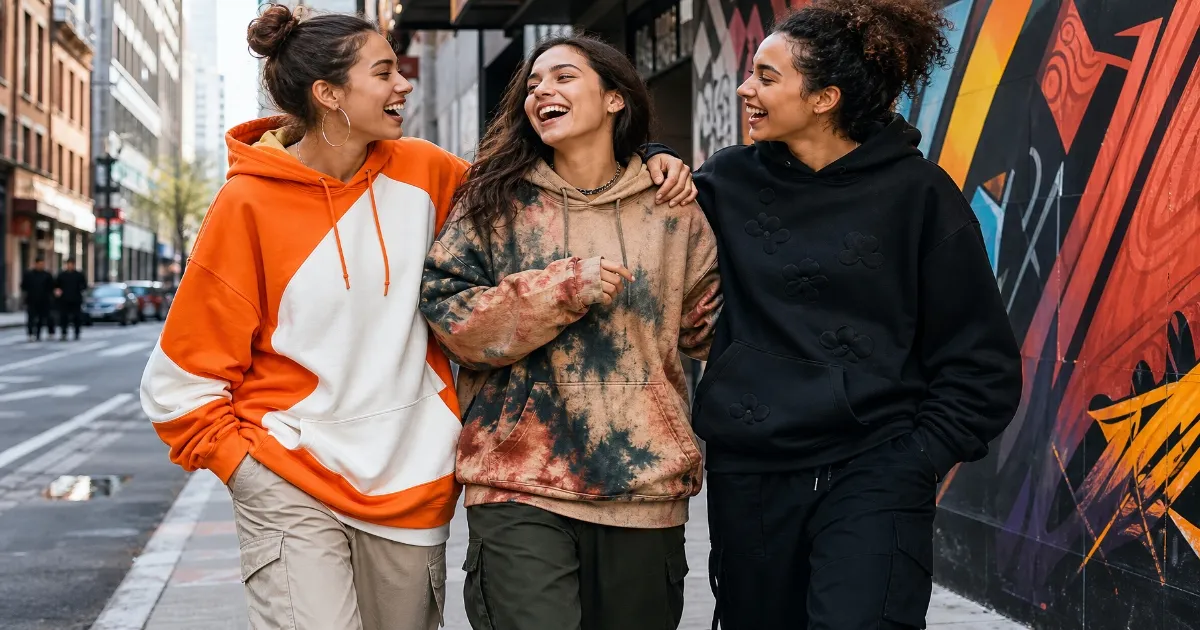
A washed hoodie gives a used, soft, and relaxed look. It works well for modern streetwear because it feels less new and more personal4.
The wash can be garment wash, enzyme wash, acid wash, or vintage wash. Each method changes fabric, color, and shrinkage, so the size chart should consider wash shrinkage from the start.
8. Boxy Fit Hoodie
A boxy fit hoodie has a wider body and shorter length. It is often used in premium streetwear and fashion basics because the shape itself becomes part of the design5.
A boxy hoodie is not just a regular hoodie made larger. The shoulder, chest, sleeve, hem, and length all need balance. A reference sample or target measurement chart helps the factory understand the fit faster.
9. Drop Shoulder Hoodie
A drop shoulder hoodie gives a relaxed unisex look. The shoulder seam sits lower than a regular hoodie, which makes the shape softer and more casual.
The sleeve length and armhole must be controlled. If the shoulder drops too much, the sleeve may feel too long. If the armhole is too low, movement can feel strange. I suggest fitting at least two sizes before bulk production.
10. Puff Print Hoodie
Puff print adds raised texture to logos, numbers, and bold graphics. It can make a simple hoodie feel more special without adding many trims.
The artwork must suit puff print. Thin lines may not puff evenly, and very large solid areas can feel heavy. Bold letters and simple shapes usually work better.
11. Distressed Hoodie
A distressed hoodie can include raw edges, small holes, faded fabric, or worn seams. It can work for fashion drops, but the production standard must be clear.
Distressing cannot be random in bulk production. The factory needs clear positions, sizes, and effect standards. An approved sample should become the production guide.
Factory experience note: For washed or distressed hoodies, I do not suggest approving production only from a flat mockup. The wash can change color depth, hand feel, and measurements. For heavyweight hoodies, shrinkage and seam twisting also need attention6. A pre-production sample after wash is much safer than approving only the raw garment.
Minimal Hoodie Design Ideas for Premium Basics
Minimal hoodies look easy, but they are not easy to make well. Without a large graphic, fabric, fit, stitching, and color matching become more visible.
Minimal hoodie design works when the fabric hand feel, fit, color, stitching, and small branding details are clean. The simpler the design looks, the more important production control becomes.
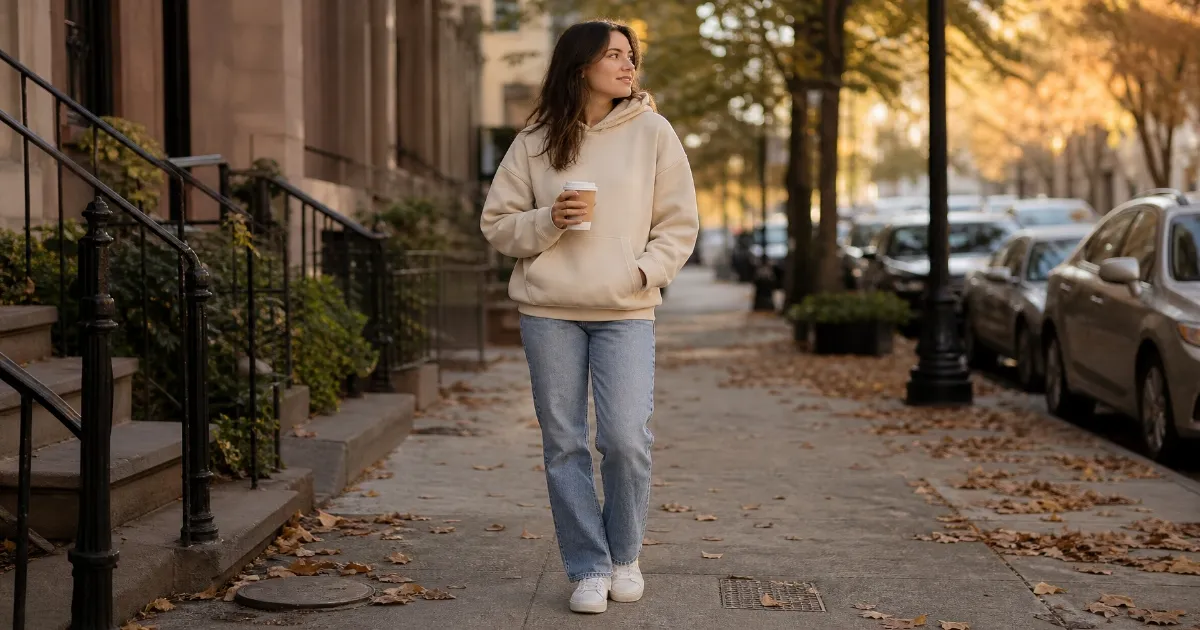
12. Tonal Embroidery Hoodie
Tonal embroidery uses thread that is close to the hoodie fabric color. A black hoodie with black embroidery or a cream hoodie with beige embroidery can feel quiet and premium.
The main point is thread matching. The thread does not need to be exactly the same color, but it should feel planned. Small tonal embroidery often looks more elegant.
13. Small Sleeve Logo Hoodie
A small sleeve logo gives the hoodie a subtle brand detail while keeping the front and back clean. It can use embroidery, print, woven patch, or rubber patch.
Placement matters. If the mark sits too low, it may disappear near the cuff. If it sits too high, it may look random. The best position is usually where the arm naturally shows when worn.
14. Clean Blank Hoodie
A clean blank hoodie is hard to sell and make well because there is no graphic to carry the value. The value comes from fabric, fit, color, sewing, and hand feel.
This idea is good for brands that want a long-term core product. But the brand still needs to define fabric weight, fleece type, rib quality, hood shape, drawstring style, and label details. A blank hoodie is still a designed product.
15. Monochrome Hoodie
A monochrome hoodie uses one color story across the fabric, rib, drawstring, print, and trims. It creates a calm and premium look.
The challenge is color matching. Fabric, rib, drawstring, zipper, and label details may come from different suppliers. Lab dips and trim samples are important when the brand wants a premium color story.
| Minimal Idea | Key Value | Main Risk |
|---|---|---|
| Tonal embroidery | Quiet branding | Poor thread match |
| Sleeve logo | Subtle detail | Wrong placement |
| Clean blank | Long-term core item | Weak fabric or fit |
| Monochrome | Premium color story | Trim color mismatch |
Hoodie Design Ideas for School, Clubs, and Campus Merch
School hoodie buyers care about identity, memory, and group feeling. Designs should be clear, wearable, and easy to organize.
School and campus hoodies work best with clear text, school colors, stable fabric, and simple sizing. Size range, personalization, delivery time, and SKU complexity should be checked before production.
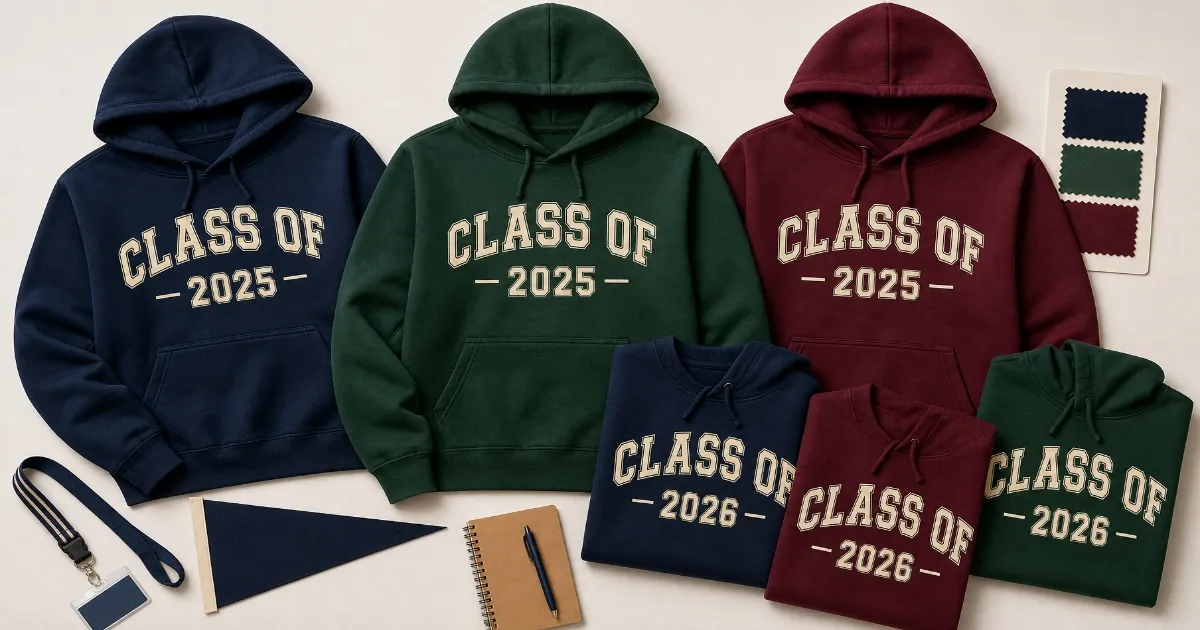
16. School Club Hoodie
A school club hoodie should show group identity clearly. It can use the club name, school logo, year, and a simple icon.
For this type of hoodie, clear typography is more important than complex art. A front text plus a small sleeve or back detail often works well.
17. Graduation Hoodie
A graduation hoodie has strong memory value. It may include names, year numbers, class lists, or custom back prints.
This design can sell well because it is tied to an important moment, but name lists must be checked carefully. One spelling mistake can ruin one piece. A clear approval process before printing is necessary.
18. Sports Team Hoodie
A sports team hoodie usually needs stronger fabric and a bold design. It can include team name, player number, mascot, or sponsor logo.
The hoodie should be comfortable for travel, warm-up, and daily wear. Size range can be wide because teams may include different ages and body types. Names and numbers should be confirmed early because personalization changes the production schedule.
19. Campus Event Hoodie
A campus event hoodie is useful for festivals, conferences, charity runs, and student activities. The design should show the event name, date, and theme.
The best event hoodies are still wearable after the event ends. A small front event logo and a stronger back graphic can work well. Delivery time is often tight, so the event date should be confirmed before choosing decoration methods.
Couple Hoodie Design Ideas for Matching Sets and Gift Collections
Couple hoodies can become too childish if the design is too direct. Better designs match as a set but still look good when worn alone.
Couple hoodie designs work best when they are matching but not identical. Unisex fit, size ratio, color pairing, print placement, fabric match, and set packaging should be planned together.

20. Matching Couple Hoodie
A matching couple hoodie can use the same color, same logo, or same short message. The safest version is simple and wearable.
Both people should feel comfortable wearing it alone. Neutral colors like black, grey, cream, navy, or brown make the product easier to wear. A small shared symbol is often better than a large romantic slogan.
21. Split Graphic Hoodie Set
A split graphic set uses two designs that connect when the couple stands together. It is strong for photos and gift marketing.
Each hoodie should still look complete alone. If one side looks strange by itself, the buyer may wear it less. Placement must be accurate, and the artwork should line up at a natural body height, not only on a flat mockup.
22. Anniversary Hoodie
An anniversary hoodie can include a date, place, initials, or private message. It works well for gift collections and made-to-order shops.
The design should feel personal but not too loud. Small embroidery on the chest, cuff, or inside label can create a premium feeling. If personalization is offered, the brand should limit options at the start to reduce mistakes.
23. Minimal Initials Hoodie
A minimal initials hoodie is simple and premium. The two hoodies can have small initials, a shared date, or a tiny symbol on the chest, sleeve, or hood.
This idea can support repeat sales because the base hoodie can stay the same while the initials change. For production, embroidery size and font thickness need to be checked. Very thin letters may not stitch well.
| Couple Idea | Best Selling Point | Production Note |
|---|---|---|
| Matching hoodie | Easy gift product | Keep it wearable |
| Split graphic set | Strong photo effect | Check alignment |
| Anniversary hoodie | Personal value | Control custom options |
| Initials hoodie | Simple and premium | Check letter thickness |
Custom Hoodie Details: Fabric, Fit, Labels, Drawstrings, and Packaging
Small details can change the full value of a hoodie. A basic hoodie can feel more like a brand product when labels, trims, and packaging are planned well.
Custom hoodie details work when they support the main design instead of adding noise. Fabric, fit, labels, drawstrings, pockets, patches, and packaging all affect the customer experience.

24. Custom Drawstring Hoodie
A custom drawstring is a small detail, but it can make the hoodie feel more branded. Options include flat drawstrings, round drawstrings, dipped-end drawstrings, metal-tip drawstrings, and printed drawstrings.
The choice should match the price level. A premium hoodie can use heavier drawstrings and metal tips. A school hoodie may only need a simple and safe drawstring. Color matching also matters because a poor contrast color can make the hoodie look cheaper.
25. Contrast Hood Lining Hoodie
A contrast hood lining can add color and structure. It works well for school, team, and brand merch because the inside of the hood can carry a secondary color.
This detail adds fabric planning. The lining fabric should match the main fabric in shrinkage and hand feel. If the lining pulls differently after washing, the hood can twist or look uneven.
26. Woven Label Hoodie
A woven label is one of the most important brand details. A hoodie can have a neck label, size label, side seam label, hem label, or care label.
The design should be simple and readable. A woven label with too much detail can become blurry. Placement also matters. A scratchy neck label can hurt the wearing experience, so a soft label or printed neck label may be better for some markets.
27. Sleeve Patch Hoodie
A sleeve patch can be woven, embroidered, rubber, leather-like, or felt. It works well for outdoor, college, streetwear, and premium casual brands.
The patch gives texture without using a large print. The main production point is attachment. The stitching must be clean and strong, and the patch should not feel too stiff on the sleeve.
28. Kangaroo Pocket Print Hoodie
A kangaroo pocket print uses a space that many brands ignore. The print can sit above the pocket, on the pocket, or partly across it.
Placement must be handled carefully because the pocket seam creates height changes. If the print crosses seams, the result may be uneven. Bold artwork and clear placement marks are safer than small details around the pocket.
29. Custom Packaging Hoodie
Custom packaging does not change the hoodie itself, but it changes the buyer’s first feeling. It matters more for gift products, online brands, and premium basics.
A simple polybag with a size sticker may be enough for wholesale. A gift set may need a custom bag, box, hangtag, sticker, or thank-you card. Packaging also affects shipping cost, so the sales channel should decide how much packaging is needed.
| Detail Idea | Value Added | Cost Control Tip |
|---|---|---|
| Drawstring | Better brand feel | Use one style across colors |
| Hood lining | Color contrast | Test shrinkage |
| Woven label | Brand identity | Keep artwork simple |
| Sleeve patch | Texture and detail | Test stiffness |
| Pocket print | Fresh placement | Avoid complex seam crossing |
| Packaging | Better unboxing | Match sales channel |
How to Choose the Right Hoodie Design for Your Brand
Choosing too many hoodie ideas at once can slow a new brand down. Variety is useful only after the brand proves what buyers want.
Choose a hoodie design by target customer, use case, fabric weight, fit, graphic method, MOQ, and reorder plan. A small focused first drop is often safer than many complex designs.

Start with the target customer. A streetwear buyer may want heavy fabric, boxy fit, drop shoulder, washed color, and strong back graphics. A gym buyer may want lighter fabric, better movement, and clean branding. A school buyer may want clear text, school colors, wide size range, and fast delivery. A couple gift buyer may care more about softness, simple matching details, and packaging.
Then look at the use case. A daily hoodie should be easy to wear many times. A merch hoodie should show identity. A graduation hoodie should hold memory. A streetwear drop should create visual desire. These use cases change the design direction.
Finally, check production difficulty. If one hoodie includes five graphics, special wash, custom labels, custom drawstrings, and gift packaging, cost and timeline will rise. That may be fine for a mature brand, but risky for a first order.
| Brand Stage | Suggested Hoodie Plan |
|---|---|
| First drop | 1 fit, 1 fabric, 1 main graphic, 1 logo, 1 or 2 colors |
| Second drop | Add one new color or one new print method |
| Growing stage | Add custom labels, trims, packaging, or wash |
| Stable stage | Build core hoodies and seasonal designs |
Design should meet production early. If the brand thinks about fabric, fit, artwork, and cost before sampling, the whole process becomes smoother. A hoodie does not need to be complicated to sell. It needs to be clear, wearable, and repeatable.
Conclusion
The best hoodie design looks good, fits the buyer, works in production, controls cost, and gives the brand a reason to reorder. A strong idea is only the starting point. The real value comes when that idea becomes a hoodie people want to wear and a product the brand can produce again.
If you already have hoodie design ideas, the next step is to check whether they can become real products. Prepare your reference images, logo file, target fabric weight, size range, print or embroidery plan, and estimated order quantity. With these details, a manufacturer can help you choose the right fabric, adjust the fit, test the decoration method, and avoid unnecessary sampling mistakes.
At Easson Apparel, we help brands turn hoodie concepts into production-ready samples and bulk orders. Whether you are planning a streetwear drop, school merch, creator hoodie, premium blank, or private label collection, we can review your design direction and suggest a practical production route before you spend money on the wrong sample.
"Study on direct printing on garment advancement in technology of ...", https://www.academia.edu/12001501/Study_on_direct_printing_on_garment_advancement_in_technology_of_garment_printing. Research on digital textile printing has documented that DTG ink adhesion and wash fastness are influenced by fabric pretreatment, fiber content, and curing temperature, with studies noting that untreated or improperly cured garments may exhibit reduced colorfastness after repeated laundering compared to plastisol screen prints. Evidence role: mechanism; source type: research. Supports: DTG printing wash durability and hand feel characteristics relative to other decoration methods. Scope note: Direct comparative wash-fastness studies between DTG and screen print on fleece hoodies specifically are limited; most published data focuses on jersey knit substrates. ↩
"Tutorial - Digitizing an Image for Embroidery - School of Art & Design", https://art.illinois.edu/about/resources-for-current-students/facilities/digital-labs/tutorials-templates/tutorial-digitizing-an-image-for-embroidery/. Screen printing and embroidery production workflows require artwork supplied as vector files (such as AI or EPS formats) or high-resolution raster files (typically 300 DPI or greater at print size) to ensure accurate color separation, clean edge reproduction, and faithful translation of design detail; low-resolution or photographic source files introduce artifacts that cannot be corrected during film output or digitizing. Evidence role: expert_consensus; source type: other. Supports: That professional apparel decoration processes require vector-format or sufficiently high-resolution raster artwork to ensure print or embroidery accuracy. Scope note: Specific resolution and file format requirements vary by decoration method and individual factory equipment; no single universal industry standard governs all decoration processes. ↩
"Performance of Fabrics with 3D-Printed Photosensitive Acrylic Resin ...", https://pmc.ncbi.nlm.nih.gov/articles/PMC10891750/. Textile printing research indicates that substrate surface smoothness and fabric construction significantly affect ink penetration, dot gain, and edge definition; fabrics with raised or uneven surfaces, such as low-density fleece, present irregular ink absorption that reduces the fidelity of fine printed details compared to smooth, tightly constructed substrates. Evidence role: mechanism; source type: research. Supports: That fabric surface characteristics, including pile height and fabric weight, influence the resolution and adhesion quality of applied prints. Scope note: Controlled studies comparing print quality across specific GSM ranges of fleece fabrics are not widely available in open-access literature. ↩
"Waste Couture: Environmental Impact of the Clothing Industry - PMC", https://pmc.ncbi.nlm.nih.gov/articles/PMC1964887/. Fashion industry analysts and trade publications have documented the sustained consumer preference for pre-washed and distressed garment finishes within streetwear categories, attributing the trend to consumer demand for authenticity, individuality, and a rejection of the appearance of mass production. Evidence role: general_support; source type: institution. Supports: That garment-washed and vintage-finish apparel has become a recognized aesthetic in contemporary streetwear markets. Scope note: Quantitative market share data specifically attributing sales growth to washed finishes versus other streetwear attributes is not consistently available in public research. ↩
"The Evolution of Streetwear: From Subculture to High Fashion - rmcad", https://www.rmcad.edu/blog/the-evolution-of-streetwear-from-subculture-to-high-fashion/. Fashion historians and industry commentators have traced the boxy, oversized silhouette in Western streetwear to influences including Japanese Ura-Harajuku fashion of the 1980s and 1990s, workwear, and hip-hop culture, with the silhouette experiencing renewed commercial prominence in the 2010s through luxury and independent streetwear labels. Evidence role: historical_context; source type: encyclopedia. Supports: That boxy or oversized silhouettes have a documented history within streetwear and contemporary fashion. Scope note: The specific association of boxy fit with 'premium' positioning is a market perception rather than a formally defined category, and its boundaries overlap with broader oversized fashion trends. ↩
"Release of Microplastic Fibers from Polyester Knit Fleece during ...", https://pmc.ncbi.nlm.nih.gov/articles/PMC12004151/. Textile engineering literature documents that residual yarn torque in spun cotton yarns can manifest as seam or fabric spirality after laundering, a phenomenon assessed under ISO 16322 and AATCC 179; heavyweight fleece constructions with higher yarn twist or unbalanced fabric structures are particularly susceptible to dimensional distortion and seam displacement after repeated wash cycles. Evidence role: mechanism; source type: research. Supports: That laundering heavyweight cotton or cotton-blend fleece garments can produce dimensional changes including shrinkage and seam torque. Scope note: The degree of seam twisting is highly dependent on yarn twist direction, fabric construction, and wash conditions, making generalized predictions difficult without fabric-specific testing. ↩