

You picked a fabric. The samples arrived. Something feels wrong — too thin, too stiff, or the print bled. GSM was the culprit, and now you're paying for another round of samples.
GSM for hoodies typically ranges from 260gsm to 420gsm. Lightweight hoodies (260–300gsm) suit warmer climates and layering styles.1 Mid-weight hoodies (320–360gsm) work well for many casual and lifestyle styles, especially in mild fall-winter markets. Heavyweight (380gsm+) works for cold-weather outerwear.2 The right GSM depends on end use, season, and how the garment will be decorated.
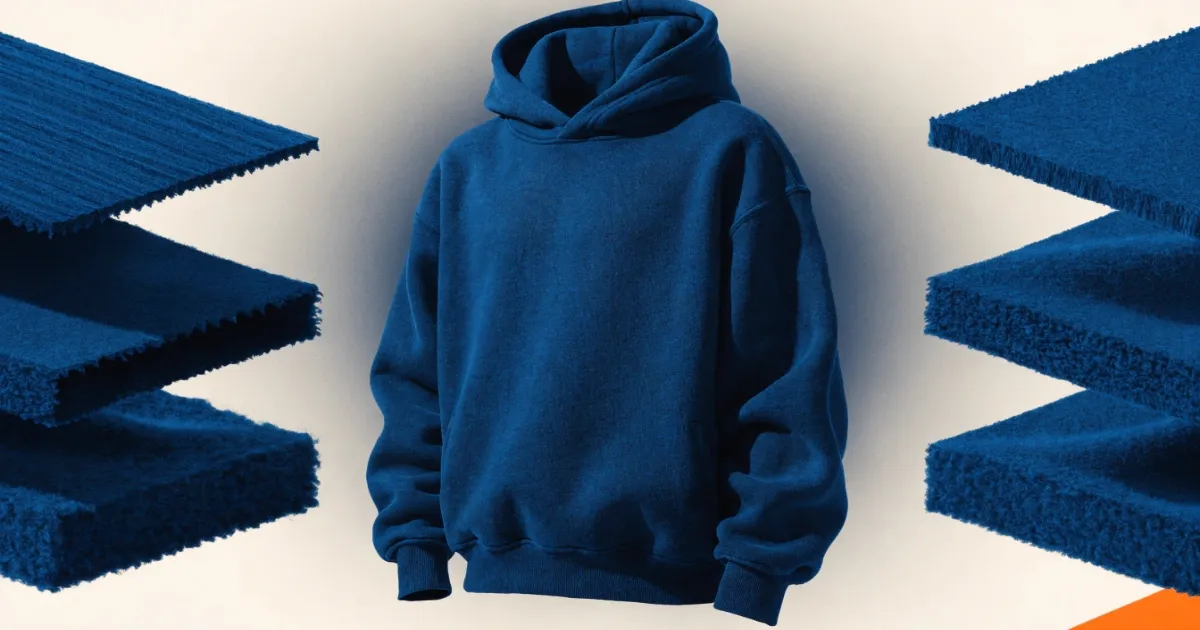
Most hoodie buyers come to us with one question: what's the best GSM? That question sounds simple. But GSM isn't a quality score — it's a variable. And picking the wrong one doesn't just affect how the hoodie feels. It affects how it prints, how it holds up, and whether your customer returns it. This guide breaks down how to choose the right GSM for your specific product, not just the highest number you can afford.
What Does GSM Mean in Hoodie Fabric?
You've seen the number in every fabric spec sheet. But if no one's explained what it actually means for your product, it's easy to treat it like a prestige signal instead of a spec.
GSM stands for grams per square meter. It measures how much a fabric weighs per unit of area.3 In hoodies, a higher GSM generally means a heavier, thicker fabric. A lower GSM means a lighter, thinner fabric. GSM does not, by itself, tell you how warm, soft, or durable a hoodie will be.4
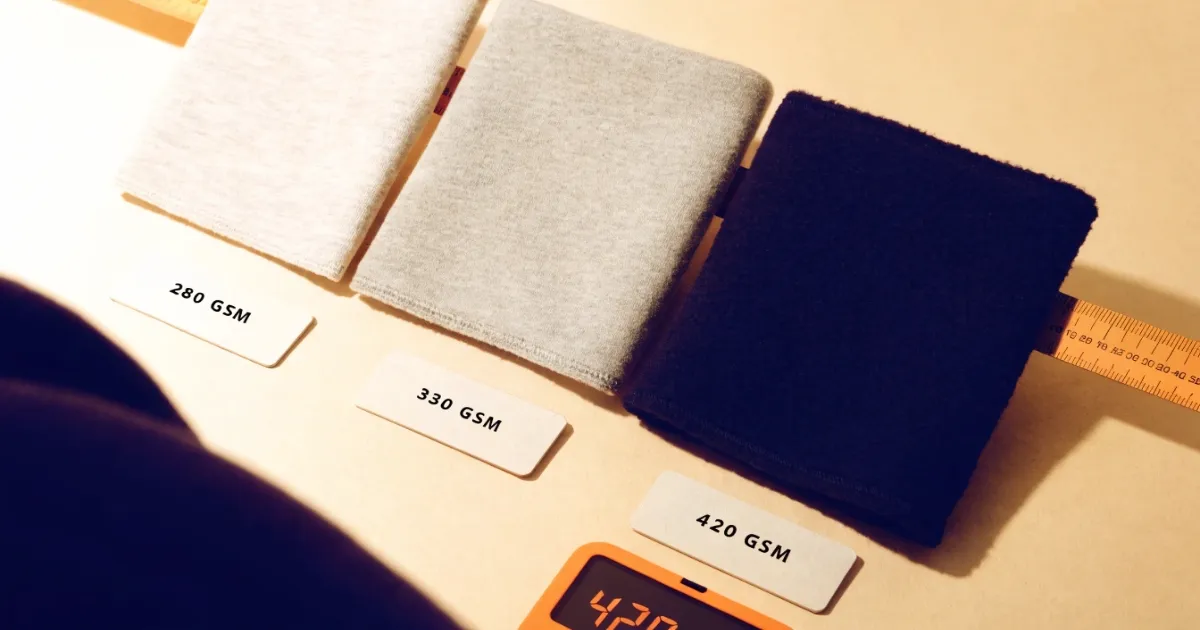
GSM is one data point. It tells you about weight. It does not tell you about construction, fiber content, or finishing — all of which change how a fabric actually performs. A 320gsm French terry behaves very differently from a 320gsm brushed fleece, even though they share the same number. When you're building your tech pack, GSM needs to sit alongside fabric composition and fabric structure — not stand alone.
GSM vs. Fabric Feel: Why the Number Alone Misleads You
Here's what we see regularly in sample development: a buyer requests 350gsm, receives the sample, and says it feels too stiff. Or they request 300gsm and say it feels cheap. Neither complaint is really about GSM. They're about fiber content and fabric construction.
| Fabric Type | Same GSM, Different Feel |
|---|---|
| 100% Cotton Fleece | Soft, breathable, slight drape |
| Cotton-Poly Blend Fleece | More structure, less shrinkage, holds shape |
| French Terry | Lighter hand feel, loops on inside, less insulation |
| Brushed Terry | Plush inner surface, warmer feel at same weight |
The table above shows why two hoodies at 320gsm can feel completely different in hand. GSM sets the weight range. Fabric type and construction determine the feel within that range.
What GSM Is Best for Different Types of Hoodies?
This is the question buyers actually need answered. Not "what's the best GSM" in the abstract — but what works for the specific product they're building.
For most hoodie categories: 260–300gsm suits lightweight and warm-climate styles; 320–360gsm covers standard casual and lifestyle hoodies for fall-winter retail in cooler US or European markets; 380gsm and above fits heavyweight outerwear or premium staple positioning. These are working ranges based on production observation, not fixed industry standards.
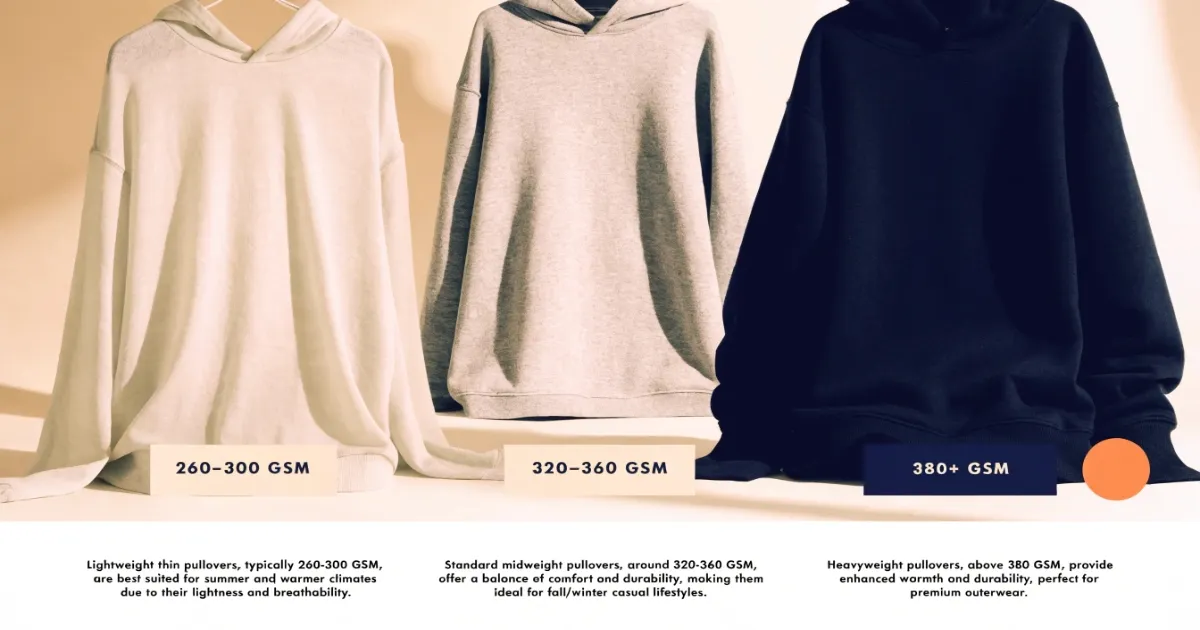
The right range comes down to three questions: What is the hoodie for? What season is it sold in? Where is it sold and how is it priced? Below is how those answers map to GSM in practice.
GSM by Use Case, Season, and Sales Channel
| Use Case | Season / Climate | Recommended GSM Range |
|---|---|---|
| Indoor lounge / year-round wear | Warm climate or heated indoor | 260–300gsm |
| Casual streetwear / DTC brand drop | Spring-Fall, mild climates | 280–320gsm |
| Standard lifestyle hoodie | Fall-Winter, US / Europe retail | 320–360gsm |
| Cold-weather hoodies | Winter, colder climates | 380–420gsm |
| Premium staple / brand hero piece | Year-round retail staple | 360–400gsm |
These ranges are what we see working across production runs. They're starting points, not locked specs. Your specific fabric choice, construction, and target market will shift where you land within each range.
One pattern we see often: buyers developing their first hoodie for a DTC channel default to 400gsm+ because it sounds premium. Then the product lands in a climate where it's only wearable three months a year, and repeat purchase rates drop. Choosing GSM for your actual customer's context is more commercially useful than choosing GSM for its own sake.
Is 300 GSM Good for Hoodies?
A lot of first-time buyers land on 300gsm because it shows up in mid-range samples and sounds like a safe middle ground. Whether it actually works depends on what you're building.
300gsm is a viable GSM for hoodies sold in warmer climates, used as indoor or layering pieces, or positioned as lightweight everyday styles. It is not ideal for fall-winter retail in cold markets where customers expect substantial weight and warmth. The fabric type matters as much as the number.
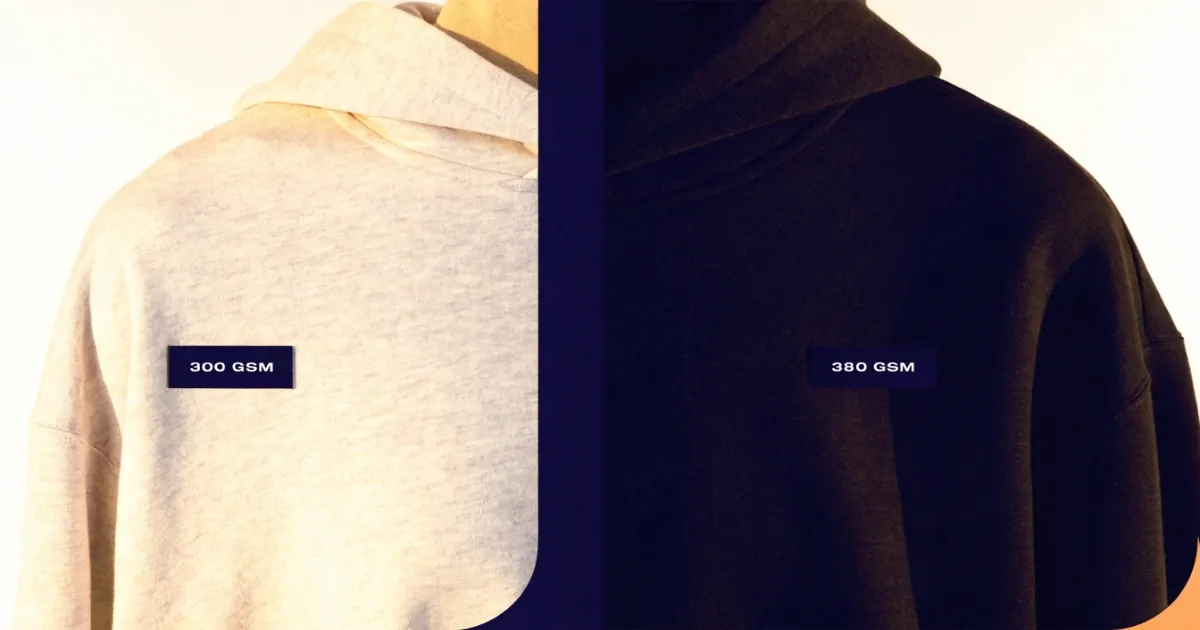
In our production experience, 300gsm hoodies work well for brands targeting year-round wear in mild climates, or for DTC brands whose selling point is a soft, breathable everyday feel. Where they fall short is in wholesale or retail contexts where buyers are picking up the garment in-store and comparing it to heavier competitors on the same rail.
When 300gsm Works and When It Doesn't
The issue isn't that 300gsm is too light — it's that "light" needs to match your market expectation.
| Selling Context | Does 300gsm Work? | Why |
|---|---|---|
| DTC, warm-climate market | Yes | Soft feel sells well; breathability is a feature |
| Year-round indoor / loungewear | Yes | Weight is appropriate; comfort is the priority |
| Fall-Winter US / EU wholesale | Risky | May feel thin compared to retail competition |
| Cold-weather outerwear | No | Insufficient insulation at this weight |
| Premium positioning, any market | Unlikely | Hand feel doesn't support a premium price point |
If your brand story centers on softness and comfort, 300gsm in a 100% cotton fleece can absolutely support that narrative. If you're selling into a market where customers expect a hoodie to feel substantial the moment they hold it, you likely need to move up.
Is Higher GSM Always Better for Hoodies?
This is the most common misconception we deal with at the sampling stage. Buyers treat GSM like a quality ladder. Higher is better. More is more. It doesn't work that way.
Higher GSM is not always better for hoodies. A heavier fabric costs more, takes longer to dry, and may be uncomfortable in warmer conditions or for active wear. Choosing a GSM that exceeds your product's functional needs adds cost without adding value to your customer.

We've seen this play out in client feedback more times than I can count. A brand orders a 420gsm hoodie because it sounds premium. The product arrives, the quality is fine, but the price per unit is higher than their retail price can absorb. Or the customer in their market wears it twice in winter and the rest of the year it stays in the closet. The hoodie isn't bad — it's just wrong for the context.
The Real Cost of Over-Specifying GSM
Over-specifying GSM creates three specific problems in production and retail.
| Problem | What Happens in Practice |
|---|---|
| Higher material cost | Heavier fabric costs more per meter; unit cost rises without matching perceived value increase |
| Longer production lead time | Heavier fleece takes longer to knit and finish; it can extend your production window |
| Wrong product-market fit | Customers in your climate or price bracket may find the hoodie too heavy or too expensive |
The right GSM is the one that fits your end use. A 280gsm hoodie that your customer wears 200 days a year beats a 420gsm hoodie they wear 20 days a year. Design for use, not for the spec sheet.
How Fabric Material Affects the Right GSM
Fabric composition changes everything about how a GSM number performs. Two hoodies with identical GSM numbers can feel completely different, perform differently in wash, and require different decoration setups — purely because of what the fabric is made from.
Cotton, polyester, and cotton-polyester blends all behave differently at the same GSM. 100% cotton at 350 GSM often feels more natural and fuller in hand than a 350 GSM cotton-poly blend, while blends usually offer better shape retention and shrinkage control. Blends add structure and reduce shrinkage. The fabric material determines how a GSM weight actually translates into wearability and production outcomes.
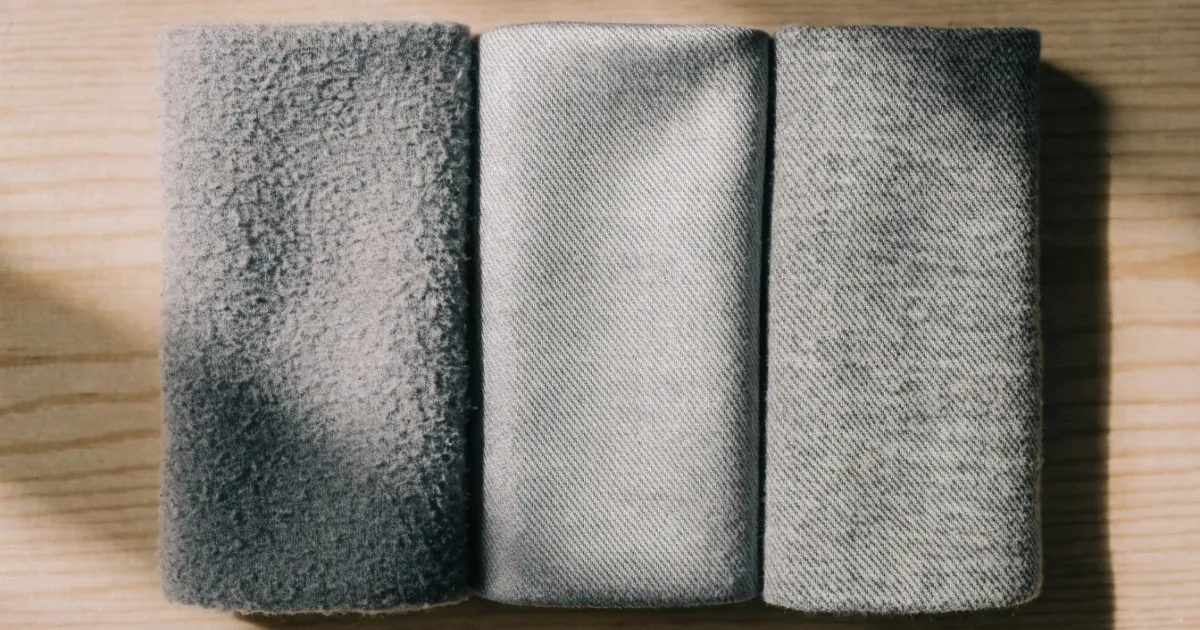
This is a spec literacy gap we see most often with first-time buyers. They see 340gsm in a competitor's product and ask us to match it. But the competitor's 340gsm is a 60/40 cotton-poly brushed fleece. The buyer's reference sample is a 100% cotton French terry. Same number, completely different product. Understanding what the fabric is made of is just as important as understanding the weight.
GSM Behavior Across Common Hoodie Fabric Types
| Fabric Type | Typical Composition | How GSM Reads in Wear |
|---|---|---|
| Brushed Fleece | 80% cotton / 20% poly or 100% cotton | Soft, warm; feels heavier than it weighs |
| French Terry | 80–100% cotton | Lighter feel; loops inside; less insulation per GSM |
| Terry / Loop Back | 100% cotton or blend | Mid-weight feel; structured outer, loop inner |
| Cotton-Poly Blend Fleece | 50–60% cotton / 40–50% poly | More stable; less shrink; slightly stiffer hand |
One practical implication: if you're ordering a 100% cotton fleece hoodie, you need to build shrinkage tolerance into your spec. Cotton shrinks. The GSM on your fabric spec sheet is measured before washing and finishing. After production and wash, the effective weight and dimensions shift. This is normal — but it means the 320gsm you specified pre-wash may behave like 330–340gsm in the finished garment. When we discuss specs with buyers, we always flag this gap so there are no surprises at final QC.
How GSM Affects Printing, Embroidery, and Product Quality
This is the part most buyers don't know to ask about until something goes wrong in decoration. GSM doesn't just affect how a hoodie feels — it directly affects how well it takes a print or an embroidery.
Low-GSM or loosely knitted fabrics can be more difficult to control during screen printing, especially when the fabric surface is unstable or the ink setup is not adjusted correctly. Very high-GSM fabrics may require adjusted pressure, curing time, or pretreatment settings depending on the printing method and fabric surface. Fabric stability, which relates to both GSM and construction, determines how clean and durable your decoration will be.
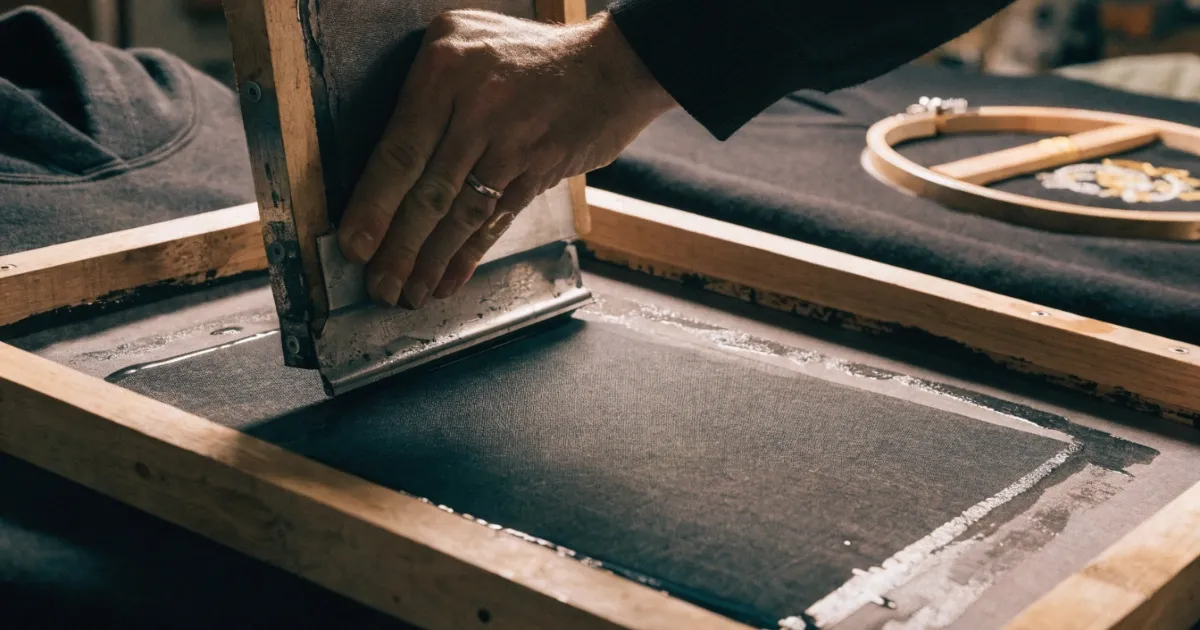
We've seen embroidery distort on hoodies where the base fabric wasn't stable enough — not because the embroidery work was poor, but because the fabric moved under the needle. The fix required changing the base fabric spec, not the embroidery design. Decoration and fabric spec are linked, and GSM is part of that link.
Decoration Method and GSM Compatibility
| Decoration Method | GSM Consideration | Risk if Spec Is Wrong |
|---|---|---|
| Screen Printing | Mid-weight fabrics hold ink better; too-low GSM on fleece can cause bleed | Ink bleeding through fabric layers or uneven coverage |
| DTG (Direct to Garment) | Fabric surface must be smooth and stable; very high GSM can reduce ink absorption | Faded print after first wash; poor ink adhesion |
| Embroidery | Fabric needs to be stable and dense enough to hold stitching | Puckering, distortion, or pull on lightweight / loose-knit fabrics |
| Heat Transfer / Vinyl | Works across a wide GSM range; fabric smoothness matters more than weight | Peeling or cracking if applied to uneven fabric texture |
If decoration is a key part of your product — which it is for most streetwear and lifestyle brands — you need to spec your fabric with your decoration method in mind. A hoodie built for a large chest embroidery needs a different base fabric than one designed for a clean, minimal DTG print. Get this wrong at the spec stage and you're paying to reprint or reembroider at the sample stage, or worse, after bulk production.
How to Choose the Right Hoodie GSM for Your Brand
You now have the context. Here's how to turn it into a decision.
To choose the right GSM for your hoodie: identify your end use and selling season, then match GSM to that context. Pair your GSM choice with the correct fabric composition and construction type. Factor in your decoration method. Start with a sample in your target GSM range before locking in bulk specs.

When buyers come to us asking for hoodie specs, this is exactly the process we walk them through. Not "what's the best GSM" — but what is this hoodie for, who is wearing it, and what are you putting on it. The answers to those three questions define the spec. The spec doesn't define the product.
A Decision Framework for Choosing Hoodie GSM
Work through these four questions before you write a GSM number into your tech pack.
| Decision Step | Question to Answer | What It Determines |
|---|---|---|
| 1. End Use | Is this for warmth, layering, or casual everyday wear? | Your GSM range floor and ceiling |
| 2. Season & Climate | Where is your customer wearing this, and when? | Whether you need 280gsm or 400gsm |
| 3. Sales Channel | DTC, wholesale, or retail? What's the hand-feel expectation at point of sale? | Whether a lighter weight can carry a premium price |
| 4. Decoration | Screen print, embroidery, DTG, or no decoration? | Fabric stability requirements and GSM minimum |
One thing worth knowing before you finalize: always request a physical sample in your target GSM, wash it, and check it before approving bulk production. GSM specs on paper and GSM in hand are two different things. The sample stage is where you close that gap — not after the bulk order lands.
Conclusion
If you are not sure which GSM works best for your hoodie project, we can help you compare fabric options, sample the right weight, and match the material to your fit, decoration, budget, and target market.
At Easson Apparel, we help clothing brands choose suitable hoodie fabrics, GSM ranges, printing methods, labels, packaging, and production details based on real product goals — not just a spec sheet.
"Clothing insulation and temperature, layer and mass of ... - PMC - NIH", https://pmc.ncbi.nlm.nih.gov/articles/PMC3707773/. Clothing thermal-comfort studies associate garment insulation with properties such as fabric thickness, mass, air layers, and layering, supporting the general use of lighter fabrics where lower insulation or flexible layering is desired. Evidence role: general_support; source type: paper. Supports: Thermal-comfort research should support the general relationship between lighter garments, lower insulation, and suitability for warm conditions or layering.. Scope note: Contextual support; such sources are unlikely to establish the exact 260–300 GSM hoodie range. ↩
"Thermal Insulation of Protective Clothing Materials in Extreme Cold ...", https://pmc.ncbi.nlm.nih.gov/articles/PMC10024235/. Research on clothing insulation reports that fabric thickness, trapped air, and related mass-per-area characteristics contribute to thermal resistance, supporting the general suitability of heavier fabrics for colder conditions. Evidence role: mechanism; source type: paper. Supports: Textile thermal-insulation research should support the relationship between fabric mass or thickness and increased insulation in cold-weather clothing.. Scope note: Contextual support; it would not directly validate 380 GSM as a universal cutoff for hoodie outerwear. ↩
"Textile - Wikipedia", https://en.wikipedia.org/wiki/Textile. ASTM D3776/D3776M defines fabric mass per unit area as a standard textile measurement, supporting the use of grams per square meter as a fabric-weight specification. Evidence role: definition; source type: institution. Supports: A textile standard or neutral reference should support that GSM refers to fabric mass per unit area measured in grams per square meter.. ↩
"Thermal Comfort Properties of Biodegradable Hemp and Polylactide ...", https://pmc.ncbi.nlm.nih.gov/articles/PMC11990937/. Textile-performance literature describes thermal insulation, tactile hand, and durability as functions of fiber composition, yarn and fabric structure, finishing, and fabric mass, indicating that GSM alone is not a complete predictor of garment performance. Evidence role: expert_consensus; source type: paper. Supports: Textile research should support that warmth, hand feel, and durability depend on multiple material and construction variables rather than fabric mass alone.. Scope note: Contextual support; the source would establish the textile principle rather than test the specific hoodie examples in the article. ↩