
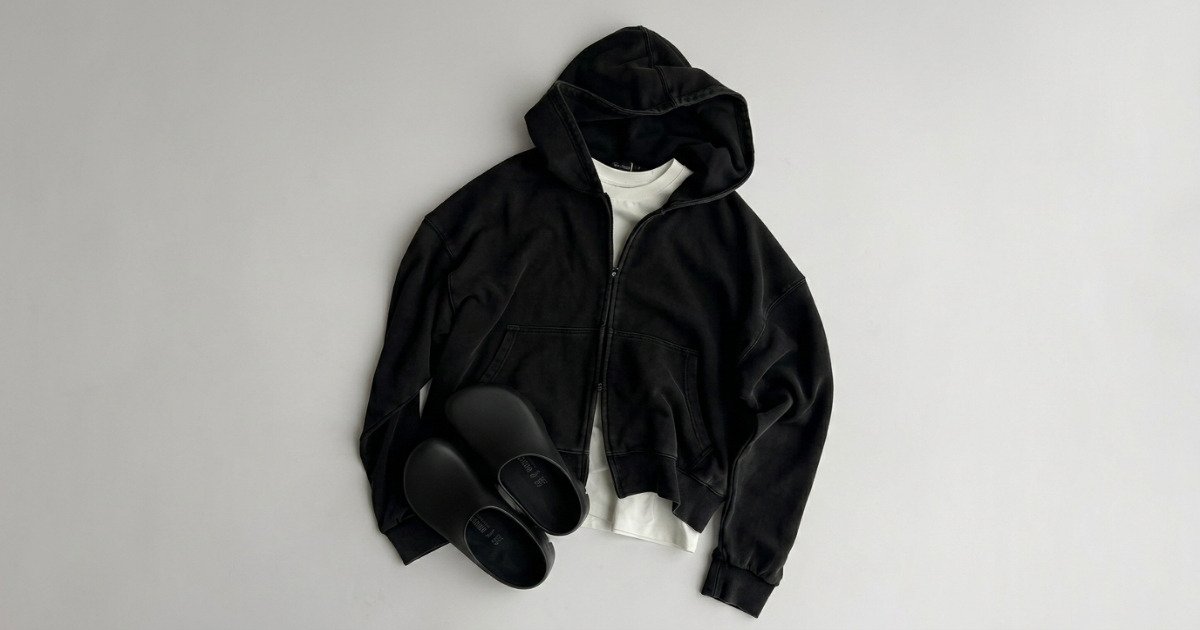
Black hoodies dominate wardrobes worldwide, yet most people struggle to explain exactly why.
The black hoodie's popularity comes down to a single, underappreciated idea: it gives the wearer control over their own visibility. The hoodie provides comfort, coverage, and utility. Black eliminates decision-making friction1. Together, they let a person move between blending in and standing out without committing to either — making the black hoodie one of the most adaptable garments ever produced.

That answer sounds simple. But unpacking it reveals a layered logic that spans fabric science, consumer psychology, and cultural history. Understanding that logic is what separates a well-positioned hoodie product from another forgettable SKU.
7 Reasons Behind the Popularity of Black Hoodies
Why do so many different types of people — skaters, executives, musicians, parents, athletes — reach for the same black hoodie?
Because each group is solving a different problem with the same garment. The black hoodie doesn't belong to one identity. It carries low enough information to be claimed by almost anyone, which is precisely what makes it universally appealing.

That low-information quality is worth examining carefully. Here are the seven interconnected reasons that drive the black hoodie's enduring popularity — structured not as a random list, but as a single argument that builds on itself.
1. The Hoodie Format Solves Comfort and Coverage at Once
Before the color matters, the silhouette matters. A hoodie does something most garments cannot: it wraps the torso, covers the head, and protects without the formality of outerwear. It manages body temperature across a wide range — warm enough for a cool morning, light enough for an air-conditioned office.
The hood itself adds a functional layer that goes beyond warmth2. It frames the face when worn up. It disappears entirely when worn down. That single structural feature gives the wearer two different social modes within one garment.
2. Black Removes Decision-Making Friction
Once you accept that the hoodie format is uniquely functional, the question becomes: why black specifically?
The honest answer is that black reduces the cognitive cost of getting dressed. Most people do not choose clothes to create a new look each morning. They want to get it right quickly, without thinking too hard. Black achieves that because it:
- Pairs with denim, joggers, cargo pants, and tailored trousers
- Works across athletic, streetwear, minimalist, and casual aesthetics
- Repeats across seasons without looking season-specific
- Eliminates color-matching calculations entirely
This isn't just versatility in the styling-magazine sense. It's friction reduction. The black hoodie removes a small but real daily stressor, and people return to items that do that reliably.
3. It Offers "Controllable Presence"
Here's the insight I find most compelling, and the one that took me the longest to articulate clearly. A brightly colored or heavily patterned garment communicates loudly by default. It makes a statement whether the wearer intends to or not.
A plain black hoodie does the opposite. It communicates almost nothing on its own — and that silence is strategic.
- Worn plain: It reads as quiet, unfussy, and self-contained. No explanation required.
- Worn with an oversized fit or washed finish: It becomes a deliberate streetwear statement.
- Hood up: It adds a layer of visual withdrawal, a way of reducing social surface area.
- Hood down: It collapses back into an unremarkable everyday layer.
The wearer controls the signal. That level of wardrobe agency is genuinely rare. Most garments commit you to a register — formal, casual, sporty, eccentric. The black hoodie stays neutral until you decide otherwise.
4. Low Information, High Adaptability Across Subcultures
Because the plain black hoodie carries so little inherent identity, different communities can claim it simultaneously without contradiction. A skater and a tech founder and a hip-hop artist can all wear the same black hoodie silhouette. But they assign it completely different meanings.
| Subculture | What the Black Hoodie Represents |
|---|---|
| Streetwear / Skateboarding | Authenticity, anti-establishment ease |
| Tech and startup culture | Focused minimalism, anti-fashion practicality |
| Music (hip-hop, metal, indie) | Creative identity, subcultural belonging |
| Luxury and high fashion | Elevated basics, quiet luxury |
| Fitness and athleisure | Performance crossover, gym-to-street versatility |
No other garment color achieves this range. Navy comes close. Grey is similar. But black absorbs meaning from its context rather than imposing its own — and that makes it the most cross-cultural neutral in apparel.
5. Cultural Reinforcement Has Been Constant for Decades
The black hoodie did not become culturally entrenched by accident. Decades of film, music, and technology have coded it as a symbol of focused individualism.
- Early hip-hop and skateboarding scenes adopted it as workwear-adjacent uniform.
- Films and television used it to signal outsider status, creative intensity, or quiet menace.
- Silicon Valley normalized it as a statement of anti-sartorial seriousness.
- Luxury brands then recontextualized it, placing the silhouette in premium fabrications and elevating it without changing its fundamental form.
Each of these waves reinforced the garment's cultural weight without canceling the previous associations. That layering is why the black hoodie resonates across age groups. A 20-year-old and a 45-year-old both wear it, but they're drawing on different chapters of the same cultural story.
6. Black Simplifies Production Without Reducing Consumer Expectation
From a manufacturing perspective, black is operationally attractive. Dyeing consistency is more achievable in dark colorways. Minor fabric lot variations are less visually apparent. Print and embroidery designs show maximum contrast.
But — and this is important — black does not lower the consumer's quality threshold. If anything, it raises it. When a garment offers no distraction from color, texture, or pattern, the buyer's eye goes directly to:
- Fabric hand feel and weight — is it substantial or thin?
- Depth and evenness of black — does it look rich or flat?
- Rib and body color matching — is there a visible tonal mismatch between cuffs and body?
- Wash performance — does it fade to grey or hold its depth after repeated washing?
- Pilling resistance — does the surface remain clean or break down quickly?
Black commoditizes quickly precisely because it looks the same at a distance. Consumers notice the differences only when they hold the product — which is exactly why construction quality, fabrication, and finishing details become the real differentiators.
7. The Black Hoodie Has Become a Brand's Safest Entry Point — and Its Hardest Test
For many startup and streetwear brands, a black hoodie is a common early product choice. It lowers the consumer's psychological barrier to trying a new brand — familiar color, familiar silhouette, low risk. Its familiar color and silhouette can reduce the amount of explanation needed at launch..
But that safety is also a trap. Because consumers buy their second black hoodie from a brand for completely different reasons than they bought the first. The second purchase is based on:
- How the fabric held up
- Whether the fit remained consistent after washing
- How the print or embroidery aged
- Whether the brand felt worth returning to
A black hoodie is easy to sell once. It is hard to sell repeatedly. Getting that repeat requires quality control, production consistency, and construction standards that a basic colorway cannot disguise.
How the Black Hoodie Became a Cultural Staple
How does a simple sweatshirt with a hood become a cross-generational, cross-cultural uniform?
The black hoodie became a cultural staple because it was repeatedly adopted by influential subcultures, each of which assigned it new meaning without erasing the old. Over decades, those accumulated associations made it the most symbolically neutral yet symbolically rich garment in casual apparel.
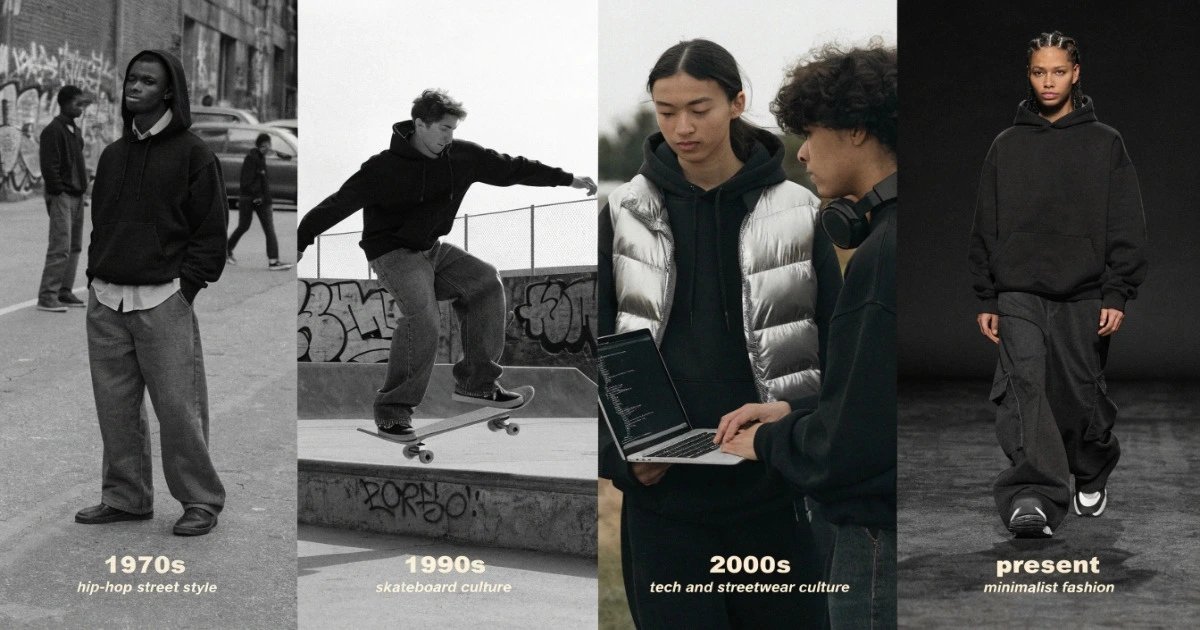
Understanding this history matters for brands. The garment arrives at every consumer with a pre-loaded set of cultural references. Brands do not build the black hoodie's meaning from scratch — they position themselves within an existing conversation.
The Accumulation of Subcultural Meaning
The hoodie's cultural ascent followed a predictable but powerful pattern. Working-class and athletic origins gave it functional credibility. Skateboarding and hip-hop adopted it for its practicality and its distance from mainstream fashion. That adoption gave it cultural currency. Then mainstream fashion absorbed that currency, and luxury labels refined it.
Each step expanded the audience without shrinking the authenticity of earlier adopters. That is unusual. Most garments become "mainstream" and lose subcultural credibility. The black hoodie avoided that fate because its form is so neutral that each group projects their own meaning onto it rather than inheriting the previous group's.
Why Black Specifically Survived the Luxury Crossover
When Vetements, Balenciaga, and similar labels produced oversized black hoodies at premium price points, they were not creating new meaning. They were surfacing the existing cultural weight of the garment in a new commercial context.
Black survived that crossover for one reason: it is the only color that functions as a blank canvas at every price point. A pastel or primary-colored hoodie carries inherent associations. Black carries almost none. It lets the cut, the fabric, and the label speak first.
The Drawbacks of Black Hoodies
Are there genuine disadvantages to black hoodies that brands and consumers should factor in?
Yes. Black hoodies show lint, dust, and pet hair visibly. They absorb heat significantly in warm or sunny conditions. And from a brand differentiation standpoint, the color's ubiquity makes it harder — not easier — to create a distinctive product identity without investing heavily in construction quality and finishing.
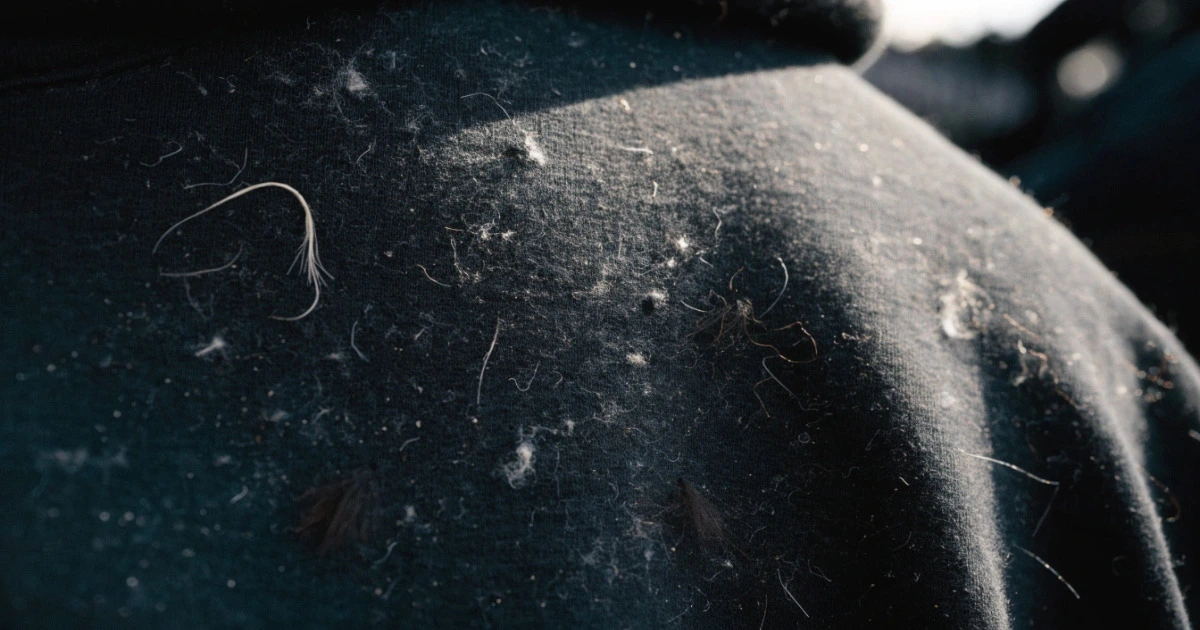
These drawbacks are practical but also strategic. Understanding them helps both consumers make better purchasing decisions and brands make better product development decisions.
Practical Consumer Drawbacks
- Lint and debris visibility: Black shows white lint, pet hair, and dust immediately. Without a lint roller, a black hoodie can look unkempt within hours of wearing.
- Heat absorption: In direct sun, black fabric usually absorbs more solar energy than lighter colors, although actual comfort still depends on fabric weight, airflow, and fit.
- Fading over time: Black is one of the most demanding colorways to maintain3. Poor-quality dyes or insufficient dye fixation lead to greying within several wash cycles. This is one of the sharpest quality signals available to consumers.
- Care requirements: To maintain depth, black garments often require cold washing, inside-out laundering, and low-heat drying — steps that not all consumers follow consistently.
Brand and Production Drawbacks
From a sourcing and product development perspective, the black hoodie's popularity creates a specific challenge: the market is saturated, and black commoditizes quickly. A buyer comparing ten black hoodies on a screen sees almost no difference. The differentiation only becomes apparent at the moment of handling — in-store or post-delivery.
This means brands sourcing black hoodies need to invest upstream, in fabric quality and construction standards, rather than relying on colorway or print to create distinction.
What Consumers and Clothing Brands Should Consider
What should buyers and apparel brands actually evaluate before choosing or producing a black hoodie?
Consumers should evaluate fabric weight, black depth consistency, rib-to-body color matching, and wash performance before committing to a black hoodie. Brands sourcing or producing black hoodies should treat color as a baseline and invest their differentiation budget in fit construction, fabric specification, and finishing quality — because in a saturated colorway, construction is the only durable competitive advantage.

For Consumers: A Quality Evaluation Framework
When assessing a black hoodie before purchase, consider:
- GSM (grams per square meter): Heavier fabrics (320–400 GSM) generally indicate better durability and drape.
- Rib consistency: Hold the cuffs and hem next to the body fabric. If the black tones differ noticeably, the dye lots were not matched — a sign of inconsistent production.
- Interior finish: French terry and fleece-lined interiors serve different purposes. French terry is lighter and more breathable. Fleece is warmer but varies widely in quality.
- Wash test: Where possible, wash once and reassess. How a black garment looks after one wash reveals far more than how it looks in a retail environment.
For Clothing Brands: Sourcing and Production Considerations
Black may be the safest entry point for a new hoodie product, but it demands more upstream discipline than most brands expect:
- Specify dye standards precisely. Black is not one color — it ranges from blue-black to warm black to cool charcoal4. Define your target shade in your tech pack and verify it against physical standards before bulk production.
- Verify dye fastness ratings. Wash fastness and rub fastness ratings tell you how reliably the color holds. Request test data from your manufacturer and verify independently where possible.
- Control rib and body fabric from the same dye batch. Tonal mismatches between the main body and ribbed trims are one of the most common — and most visible — quality failures in black hoodies.
- Define fade tolerance limits. Set acceptable delta-E values for color change after a defined number of wash cycles. Without a numeric standard, "acceptable" is undefined and inconsistent.
- Invest in finishing details. In a saturated colorway, the details that differentiate your product are stitching quality, label placement, drawcord finish, pocket depth, and hardware (if applicable). Brief your manufacturer on these specifically, not generically.
Conclusion
The black hoodie's popularity is not accidental, and it is not simply about aesthetics. It sits at the intersection of comfort, utility, and color psychology — a combination that lets wearers control their own visibility in a way no other garment quite replicates. Black reduces decision friction. The hoodie format provides functional coverage. Together, they create a garment with genuine adaptability across contexts, subcultures, and decades of cultural reinforcement.
For clothing brands sourcing or producing black hoodies, the key takeaway is this: black is an entry point, not a differentiator. In a colorway this saturated, construction quality, fabric specification, and finishing precision are the only sustainable competitive advantages.
"Decision Fatigue: Why what you wear might be draining your ...", https://www.houseofcolour.co.uk/blog/decision-fatigue-why-what-you-wear-might-be-draining-your-brain-and-how-to-change-that. Studies on decision fatigue and clothing suggest that neutral colors like black can simplify choices, reducing cognitive load. However, direct studies on black hoodies specifically may not exist. Evidence role: mechanism; source type: research. Supports: The idea that black clothing reduces decision-making friction by simplifying outfit choices.. Scope note: The evidence may apply broadly to neutral clothing colors rather than exclusively to black. ↩
"Dress is a Fundamental Component of Person Perception - PMC - NIH", https://pmc.ncbi.nlm.nih.gov/articles/PMC10559650/. Research on hooded garments highlights their utility in providing both physical protection and social signaling options. However, specific studies on black hoodies may not be available. Evidence role: mechanism; source type: research. Supports: The functional benefits of the hood in providing versatility and additional utility beyond warmth.. Scope note: The evidence may focus on hooded garments in general rather than black hoodies specifically. ↩
"How to Wash Black Clothes Without Fading", https://www.dcleaners.com/blog/how-to-wash-black-clothes-without-fading/. Textile care research highlights that black garments are prone to fading and require specific maintenance to retain their color depth. However, the findings may not be exclusive to hoodies. Evidence role: mechanism; source type: research. Supports: The challenges of maintaining black garments, including fading and care requirements.. Scope note: The evidence may apply broadly to black textiles rather than specifically to hoodies. ↩
"Color Science Lab", https://colorsciencelab.textiles.ncsu.edu/. Color science research confirms that black textiles can vary in shade due to differences in dye composition and processing. However, the specific impact on hoodies may not be detailed. Evidence role: definition; source type: research. Supports: The existence of different shades of black in textiles, such as blue-black, warm black, and cool charcoal.. Scope note: The evidence may focus on general textile production rather than specific applications in hoodies. ↩