Most people have stood in front of their wardrobe dreading the same choice: wear the comfortable sweatpants and look sloppy, or wear the stiff jeans and spend the day uncomfortable. Sweatpant jeans exist to eliminate that choice entirely — and the category is growing fast.
What Are Sweatpant Jeans? Quick Answer
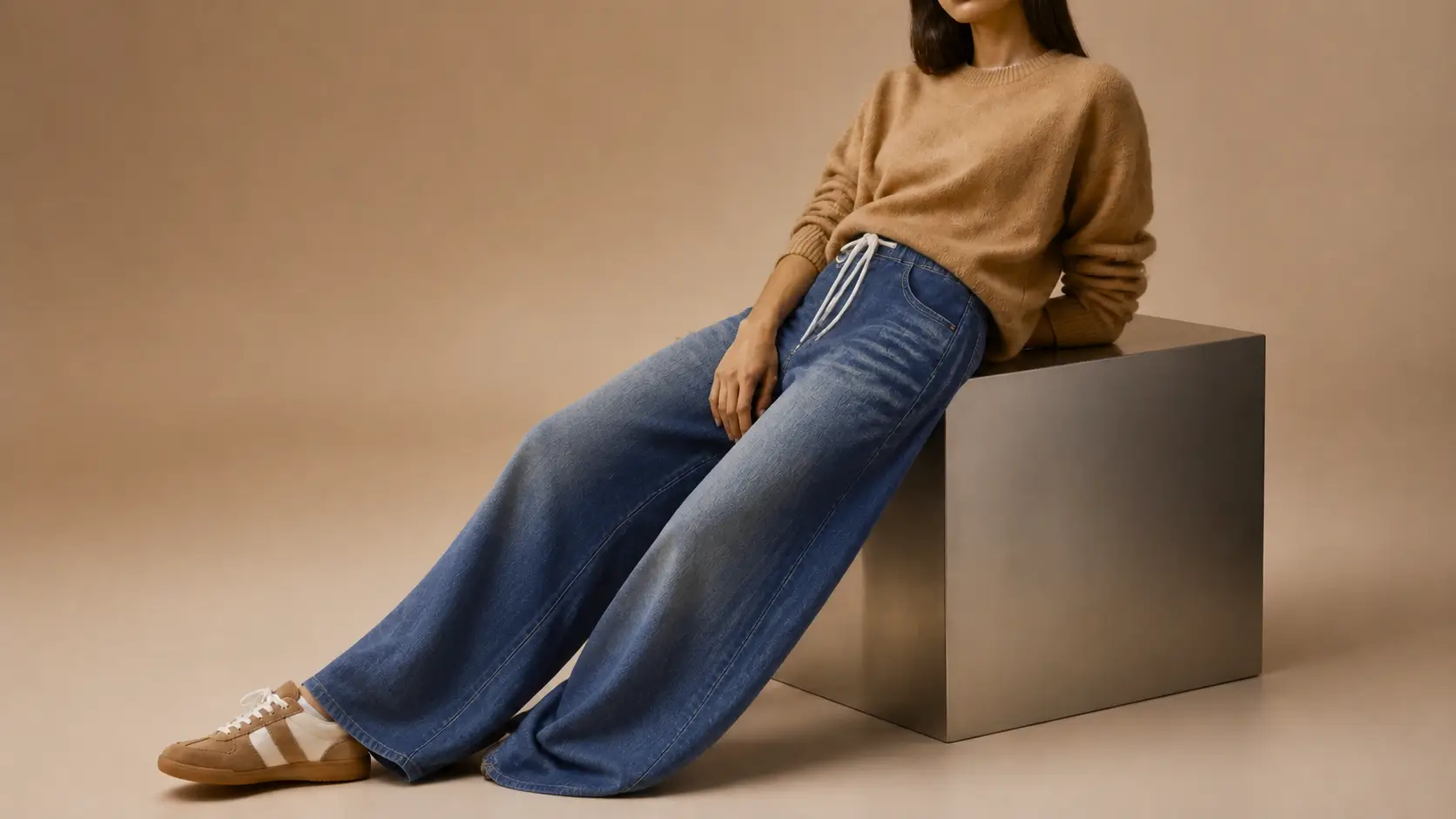
Sweatpant jeans are soft, flexible pants designed to look like traditional denim while offering the comfort of sweatpants.1 Some use printed French terry or jersey to imitate denim pockets, seams, fading, and whiskers. Others use knitted denim or highly stretchable woven denim with an elastic waistband. Unlike jeggings, sweatpant jeans usually have a relaxed, straight, jogger, or wide-leg silhouette rather than a skin-tight fit.
Understanding what makes sweatpant jeans work — and what makes them fail — requires looking at three things together: the fabric choice, the printing method, and the placement strategy. Each one depends on the others. Let me walk through all of them.
Why Are Sweatpant Jeans Becoming Popular?
Comfort alone does not explain the rise of sweatpant jeans. Sweatpants have always been comfortable. The problem has always been social acceptability — and that is exactly the gap this category fills.
Sweatpant jeans are popular because they offer socially acceptable comfort. The core appeal is not softness — it is the ability to look dressed without the physical discomfort of traditional denim. That distinction is what separates this category from ordinary sweatpants.
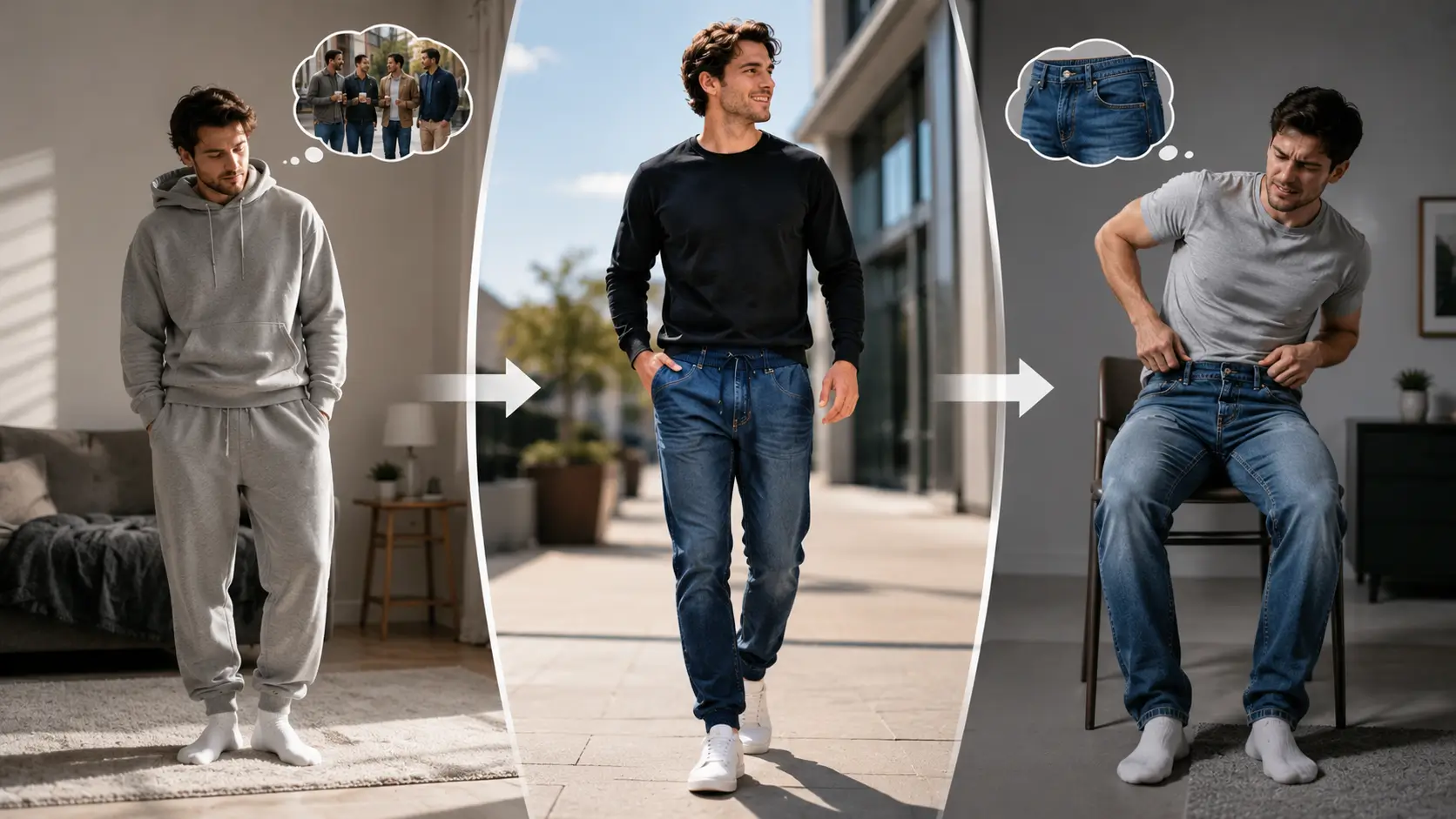
I talk to a lot of American brand clients about this category, and the conversation keeps coming back to the same insight. Most people do not avoid sweatpants because they are uncomfortable. They avoid them because sweatpants signal that you did not try — that you are one step away from pajamas.
Sweatpant jeans solve that perception problem. They give the wearer the feeling of already being dressed.
Who Is Actually Buying Them?
Based on the inquiries I receive, demand from US brand clients significantly outpaces domestic Chinese demand. The product resonates strongly with:
- Remote workers and freelancers who move between home and public spaces throughout the day
- Commuters who want to sit comfortably but still look put-together on arrival
- People who dislike the waistband pressure of traditional denim — a very common complaint
- Consumers who transition directly from home to casual public settings without wanting to change
This is not a niche. These are massive, overlapping consumer segments.
The Deeper Reason This Category Works
The product succeeds because it does not ask the consumer to make a trade-off. Traditional denim offers a visual payoff at a physical cost — stiffness, waistband pressure, limited stretch. Traditional sweatpants offer comfort at a social cost. Sweatpant jeans remove both costs simultaneously.
That is a genuine product innovation, even if the underlying fabric is familiar. When a product stops requiring compromise, adoption accelerates. That is what we are seeing here.
What Fabric Is Used for Sweatpant Jeans?
Choosing the wrong fabric for sweatpant jeans does not just affect comfort — it can make the printed denim pattern look unconvincing. Fabric selection and print quality are directly linked.
Sweatpant jeans are most commonly made from heavyweight French terry or cotton jersey. Common constructions include 100% cotton terry and cotton-polyester blends such as 86% cotton / 14% recycled polyester. The fabric must balance surface smoothness for print clarity, structural weight for denim-like silhouette, and stretch for comfort.
If you are developing this product, you need to answer four questions before you touch a fabric swatch:
- Which type of denim are you trying to imitate? A slim dark wash reads differently from a faded baggy indigo.
- What drape does the silhouette require? Wide-leg needs different weight than a straight leg.
- How flat does the print surface need to be? More texture means softer edges in the printed detail.
- What is the wearing season and context? Summer travel versus autumn streetwear require very different fabric weights.
The Core Tension in Fabric Selection
There is a natural contradiction at the center of this category:
| Fabric Property | Advantage | Trade-off |
|---|---|---|
| Smoother, low-hair face | Sharper gradients and printed details | May feel visually flatter |
| Hairier or uneven printable face | More casual surface character | Can reduce edge and gradient clarity |
| Looped back | Softer interior hand feel | May add weight, but does not directly reduce front-face print clarity |
Print clarity is affected mainly by the printable face—its hairiness, evenness, absorption and stability—not simply by whether the fabric has loops on the reverse.
What Leading Brands Are Using
Two public examples illustrate the range:
- Rag & Bone Miramar uses 100% cotton terry. This prioritizes a natural hand feel and a clean brand story around cotton.
- Gap Printed Baggy Sweatpant Jeans uses 86% cotton / 14% recycled polyester heavyweight French terry. The polyester addition improves dimensional stability — the garment holds its shape better across washes and wearings.
Neither is the single correct answer. Pure cotton emphasizes natural feel and is easier to position as premium. Cotton-polyester blends add size consistency and durability, which matters more at higher production volumes. The right answer depends on your price point, your target consumer, and your wash-care story.
How Knit Fabric Is Printed to Look Like Real Denim
This is where most people assume the difficulty is the ink or the printer. It is not. The hard part is placement.
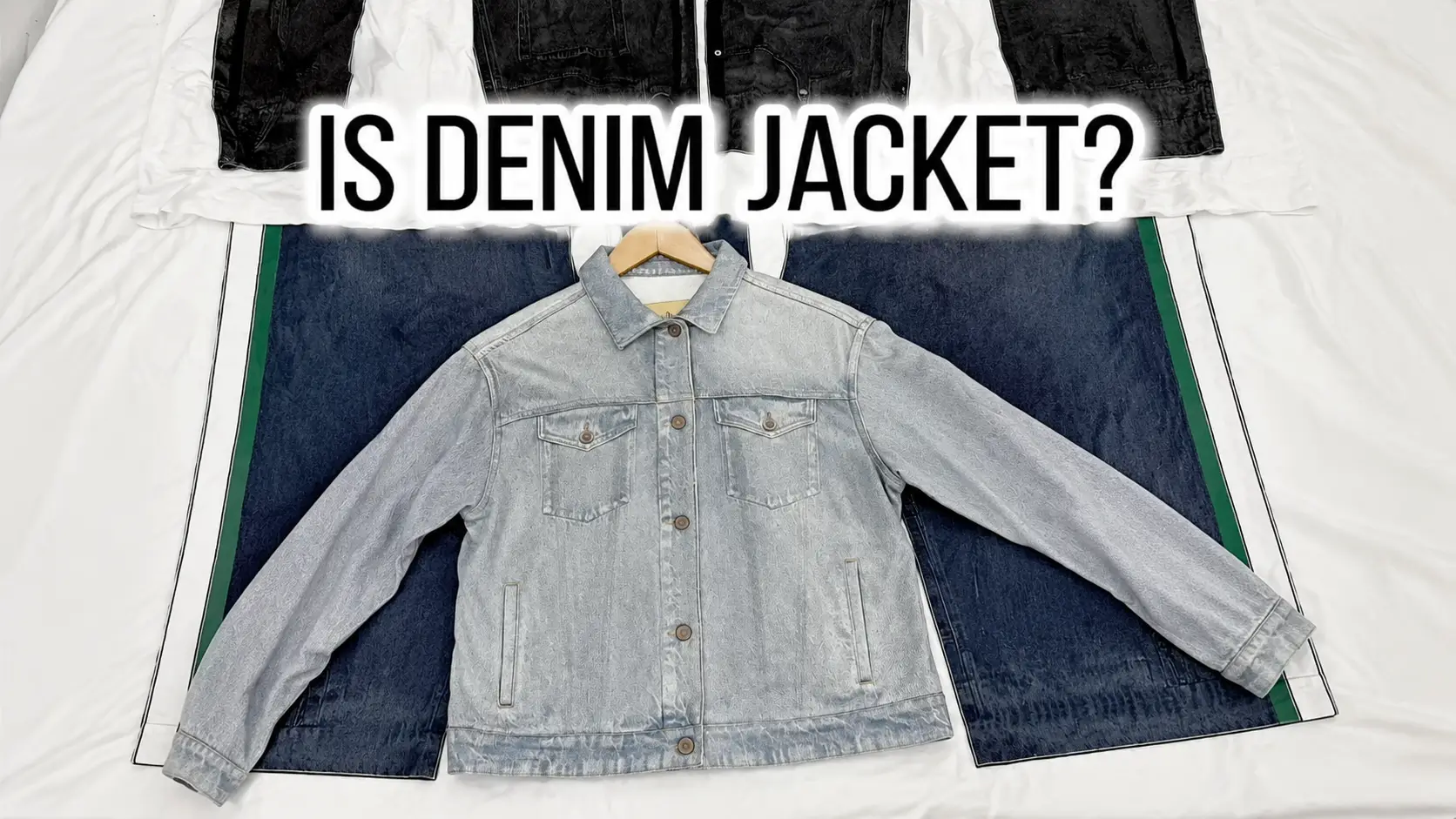
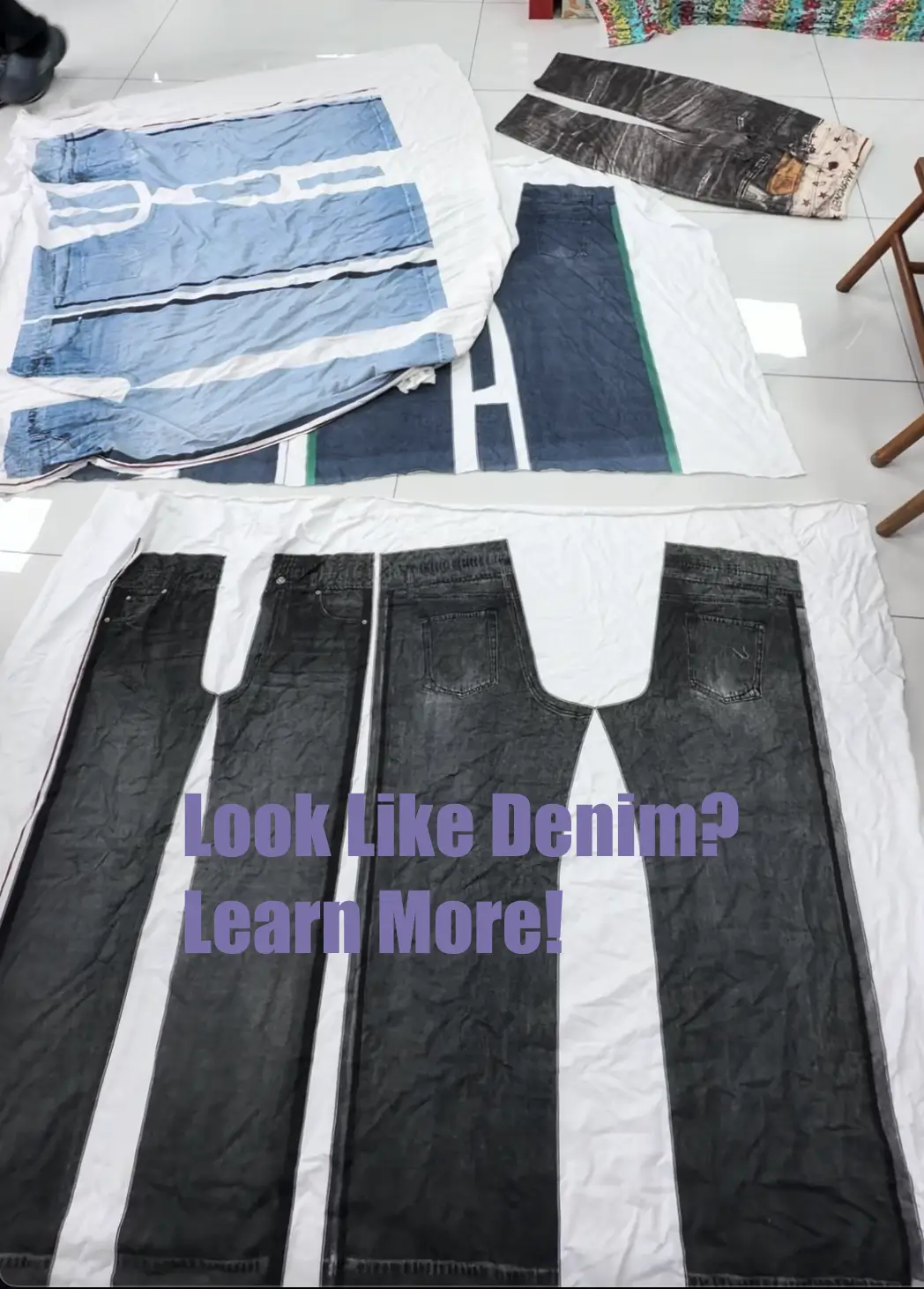
Knit fabric is printed to look like real denim through reactive digital printing combined with engineered placement — a process where the denim graphic is precisely mapped to the garment pattern pieces so that visual details like fading, whiskering, and pocket positions land in anatomically correct locations on the finished garment.
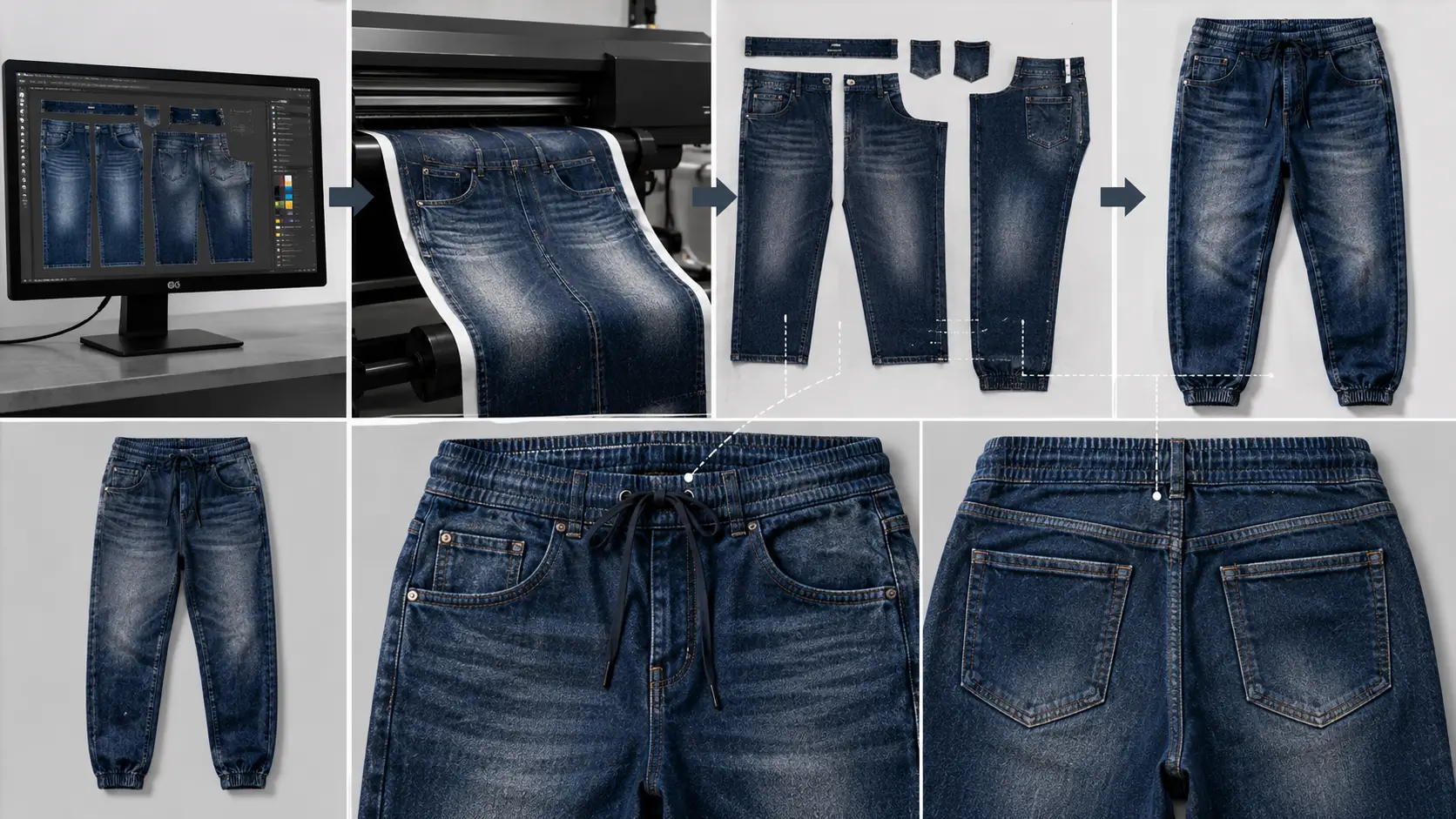
I visited a print factory a couple of years ago, and the production manager there told me something that has stayed with me: the real difficulty is not printing — it is positioning. A denim texture image can be printed onto almost any fabric. A convincing product requires something else entirely.
What Engineered Placement Actually Means
Printing a blue texture is easy. Replicating the complete visual logic of a pair of jeans is genuinely difficult. Here is why:
Every detail in a convincing denim print must correspond to an actual anatomical or structural position on the garment:
- Knee fading must fall near the actual knee of the wearer — not the midpoint of the panel
- Front fly and seam lines must sit on the center front of the trouser
- Whiskering (the radiating fade lines at the hip crease) must be positioned at the hip, where fabric naturally creases when sitting
- Back pockets must appear at a realistic height on the back rise
- Rivet and bartack details must align with stress points that actually exist in denim construction
This requires the designer and the pattern maker to work together at a level most apparel development processes do not routinely require. The design cannot be finalized until the pattern is confirmed. The pattern cannot be fully graded until the print placement is mapped for each size.
The Grading Problem
This is a detail that often surprises brand clients when I explain it. You cannot simply scale the same denim graphic proportionally across sizes.
If you take an S-size denim print and enlarge it uniformly to XL, the result looks wrong — and sometimes absurd:
- Back pockets may become disproportionately large
- Whiskering may migrate down toward the thigh
- The fly simulation may become too long for the actual rise
Correct size grading for sweatpant jeans requires grading the print relative to the pattern pieces, not relative to the original image. This means the design team and pattern team must work in parallel across the entire size run — not sequentially.
Why Wide-Leg and Baggy Silhouettes Dominate This Category
When I browse the Rag & Bone Miramar collection and Gap's current offerings, both brands concentrate heavily on wide-leg, baggy, and relaxed straight silhouettes. This is partly a trend decision, but it is also an engineering decision.
Advantages of wider silhouettes for this product:
- French terry drape naturally matches wide-leg proportions
- The fabric is not stretched significantly, so print distortion is minimized
- Whisker and fade placement does not have to accommodate extreme body flexion
- Consumer expectations for relaxed-fit trousers already include a soft, drapey hand
Risks of fitted silhouettes:
- Lateral stretch distorts the printed graphic — fake pockets widen, seam lines curve
- Printed surface can develop cracking or show base fabric under tension
- Crotch and knee placement becomes much harder to maintain convincingly
- The product more easily reads as jeggings rather than sweatpant jeans, which affects perceived value
This is why the current market leaders are concentrated in wide-leg, baggy, track-pant, and relaxed-straight shapes.
The Rule of "Real Where Touched, Printed Where Observed"
I think about this category through one guiding principle: be real where the consumer will touch, and print where the consumer will only look.
Functional and tactile elements should be genuine:
- Drawstrings should be actual drawstrings — not printed
- Front pocket openings should be functional — fake pockets feel cheap immediately
- Waistband construction should deliver actual comfort
Visual elements that are observed but not handled can be convincingly printed:
- Rivets and bartack details
- Wash fading and distressing effects
- Brand embroidery simulations
- Seam line shadows
- Back pocket stitching patterns
A product that gets this balance right does not feel like a trick. It feels like a considered design decision.
Sweatpant Jeans vs. Jeggings vs. Stretch Denim
These three categories overlap enough to confuse both consumers and buyers — but the differences matter for positioning, pricing, and production.
Sweatpant jeans use knit fabric with a printed denim graphic. Jeggings use stretch denim or denim-look jersey cut in a legging silhouette. Stretch denim uses woven denim fabric with added elastane. The key difference is that sweatpant jeans achieve their denim appearance through print engineering, while the others use denim-adjacent fabric construction.
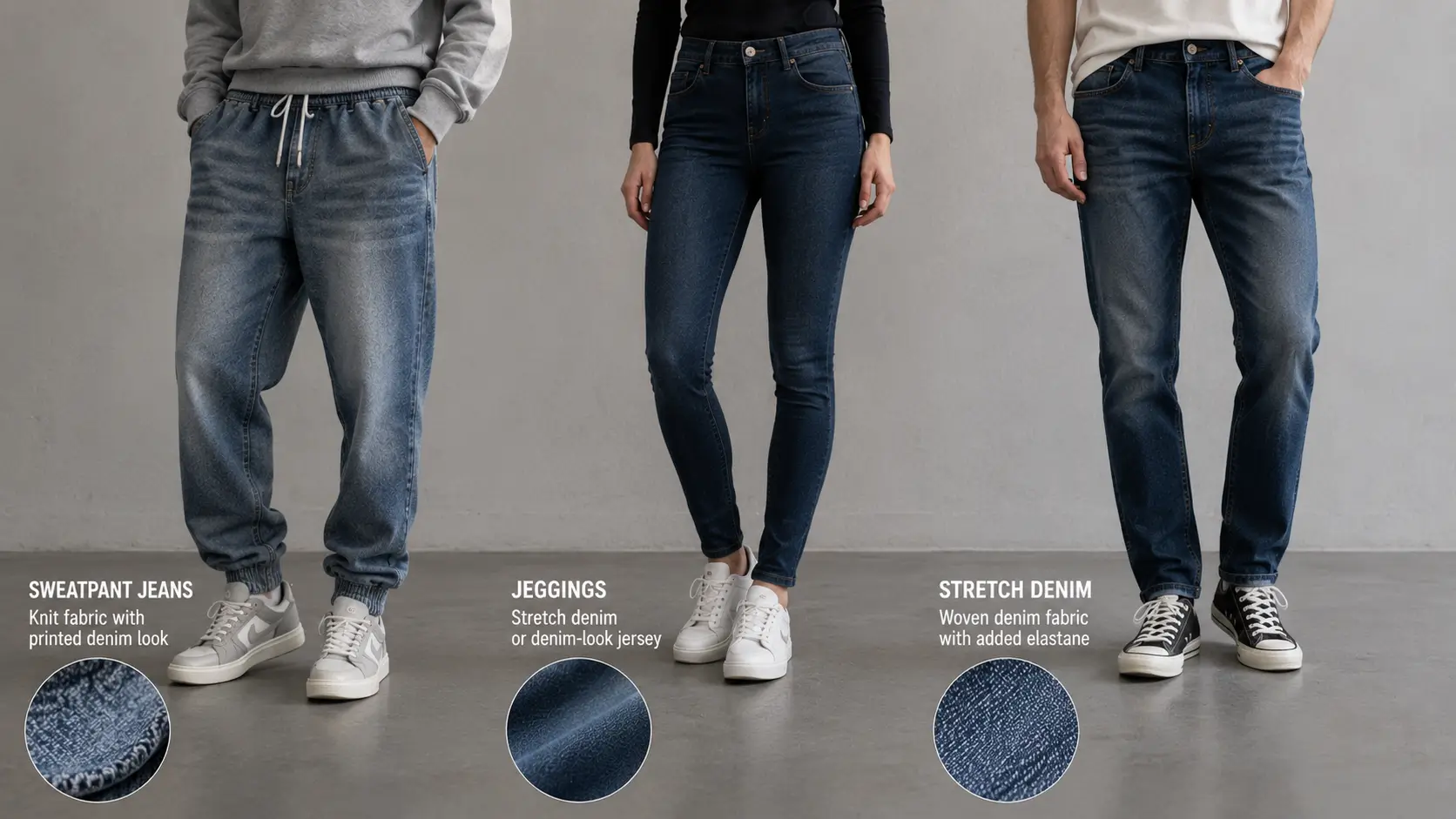
| Feature | Sweatpant Jeans | Jeggings | Stretch Denim |
|---|---|---|---|
| Base fabric | Knit (French terry, jersey) | Stretch jersey or thin denim | Woven denim + elastane |
| Denim appearance | Printed graphic | Fabric texture or print | Actual denim weave |
| Comfort level | Highest | High | Moderate |
| Print complexity | High (engineered placement) | Low to none | None |
| Silhouette range | Wide-leg to relaxed | Mostly slim/fitted | Full range |
| Wash care sensitivity | Moderate (print care required) | Low | Low |
| Perceived formality | Casual-smart | Casual | Casual to smart |
The category sweatpant jeans are closest to replacing is not jeggings — it is regular denim.2 The consumer choosing sweatpant jeans is someone who would have bought jeans but has decided the comfort cost is no longer worth it.
Where the Category Is Heading
Rag & Bone's Miramar line is instructive here.3 What started as a single trouser silhouette has expanded into a full visual platform — now covering wide-leg pants, straight pants, track pants, shorts, jackets, shirts, dresses, and kidswear, across different base fabrics including cotton terry, fleece, and their Neo-Knit construction.
That expansion tells you something important: the most valuable asset in this category is not any single garment, but a scalable denim illusion system — a library of correctly graded, anatomically placed print files that can be applied across multiple silhouettes and product types.
Acne Studios reinforces this from a different direction.4 Their use of trompe-l'œil techniques to simulate distressing and surface complexity on denim products shows that "using print to replace some of the visual work of traditional washing and finishing" is becoming a broader design tool — not a novelty.
Frequently Asked Questions
Are sweatpant jeans a new fabric or a new product category?
Sweatpant jeans are a product category, not a fabric type. The underlying fabric is standard knit construction — typically French terry or cotton jersey. The denim appearance comes from engineered digital printing. The innovation is in how the graphic is positioned and graded across the garment, not in the material itself.
Can sweatpant jeans be washed the same way as regular jeans?
Care instructions may differ from traditional denim because performance depends on the base knit, ink system and finishing process. Buyers should validate dimensional stability, colorfastness and visual alignment through wash testing.
What is the minimum order quantity for developing custom sweatpant jeans?
This varies by manufacturer. For custom color, pattern placement, and private label development, MOQs at our factory typically start from 100 pieces per style, though this can increase depending on fabric specification and print complexity. Engineered placement styles require additional sampling investment before bulk production.
Why do most sweatpant jeans come in wide-leg or baggy fits?
Wide and relaxed silhouettes reduce print distortion caused by fabric stretch, allow French terry's natural drape to support the silhouette, and make it easier to position denim details — fading, whiskering, pocket placement — in anatomically convincing locations. Fitted silhouettes significantly increase print engineering complexity and distortion risk.
Is reactive digital printing the only method used for sweatpant jeans?
Reactive digital printing is one suitable option for cotton-based styles, while pigment systems may be selected for cotton blends or workflows requiring simpler post-processing. Screen printing can replicate simpler denim patterns at lower cost but lacks the tonal subtlety needed for convincing wash effects. The right method depends on the level of realism required and the production volume.
Conclusion
Sweatpant jeans succeed because they stop asking the consumer to choose between comfort and appearance. The fabric is knit — French terry or cotton jersey — but the product reads as denim through carefully engineered print placement, correct anatomical positioning, and size-specific graphic grading. The challenge is never the printing itself. It is aligning the designer, the pattern maker, and the print file so that every visual detail lands in the right place on the finished garment.
If you are developing sweatpant jeans for your brand, start with your silhouette and your target denim reference before you touch fabric swatches or print files. Everything else — fabric weight, print method, placement strategy — follows from those two decisions. Our factory has supported this category for several American brand clients, from initial sampling through bulk production. If you are ready to develop your own sweatpant jeans line, reach out and let's talk through the details.
"Best Sweatpant Jeans: My Honest Take After Trying 6 Pairs". Research on textile manufacturing confirms that sweatpant jeans often use knit fabrics such as French terry or cotton jersey, with photorealistic printing techniques to replicate denim patterns. Supports: Sweatpant jeans are made from knit fabrics like French terry or cotton jersey and use photorealistic printing to mimic denim. ↩
"Do Sweatpants Jeans Live Up to the Hype? - by Amy Odell". Market analysis suggests that sweatpant jeans are increasingly seen as an alternative to regular denim due to their comfort and visual appeal.Supports: Sweatpant jeans are positioned as a replacement for regular denim rather than jeggings. ↩
"rb Miramar - Sweatpant Jeans & More". Brand reports confirm that Rag & Bone's Miramar line has grown from a single trouser silhouette to a diverse product range.Supports: Rag & Bone's Miramar line has expanded into a broader product range.. ↩
"trompe-l'œil jeans - 1981 - Mid blue". Fashion design analysis highlights Acne Studios' use of trompe-l'œil techniques to create visual complexity in denim products. Supports: Acne Studios employs trompe-l'œil techniques to simulate distressing on denim products. ↩