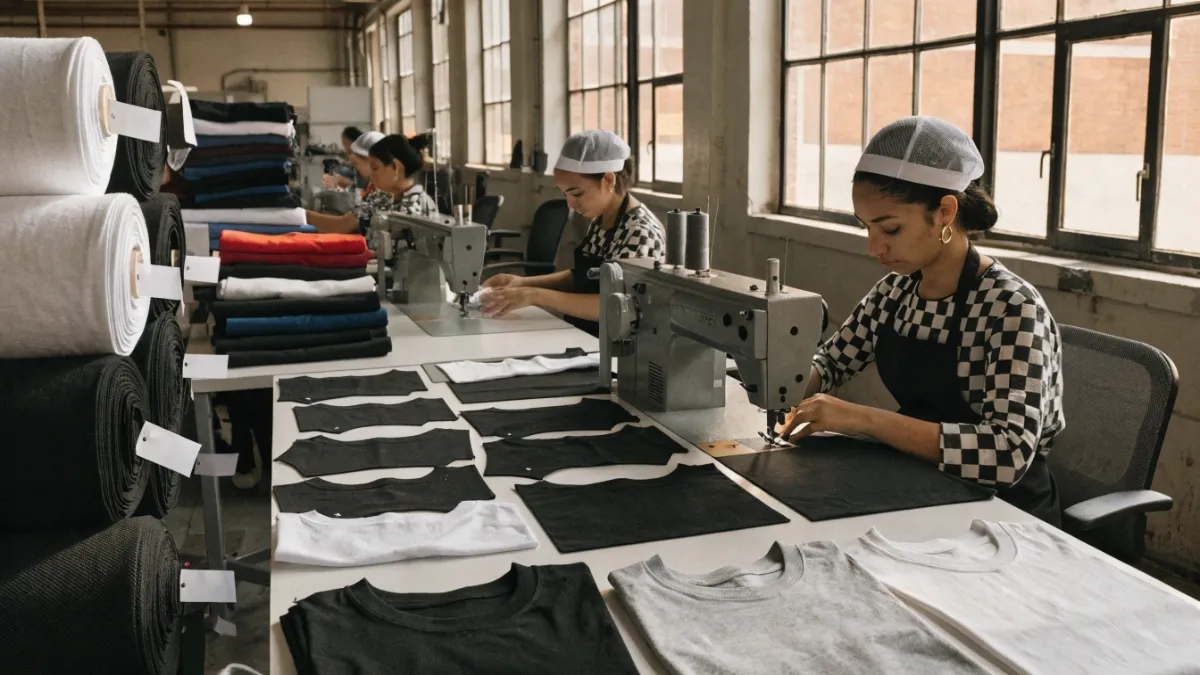
T-shirts are everywhere—gym bags, concert merch, startup uniforms, corporate apparel, private-label collections, and everyday fashion basics. If you're starting a clothing brand or sourcing apparel from a custom T-shirt manufacturer, understanding how T-shirts are made is essential.
The T-shirt manufacturing process affects fabric quality, fit, production cost, minimum order quantity, delivery timeline, and final customer satisfaction. A simple-looking T-shirt may go through many factory checkpoints before it becomes a finished product ready for packing and shipping.
This guide walks you through the complete T-shirt manufacturing process, from fabric selection to finished cartons, with startup-friendly notes on MOQs, cost drivers, lead times, and factory quality control.
Overview: How T-Shirts Are Made
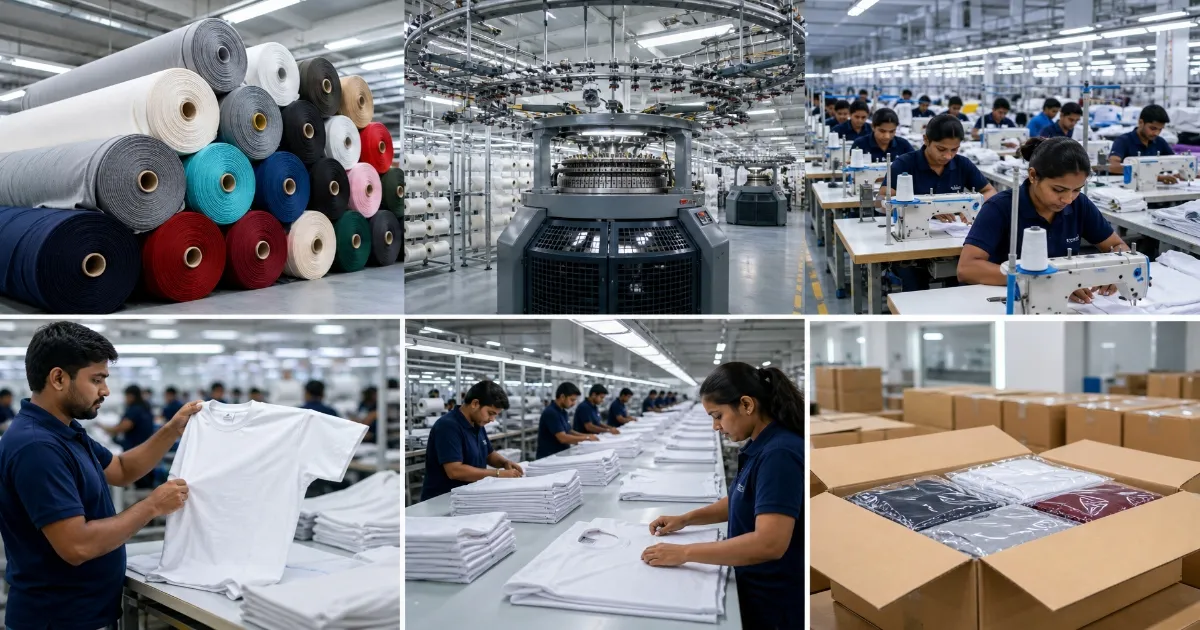
At a high level, the T-shirt production process moves through fabric selection, knitting, dyeing and finishing, pattern making and grading, fabric spreading and cutting, sewing and assembly, printing or embroidery, quality inspection, then packaging and shipping.
If you’re mapping how T-shirts are manufactured at a factory, these are the main checkpoints you’ll manage from sampling to bulk production.
Factory Process Table: From Fabric to Finished T-Shirt
| Stage | What Happens | Buyer Approval Needed? | Common Risk |
|---|---|---|---|
| Fabric Selection | Choose fabric composition, GSM, handfeel, color, and performance requirements | Yes | Wrong fabric quality, poor handfeel, or budget mismatch |
| Knitting | Yarn is knitted into jersey or other T-shirt fabrics | Usually no | GSM variation, tension issues, fabric distortion |
| Dyeing & Finishing | Fabric is dyed, washed, softened, and finished | Yes, through lab dips or color approval | Color difference, shrinkage, poor colorfastness |
| Pattern & Sample | Factory develops the fit, size spec, and construction sample | Yes | Fit not matching the brand’s target customer |
| Fabric Cutting | Fabric is relaxed, spread, marked, and cut into garment panels | Usually no | Fabric twisting, shrinkage, cutting defects |
| Sewing & Assembly | Panels are sewn together with overlock, coverstitch, and lockstitch machines | No, but in-line QC is needed | Uneven seams, puckering, loose threads, neckline issues |
| Printing / Embroidery | Logos, graphics, labels, or artwork are applied | Yes, through strike-off or sample approval | Wrong placement, poor print cure, color mismatch |
| Quality Inspection | Measurements, appearance, stitching, print, labels, and packing are checked | Sometimes final approval required | Measurement defects, visible stains, packing mistakes |
| Packaging & Shipping | T-shirts are folded, bagged, labeled, packed, and shipped | Usually yes for packing requirements | Wrong carton marks, barcode mistakes, shipping delay |
Step-by-Step T-Shirt Manufacturing Process
Step 1 – Fabric Selection
Most T-shirts use single-jersey knit fabrics made from 100% cotton, cotton-polyester blends, organic cotton, or performance blends. If you are comparing fabric options, this guide to cotton vs polyester T-shirts can help you understand the differences in comfort, durability, shrinkage, and cost. Fabric weight is usually measured in GSM, which means grams per square meter.
For mainstream T-shirts, fabric weight often ranges from around 140–220 GSM. If you are unsure which weight is right for your brand, our T-shirt GSM guide explains how different fabric weights affect handfeel, structure, seasonality, and cost. Lightweight fabrics are common for promotional tees or summer basics, while 180–220 GSM fabrics are often preferred by brands that want a more premium, structured feel.
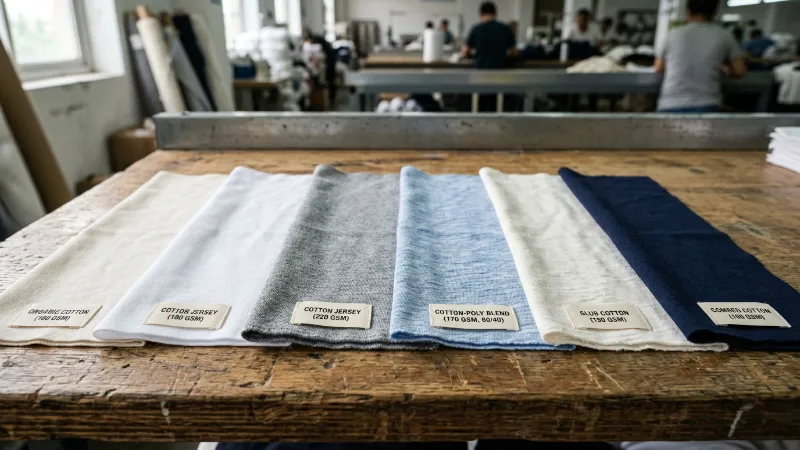
Softer handfeel usually comes from combed cotton, ring-spun yarn, or special finishing. Blends can improve durability, reduce shrinkage, and support faster drying.
Factory note from Easson Apparel:
For most custom T-shirt projects, we usually recommend 180–220 GSM cotton or cotton-blend jersey if the brand wants a more premium handfeel and better structure. Lightweight 140–160 GSM fabric can work for promotional tees, but it may feel too thin for premium streetwear or private-label collections.
Startup note: Fabric is usually one of the biggest cost drivers in T-shirt production. Each colorway can trigger its own minimums at the fabric mill or dyehouse, so adding too many colors may increase MOQ, unit cost, and production time.
Need help choosing the right fabric weight for your T-shirt collection? Send us your target style, reference photo, or fabric requirement, and we can suggest a suitable GSM and composition before sampling.
Step 2 – Fabric Knitting
Cotton yarn or blended yarn becomes fabric through circular knitting machines. For a simple technical explanation of circular knitting machines, CottonWorks has a useful overview of knit machinery1. Single jersey is the most common fabric construction for T-shirts because it is soft, flexible, breathable, and efficient for bulk production.
Machine gauge, stitch length, yarn count, and yarn tension all affect GSM, stretch, drape, and fabric stability. Some factories produce tubular fabric, while others use open-width fabric depending on the garment style and production method.
Checkpoint: During fabric production, small swatches should be weighed to confirm GSM against the approved specification. If the fabric weight drifts too much, the factory may need to adjust stitch length or machine settings.
Step 3 – Fabric Dyeing and Finishing
The dyeing method depends on the fiber content. Cotton is usually dyed with reactive dyes, while polyester uses disperse dyes at higher temperature and pressure. For cotton-polyester blends, dyeing may require different dye systems to achieve the correct shade and fastness.
After dyeing, the fabric may go through washing, softening, drying, compacting, and finishing. These steps affect handfeel, shrinkage, width, color stability, and appearance.
Checkpoint: Before bulk dyeing, the buyer should approve lab dips under standard lighting such as D65. The factory should also run basic wash and rub tests to check colorfastness before moving into bulk production. For buyers who want to understand color transfer testing, AATCC explains the purpose of colorfastness to crocking2 testing for textiles.
Step 4 – Pattern Making and Grading
Pattern makers translate the design and fit requirements into production patterns. These patterns define the shape of each garment part, including the front body, back body, sleeves, collar, neck rib, and any special panels.
After the base size is approved, the pattern is graded into other sizes such as XS, S, M, L, XL, and XXL. CAD systems such as Gerber or Lectra can help maintain measurement accuracy and improve cutting efficiency.
Checkpoint: Before cutting bulk fabric, confirm seam allowances, notches, grainlines, label positions, collar width, sleeve length, body length, and size grading. A pre-production sample should be approved before bulk production starts.
Step 5 – Fabric Relaxation and Cutting
Before cutting, knitted fabric should usually be relaxed. This means the fabric is laid out and allowed to rest before cutting. For cotton jersey and stretch fabrics, relaxation helps reduce shrinkage, twisting, and shape distortion after sewing or washing. CottonWorks also explains how shrinkage and skewing3 can affect cotton fabrics and finished garments.
After relaxation, the fabric is spread in layers on the cutting table. The marker, which is the layout of all pattern pieces, is placed on top. The cutting team then cuts the fabric using straight knives, round knives, or automated cutting machines.
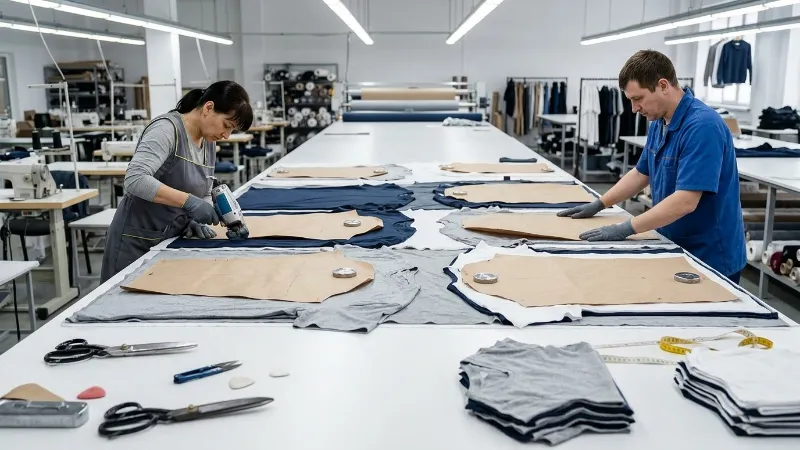
Good marker planning improves fabric yield and helps reduce cost. Poor marker planning can waste fabric and increase the final unit price.
Checkpoint: Inspect fabric before cutting and avoid placing defects in visible areas. For knitted fabrics, relaxation is especially important because cutting too early can cause twisting, shrinkage, or measurement changes later.
Step 6 – Sewing and Assembly
After cutting, the panels move to the sewing line. Operators join the garment parts together using different machines depending on the seam type.
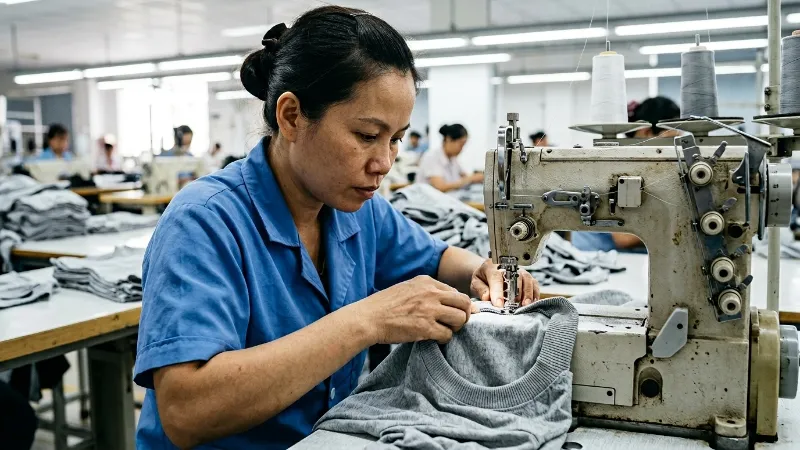
Common machines used in T-shirt sewing include:
| Machine Type | Common Use |
|---|---|
| Overlock machine | Side seams, shoulder seams, sleeve joining |
| Coverstitch machine | Bottom hem, sleeve hem, neckline finishing |
| Lockstitch machine | Labels, reinforcement, topstitching |
| Rib attaching machine | Neck rib or collar attachment |
Needle type, thread tension, seam allowance, and differential feed all affect final quality. For knitted fabrics, a ballpoint needle is often used to avoid damaging the fabric loops.
Checkpoint: In-line QC should check shoulders, collar shape, sleeve joining, side seams, hem width, and measurement consistency. Catching problems during sewing is much cheaper than repairing finished garments after final inspection.
Step 7 – Printing or Embroidery
After sewing, some T-shirts go through printing or embroidery. In some production workflows, printing may happen before sewing, especially when the artwork placement is easier to control on flat panels.
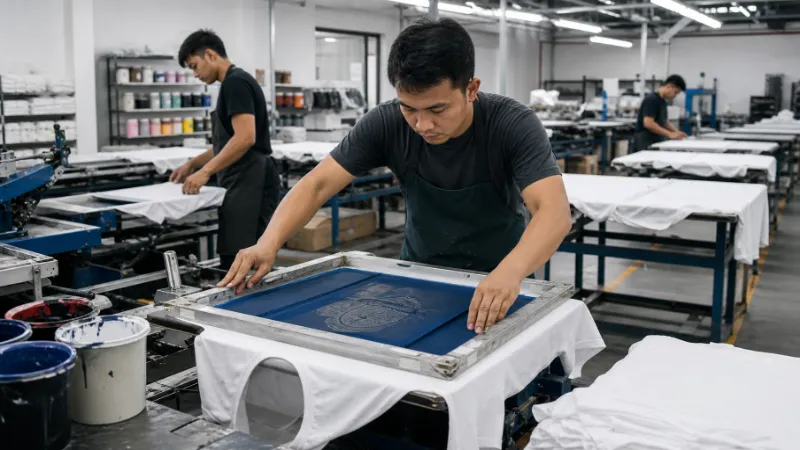
Common T-shirt decoration methods include:
| Method | Best For | Notes |
|---|---|---|
| Screen Printing | Medium to large orders, simple color designs | Low unit cost after setup; durable when cured correctly |
| DTG Printing | Small runs, complex artwork, many colors | Good for small batches but less efficient for large orders |
| Heat Transfer | Names, numbers, small batches, special effects | Flexible but quality depends on transfer material |
| Embroidery | Logos, premium branding details | More structured and premium, but heavier and more expensive |
| Puff / Flock / Special Printing | Streetwear and fashion designs | Requires testing for handfeel and durability |
If you are comparing DTG and screen printing for your first T-shirt order, this DTG vs screen printing guide4 gives a simple explanation of how design complexity and order quantity affect the best choice.
For plastisol screen prints, the ink must be cured properly. If the curing temperature or time is wrong, the print may crack, peel, or fail after washing.
Checkpoint: Approve strike-offs or test prints before bulk production. Confirm artwork size, Pantone color, print placement, handfeel, and wash durability.
Factory note from Easson Apparel:
For startup brands, printing cost can increase quickly if there are too many artwork placements or too many colors. A simple one-position screen print is much easier to control than several large prints across the chest, back, sleeves, and hem. If the first order budget is limited, simplifying the print design can help keep the unit cost reasonable.
If you already have artwork, send us a PNG with transparent background, AI file, PDF, or vector file. We can help check whether your design is more suitable for screen printing, embroidery, heat transfer, or another method.
Step 8 – Quality Inspection
Quality inspection should happen at different stages, not only at the end. A good T-shirt factory usually checks quality during fabric inspection, cutting, sewing, printing, finishing, and final packing.
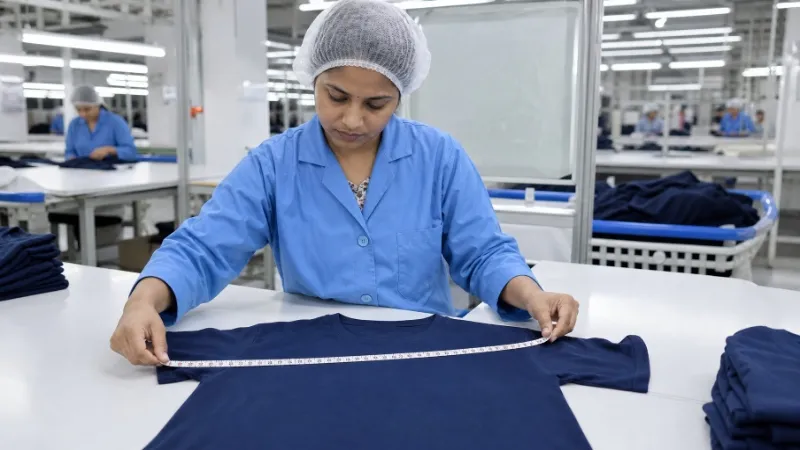
Most brands use AQL inspection before shipment. A common apparel inspection standard is:
- Critical defects: 0.0
- Major defects: 2.5
- Minor defects: 4.0
- Inspection level: General Level II
Inspectors usually check:
- Measurements
- Fabric defects
- Stains or oil marks
- Seam quality
- Collar shape
- Sleeve and hem symmetry
- Print placement
- Print curing
- Embroidery quality
- Label position
- Size labels
- Packing accuracy
- Carton marks
Checkpoint: Final AQL inspection is important, but it should not replace in-line quality control. If defects are only discovered at the final stage, rework becomes slower and more expensive.
Step 9 – Packaging and Shipping
After final trimming, pressing, and inspection, T-shirts are folded and packed according to the buyer’s requirements. Common packaging options include individual polybags, size stickers, barcode labels, hang tags, tissue paper, inner cartons, and master cartons.
For export orders, the packing details should be confirmed before bulk production ends. This includes carton size, carton weight, shipping marks, SKU labels, and destination requirements.
If humidity is a concern, desiccants may be added to reduce moisture risk during shipping.
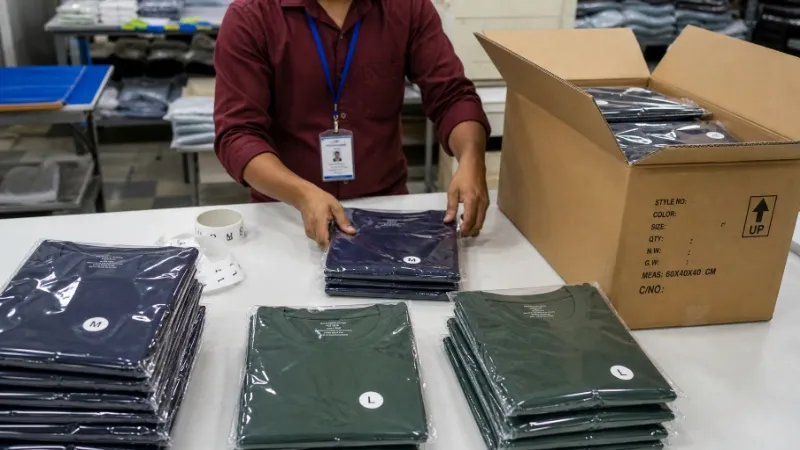
Shipping method depends on budget and launch timeline:
| Shipping Method | Best For | Notes |
|---|---|---|
| Air freight | Urgent orders, small shipments | Faster but more expensive |
| Sea freight | Larger bulk orders | Lower cost but longer transit time |
| Express courier | Samples or small urgent packages | Convenient but not ideal for large-volume goods |
Checkpoint: Confirm packing instructions early. Last-minute packaging changes can delay shipment, especially if barcode labels, hang tags, or special cartons are required.
How Long Does It Take to Manufacture T-Shirts?
The timeline depends on fabric availability, order quantity, colorways, decoration method, sample revisions, approval speed, and factory capacity.
For most custom T-shirt projects, the typical timeline is:
| Stage | Typical Timeline |
|---|---|
| Basic T-shirt sample | 8–12 days after details are confirmed |
| Complex sample | 12–20 days if custom fabric, special fit, printing, embroidery, washing, or multiple revisions are needed |
| Bulk production | 25–35 days after sample approval and deposit |
| Custom-dyed fabric or peak season orders | 35–50+ days depending on dyeing, trims, approvals, and capacity |
| Shipping | Depends on air, sea, express, and destination country |
Several factors can extend the production timeline:
- Non-stock fabric
- Custom dyeing
- Multiple colorways
- Complex print or embroidery
- Slow lab dip approval
- Slow artwork confirmation
- Multiple sample revisions
- Special packaging requirements
- Peak-season factory capacity
Factory note from Easson Apparel:
One of the easiest ways to keep a T-shirt order on schedule is to confirm fabric, size chart, artwork, color, and packaging before sampling starts. If these details change after the pre-production sample is approved, the bulk timeline may need to be adjusted.
Planning a launch date? Send us your target delivery date, order quantity, fabric requirement, and artwork. We can help estimate whether your timeline is realistic before production begins.
What Buyers Need to Prepare Before T-Shirt Production
Before contacting a T-shirt manufacturer, it helps to prepare the key production details. You do not need to have everything perfect, but the more complete your information is, the faster the factory can quote, sample, and plan production.
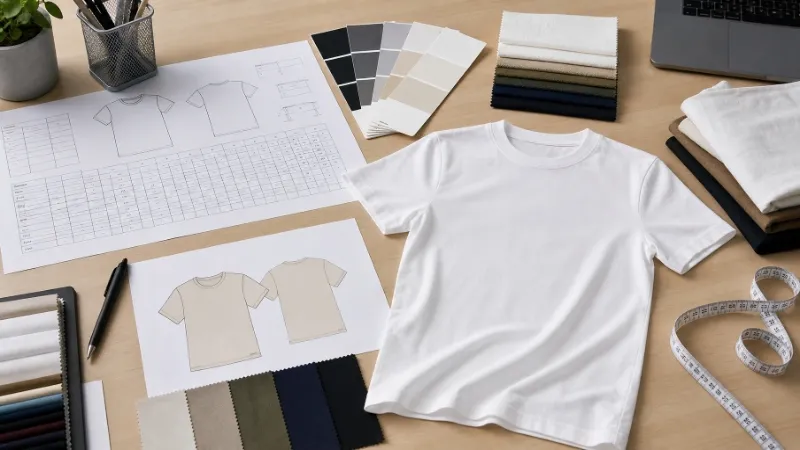
Here is a practical checklist:
| Item | Why It Matters |
|---|---|
| Design reference | Helps the factory understand the style direction |
| Tech pack | Includes measurements, construction, trims, and details |
| Size chart | Reduces fit misunderstanding |
| Fabric composition | Helps determine cost, handfeel, and shrinkage |
| GSM requirement | Affects thickness, structure, and price |
| Color requirement | Determines stock fabric or custom dyeing |
| Artwork file | Needed for printing or embroidery |
| Logo placement | Affects production method and cost |
| Quantity per color and size | Affects MOQ and unit price |
| Packaging requirement | Affects lead time and final cost |
| Target market | Helps the factory understand fit and quality expectations |
For startup brands, it is normal to begin with reference photos and rough ideas. A good factory can help turn those ideas into more complete production details. If you are still deciding on fabric, you can also read our guide on how to choose the best fabric for a clothing brand before confirming your tech pack.
Common Problems During T-Shirt Manufacturing
Even simple T-shirts can have quality problems if the process is not controlled properly. Common issues include:
1. Fabric Shrinkage
Cotton fabrics may shrink after washing if they are not properly finished or tested. This can affect body length, sleeve length, chest width, and overall fit.
2. Twisting or Spirality
Knitted fabric can twist after washing if fabric relaxation, knitting tension, or finishing is not controlled well.
3. Neckline Deformation
A weak or poorly sewn collar can stretch, wave, or lose shape after washing. Rib quality and sewing tension are both important.
4. Poor Print Durability
If screen printing ink is not cured properly, the print may crack or peel. Test prints and wash tests help reduce this risk.
5. Color Difference
Lab dip approval does not always guarantee perfect bulk shade if dyeing is not controlled well. Buyers should allow reasonable tolerance and approve colors under standard lighting.
6. Measurement Inconsistency
Different operators, fabric behavior, and sewing tension can affect final measurements. In-line QC and final measurement checks are necessary.
How to Reduce T-Shirt Manufacturing Cost Without Lowering Quality
For new clothing brands, reducing cost does not always mean choosing the cheapest fabric. A better approach is to simplify the first production run and reduce unnecessary complexity.
Here are practical ways to control cost:
| Cost-Saving Method | Why It Helps |
|---|---|
| Use available fabric colors | Reduces dyeing cost and lead time |
| Limit the number of colorways | Helps meet MOQ more easily |
| Start with fewer artwork placements | Reduces printing setup cost |
| Use one main fabric across styles | Improves fabric efficiency |
| Keep packaging simple at first | Reduces accessory and packing cost |
| Confirm specs before sampling | Avoids repeated sample revisions |
| Increase quantity gradually | Helps reduce unit cost over time |
For example, a startup brand may begin with one T-shirt style, two colors, and one main logo placement. After testing the market, the brand can expand into more colors, heavier fabrics, special washes, or more complex decoration.
If you are unsure how to balance fabric quality, MOQ, and unit price, you can send us your target budget and order quantity. We can suggest a more production-friendly way to develop your first T-shirt order.
Why Understanding the T-Shirt Production Process Matters for Brands
Understanding how T-shirts are made helps clothing brands make better decisions before production starts. It also helps reduce delays, avoid hidden costs, and communicate more clearly with suppliers.
When you understand the T-shirt factory process, you can:
- Choose the right fabric for your price level
- Set realistic sample and bulk timelines
- Avoid unnecessary design complexity
- Prepare better tech packs
- Reduce sample revisions
- Understand why MOQ changes by fabric and color
- Check quality more effectively
- Plan your launch date more accurately
Common startup pitfalls to avoid include:
- Sending incomplete tech packs
- Missing measurements or size specs
- Choosing fabric only by photo
- Adding too many colorways too early
- Changing specs after sample approval
- Ignoring lab dip or strike-off approval
- Skipping in-line QC and relying only on final inspection
- Underestimating packaging and shipping time
A T-shirt may look simple, but professional production requires clear details, stable communication, and consistent quality control.
FAQ
How long does it take to manufacture custom T-shirts?
For most custom T-shirt projects, sampling usually takes 8–12 days after fabric, artwork, size spec, and construction details are confirmed.
Bulk production usually takes around 25–35 days after sample approval and deposit. Orders with custom fabric dyeing, many colorways, special trims, or peak-season capacity pressure may require 35–50+ days.
What is the minimum order quantity for custom T-shirts?
MOQ varies depending on the manufacturer, fabric, color, and customization level. Many clothing manufacturers set a minimum order quantity of around 100–300 pieces per style for custom T-shirts.
What fabric is best for high-quality T-shirts?
The most common fabric for high-quality T-shirts is 100% cotton, especially combed or ring-spun cotton, because it feels soft, breathable, and comfortable.
Cotton-polyester blends are also popular because they can improve durability, reduce shrinkage, and dry faster. For premium private-label T-shirts, many brands choose 180–220 GSM cotton or cotton-blend jersey because it provides a thicker and more structured feel compared with lightweight fabrics.
What printing methods are commonly used for T-shirts?
The most common T-shirt printing methods are screen printing, DTG printing, heat transfer, and embroidery.
Can startup brands manufacture T-shirts with low MOQ?
Yes, some factories support startup brands with lower MOQs, especially when the order uses stock fabric, simple colors, and standard construction.
However, low MOQ does not always mean low unit cost. A 50-piece or 100-piece order may still require pattern making, sample development, artwork checking, printing setup, cutting, sewing, QC, and packing. This is why smaller orders usually have higher unit prices than larger bulk orders.
Conclusion
From fabric selection and knitting to dyeing, cutting, sewing, decoration, quality inspection, and final packaging, the T-shirt manufacturing process is a repeatable workflow with clear checkpoints.
Understanding how T-shirts are made helps brands make better decisions about fabric, fit, printing method, production cost, MOQ, and delivery timeline. It also helps avoid common problems such as shrinkage, poor neckline shape, print failure, color difference, and measurement inconsistency.
For most custom T-shirt projects, sampling takes around 8–12 days, while bulk production usually takes around 25–35 days after sample approval and deposit.
If you need a manufacturing partner that can support OEM/ODM T-shirts from fabric sourcing and sample development to bulk production, quality inspection, and packaging, Easson Apparel can help turn your design idea into production-ready garments.
Send us your tech pack, reference sample, artwork, or target order quantity, and our team can help you review fabric options, production feasibility, estimated lead time, and MOQ before sampling.
Mainly explains knitting, cotton fabrics, shrinkage, and fabric construction. Helps readers understand how T-shirt fabric is made and why issues like shrinkage, twisting, or GSM variation happen. ↩
Mainly explains textile testing standards such as colorfastness, rubbing, and shrinkage testing. Helps readers understand how T-shirts are tested for fading, color transfer, and wash durability. ↩
Mainly explains AQL inspection, apparel quality control, and factory inspection processes. Helps readers understand how bulk T-shirt orders are inspected and how product quality is evaluated. ↩
Mainly explains harmful substance testing and textile safety certification. Helps readers understand whether T-shirts meet safety standards for skin-contact apparel and international markets. ↩