
If you’re choosing fabrics for activewear, swimwear, outerwear, or performance apparel, polyamide is a material worth considering. This guide explains what polyamide fabric is, how it performs, where it works best, and when cotton or polyester may be a better option for your product line.You’ll also get sourcing-friendly benchmarks, test methods to specify, and a practical decision checklist.
If you’re still evaluating suppliers, our guide on how to find a reliable clothing manufacturer can help you connect fabric decisions with sourcing decisions.
Key takeaways
- Polyamide (nylon) offers excellent abrasion resistance, toughness, and a soft hand, making it a go-to for activewear, swimwear, lingerie, and durable outerwear shells.
- It absorbs more moisture than polyester but less than cotton, which affects comfort, dyeability, and drying. Use construction and finishes to tune breathability and moisture management.
- Nylon 6 and 6,6 differ in melting point, dyeability, and moisture uptake. Pick based on your process window and color needs, then test to the right ISO/ASTM/AATCC methods.
- Cost-to-performance: nylon often outprices polyester but can reduce returns in abrasion- or stretch-critical products. For price-sensitive basics, polyester or cotton may suffice.
- Safety and sustainability: rely on product-level certification (OEKO-TEX Standard 100) and lab testing where needed; recycled nylon is growing but still limited in market share.
What Is Polyamide Fabric?
Polyamide fabric is a synthetic material widely used in apparel, especially in activewear, swimwear, and stretch garments. In most clothing applications, polyamide is commonly known as nylon. Brands often choose it because it combines durability, softness, and abrasion resistance in a lightweight fabric structure.For more material selection guides like this, you can also explore our Fabric Resource Hub.
What is polyamide fabric made of?
Polyamide fabric is made from synthetic polymers created through chemical processing. In practical terms, brands do not need to focus on the chemistry as much as the performance outcome: polyamide fabrics are engineered to be lightweight, durable, and suitable for repeated wear.
That is why polyamide is often used in garments where strength, stretch, and abrasion resistance matter more than a fully natural handfeel.
Is polyamide the same as nylon?
In apparel, polyamide and nylon are usually treated as the same material family. Nylon is the more common commercial name, while polyamide is the technical fiber name.
The two most common types used in clothing are Nylon 6 and Nylon 6,6. Both are strong and versatile, but they can differ slightly in heat resistance, moisture behavior, and processing performance.
Why Polyamide Fabric Is Popular in Modern Apparel
For clothing brands, the value of polyamide fabric comes down to how it performs in real products. The most important properties are durability, stretch, abrasion resistance, moisture behavior, and surface feel.
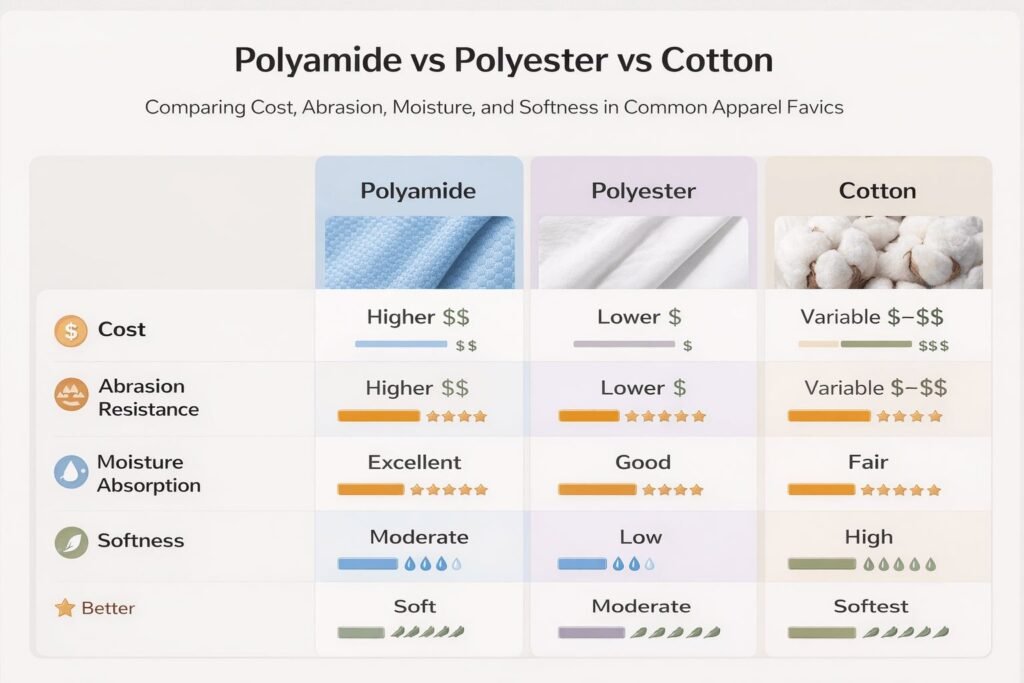
From a cost-to-performance view, nylon often sits between polyester and specialty fibers. It tends to be pricier than standard polyester but can unlock durability or comfort that reduces warranty claims and returns.
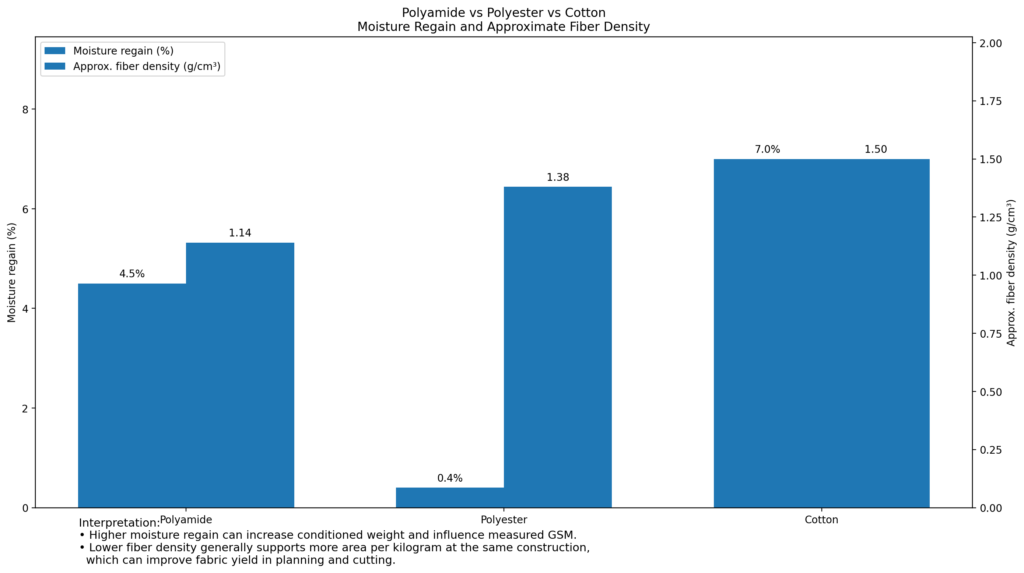
Nylon’s moisture regain sits between polyester and cotton. Practical ranges commonly cited show nylon around 3.5–5%, polyester near 0.4%, and cotton around 7–8.5% at standard conditions. See nylon property ranges contextualized by Xometry’s nylon properties overview; see polyester’s very low moisture content in Martí’s 2021 review on comfort of polyester fabrics (open access).
Main Properties of Polyamide Fabric
Below are the properties apparel teams evaluate most—and the test methods to specify in tech packs so results are comparable.
Durability and abrasion resistance
One of the biggest advantages of polyamide fabric is its durability. It performs well in garments that experience repeated rubbing, tension, or daily wear, which is why it is widely used in leggings, fitted sportswear, and outerwear shells.
Abrasion resistance is especially important for products that need to hold up over time. In supplier discussions, this is one of the key reasons brands compare polyamide with polyester and cotton.
Practical tip: For leggings or seat panels, target higher appearance grades after more cycles; for fashion knits, moderate targets may suffice. Always align pressure and endpoint criteria with the wearer’s use case.
Tensile and tear behavior
For wovens and some nonwovens, specify ASTM D5034 (grab) or D5035 (strip) for breaking strength and elongation. These methods help compare shell fabrics and durable pocketing. See an accessible summary of ASTM D5034 grab tensile.
In high-denier wovens, nylon commonly outperforms cotton on strength-to-weight. Polyester can be competitive, especially in UV-exposed applications.
Stretch and recovery in knits
Polyamide is often blended with elastane to create fabrics that stretch easily and return to shape after wear. This makes it a strong choice for garments that need body movement, support, or close fit.
For brands, good recovery matters because it affects both comfort and product lifespan. A fabric that stretches but does not recover well can quickly lose shape in real use.
Tip: In leggings, validate recovery at 50–100% extension; in lingerie, use lower extensions matched to the fit map.
Moisture behavior and drying
Polyamide generally dries faster than cotton and is often used in apparel designed for movement or performance. Its moisture behavior makes it useful in categories where sweat management and lower drying time are important.
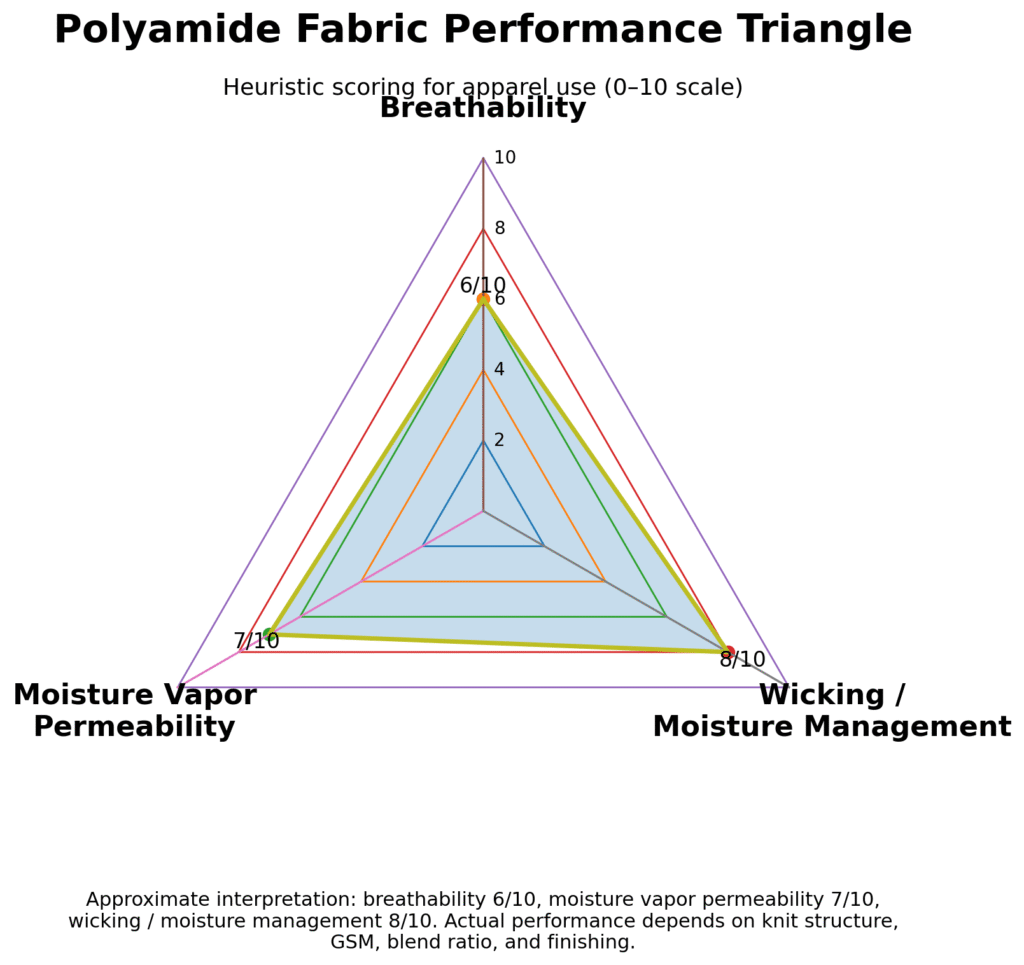
That said, fiber performance alone does not determine comfort. Fabric construction, finishing, and blend composition also play a major role in how breathable or comfortable the final garment feels.
For products marketing “quick-dry,” validate both wicking and drying time. Pair lab data with wearer trials.
Softness and surface feel
Many apparel brands choose polyamide because it feels smoother and softer than people expect from a synthetic fiber. This makes it a strong option for garments worn close to the skin, such as leggings, base layers, or lingerie.
Surface feel also matters for product positioning. A smoother, more refined hand can help a garment feel more premium, especially in fitted or technical categories.
Pros of Polyamide Fabric
Polyamide fabric offers several practical advantages for clothing brands. It is durable, resistant to abrasion, and suitable for garments that need to hold shape under frequent wear. It also works well in stretch fabrics, which makes it valuable for performance and body-contouring products.
Another advantage is its smooth surface and relatively soft handfeel. In many cases, polyamide helps garments feel more refined than standard low-cost synthetics. For brands developing activewear, swimwear, or technical apparel, that balance of performance and comfort can be a strong selling point.
Cons of Polyamide Fabric
Polyamide fabric is not the best choice for every product. It is often more expensive than basic polyester, which can make it less suitable for price-driven categories or entry-level basics. If margin is the top priority, brands need to compare performance gains against higher material cost.
It can also feel less breathable than natural fibers such as cotton, depending on the fabric construction. In addition, brands that prioritize sustainability need to look closely at recycled content, certifications, and end-of-life concerns, because polyamide is still a synthetic material with environmental trade-offs.
Polyamide Fabric vs Other Fabrics
Polyamide vs polyester
Polyamide and polyester are both widely used in performance apparel, but they are not interchangeable in every case. Polyamide often feels softer and offers better abrasion resistance, which is why it is common in premium activewear, leggings, and fitted garments.
Polyester is usually more cost-efficient and often performs well in moisture management, durability, and bulk production. For many brands, the decision comes down to target price, product positioning, and whether softness or cost efficiency matters more.
Polyamide vs cotton
Polyamide and cotton serve very different purposes in apparel. Cotton offers a more natural feel and is often preferred for comfort-led basics such as everyday T-shirts and casual tops. Polyamide is stronger, faster drying, and more suitable for stretch or technical products.
For clothing brands, cotton is usually the better choice when natural handfeel and simplicity matter most. Polyamide is usually the better choice when performance, durability, and shape retention are more important.If your brand is focused on cotton-led basics, our T-shirt manufacturing process guide explains how fabric choice affects cost, feel, and production.
Comparison table: polyamide vs polyester vs cotton
| Attribute | Polyamide (Nylon) | Polyester (PET) | Cotton |
|---|---|---|---|
| Typical moisture regain (std. conditions) | Moderate (~3.5–5%) | Very low (~0.4%) | High (~7–8.5%) |
| Hand/softness potential | Very good at fine deniers | Variable; can feel crisper | Naturally soft, breathable |
| Abrasion/strength-to-weight | Excellent for weight | Very good | Moderate (lower than synthetics) |
| UV/weather resistance | Moderate; needs care | Strong | Moderate |
| Dyeability | Generally easier than PET | More challenging; disperse-only | Reactive/direct dye families |
| Density (g/cm³) | ~1.14 | ~1.38 | ~1.5 |
| Cost position (relative) | Mid-to-high vs PET | Lowest among three | Mid (varies by grade) |
| Sustainability notes | Recycled PA growing, limited share | Broad recycled PET availability | Renewable fiber; water/land impacts vary |
| Common tests to specify | ISO 12947; ASTM D4964; ISO 9237 | Same set | AATCC/ISO colorfastness; tensile as needed |
Sources mentioned in text: ISO 12947; ISO 9237; AATCC TM195; ASTM D5034/D5035; density and moisture regain context via BASF datasheets, Xometry nylon properties, Martí 2021 review, and cotton commercial regains tradition.
Common Uses of Polyamide Fabric in Clothing
Activewear
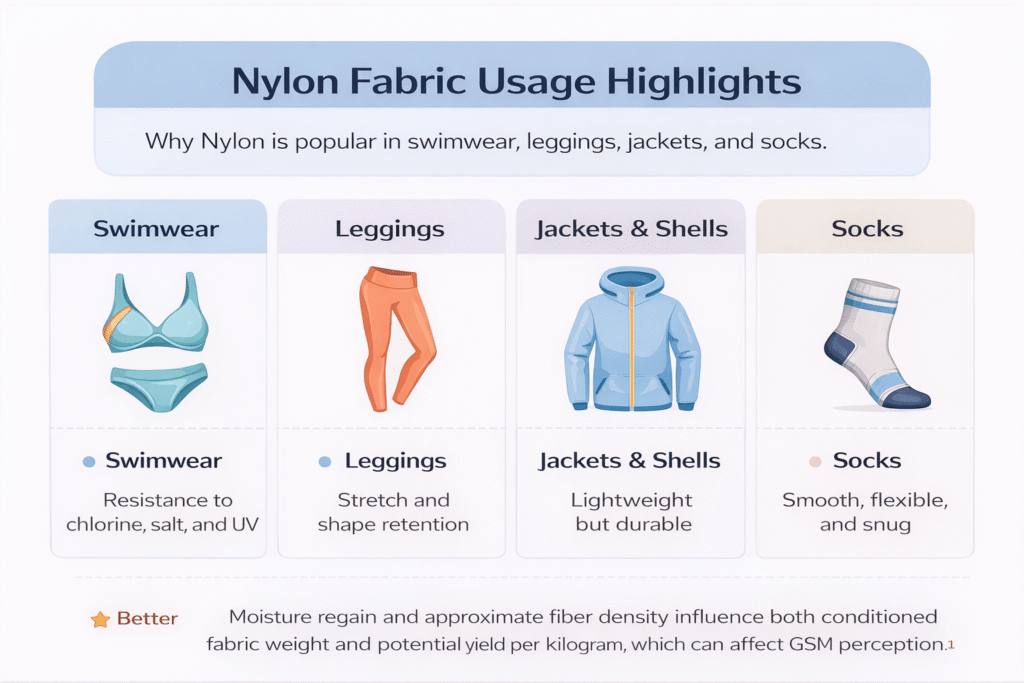
Nylon/elastane knits deliver soft hand, four-way stretch, and good recovery for leggings, base layers, and compression pieces. Validate abrasion at seat/knee and recovery after cycles.
Mini-case: A startup moved from polyester/elastane to a PA6/elastane legging knit after seat pilling complaints. By specifying ISO 12947 appearance grade ≥3 at 12 kPa after a higher cycle target and validating ASTM D4964 recovery at 75% extension, returns fell in the next season.
Outerwear shells and liners
High-tenacity nylon wovens provide tear strength and abrasion resistance for shells, pants, and bags. Pair with coatings/laminates and test air permeability and Ret to hit comfort targets.
Swimwear
PA/EA warp knits (tricot) and circular knits dominate for stretch, shape retention, and soft touch. Choose recipes resistant to chlorine, sunscreen, and UV.
Carvico publishes specs for popular swimwear families such as Vita (78% PA rec / 22% EA), which highlights pilling resistance, UV protection, and shape retention for beachwear and athleisure.
Lingerie and hosiery
Fine denier PA66 yarns (often covered with elastane) create smooth, supportive, and durable intimates and hosiery. See Fulgar’s PA66 yarn technology pages for families like DTY textured yarns commonly used in these categories.
Blended fashion apparel
Blending nylon with cotton or viscose can lift durability and reduce pilling while retaining drape. Specify pilling tests (ISO 12945) and colorfastness to rubbing (ISO 105 X12) for darker shades.
Use‑case suitability table
| Apparel category | Suitability of polyamide | Notes for sourcing and QA |
|---|---|---|
| Leggings/tights | Highly suitable | PA/EA with ASTM D4964 recovery validation; ISO 12947 abrasion at seat/knee |
| Base layers | Suitable | Balance moisture management (AATCC TM195) with hand and odor strategy |
| Swimwear | Highly suitable | PA/EA warp knits; test for chlorine/sunscreen/oil and light fastness (ISO 105 B02) |
| Lingerie/hosiery | Highly suitable | Fine denier PA66 + elastane; focus on fit map recovery and pilling |
| Outer shells | Suitable | High-tenacity wovens; test air permeability (ISO 9237) and Ret (ISO 11092) |
| Casual tees/shirts | Sometimes | Consider cotton-rich blends for breathability/hand and cost |
| Workwear/tactical | Mixed | Polyester may win on UV/weathering; consider nylon for abrasion panels |
Is Polyamide Fabric Good for Clothing Brands?
Polyamide fabric is a good option for clothing brands that need durability, stretch, and a smooth performance-oriented feel. It makes the most sense in categories such as activewear, swimwear, lingerie, compression garments, and lightweight outerwear.
It may be less suitable for brands focused on low-cost basics or products where natural softness and breathability are the main selling points. The best decision depends on your product category, target price, expected wear conditions, and whether performance benefits justify the higher material cost.
Is Polyamide Fabric Safe, Breathable, and Comfortable?
Polyamide fabric is widely used in apparel and is generally considered safe when sourced and processed according to accepted textile safety standards. For brands, the more important question is whether the supplier can provide clear compliance documents, chemical safety information, and relevant certifications when needed.
In terms of comfort, polyamide can feel smooth, soft, and supportive, especially in stretch fabrics. Breathability depends less on the fiber alone and more on the construction, blend, weight, and finishing of the fabric. A lightweight knit polyamide fabric may feel comfortable in activewear, while a dense technical fabric may feel warmer and less breathable in everyday use.
How to Choose the Right Polyamide Fabric for Your Product
Practical benchmarks to start with
- Fiber type: PA6 for wider dye window and soft hand; PA66 for higher heat tolerance and dimensional stability. Confirm with dyehouse tests.
- Yarn and denier: Active leggings 30–70 den PA with 15–25% elastane; swimwear warp knits 78–85% PA with 15–22% elastane in 150–250 g/m²; outer shells 20–420 denier high-tenacity yarns depending on weight target.
- Construction: Finer-gauge circular knits for smooth hand; warp knit tricot for swim control; plain or ripstop wovens for shells.
- Finishes: Moisture management for base layers; anti-pilling on brushed knits; UV/anti-yellowing care for light shades.
Testing and quality plan (specify methods, not just adjectives)
- Abrasion: ISO 12947 at an agreed pressure and endpoint suitable for the category.
- Tensile/tear: ASTM D5034/D5035 as applicable for wovens and durable knits.
- Stretch & recovery: ASTM D4964 at defined extensions and cycles, tied to a fit map.
- Colorfastness: ISO 105 series (E01 water/E04 perspiration/X12 rubbing/B02 light) per end-use.
- Moisture/drying: AATCC TM195 and, if needed, TM197 for wicking.
- Comfort: ISO 9237 (air permeability) and ISO 11092 Ret for multilayer systems.
MOQ, sampling, and supplier evaluation
- MOQ ranges: For stocked yarn circular knits, 300–800 meters per color is common; warp knits often run 600–1,200 meters. Specialty or recycled yarn programs can require 1,000–2,000+ meters per color. Ranges vary by mill and region.
- Lead times: Lab dips 5–10 business days; strike-offs/trial knits 1–3 weeks; bulk 4–8 weeks after approvals, longer for recycled content or dope-dyed programs.
- Sampling flow: Lab dip → hand/fit prototype → lab testing → pre-production (PP) sample → size set → pilot/PP run with inline QC → bulk.
- Supplier checks: Request recent test reports to the exact methods above, shade tolerance specs, heat-setting windows, pilling/abrasion controls, and consistency plans across dye lots.
- Coordination help: Manufacturing partners like Easson Apparel can help organize lab testing to ISO/ASTM/AATCC, align fit and fabric approval calendars, and manage pre-production pilots.
Decision checklist for brands choosing polyamide
Before approving polyamide fabric for bulk production, brands should check a few essentials:
- Is the fabric suited to the product category?
- Does it provide the stretch, recovery, or durability the product needs?
- Is the cost aligned with the target retail price?
- Has the fabric been tested for comfort, recovery, and wear performance?
- Can the supplier support MOQ, consistency, and repeat orders?
- Are compliance and certification requirements clear?
Final Thoughts: Should You Use Polyamide Fabric?
If you came here asking what is polyamide fabric and whether it fits your next collection, here’s the short answer: Polyamide fabric is a strong option for brands developing activewear, swimwear, lingerie, and lightweight performance apparel. It offers clear advantages in durability, stretch, and surface feel, especially when compared with more basic fabric choices.
At the same time, it is not the best solution for every category. For low-cost basics or products where natural handfeel matters most, cotton or cotton-rich blends may be a better fit. The right choice depends on product function, target price, and supplier testing before bulk production.
FAQs
What is polyamide fabric made of?
Polyamide fabric is made from synthetic polymers derived through chemical processing. In apparel, it is often used because it is lightweight, strong, and suitable for performance-focused garments.
Is polyamide the same as nylon?
In apparel, yes. Nylon is the polyamide you’ll buy for fabrics and yarns. The wider polyamide family includes other members (like aramids) used mostly for protective gear, not fashion.
Is polyamide a good fabric?
Polyamide fabric is good for products that need durability, stretch, and fast drying performance. It may be less suitable for brands prioritizing natural feel or maximum breathability.
Is polyamide fabric breathable?
Polyamide fabric can be breathable depending on the fabric construction, but it is generally less breathable than natural fibers like cotton. It performs better in activewear when blended or engineered for moisture management.
Is polyamide fabric toxic?
Is polyamide fabric toxic?
What is polyamide fabric used for?
Activewear, swimwear, lingerie, hosiery, durable outerwear shells, and blends for fashion knits/wovens where added durability or stretch is needed. Carvico and Fulgar publish representative examples of swim and lingerie yarn/fabric families.
Is polyamide better than polyester?
It depends. Polyamide often wins on abrasion resistance, hand, and dyeability; polyester often wins on UV/weathering, low moisture uptake, and price. Test to your end-use and choose accordingly.
How sustainable is polyamide compared with polyester or cotton?
Recycled nylon is growing but still a minority of total nylon. Textile Exchange’s market reports (2023–2024) describe recycled polyamide’s limited share and supply realities. Cotton’s impacts hinge on cultivation and processing; recycled PET is widely available. Prioritize verified claims and life-cycle context over material swaps alone.
For broader sourcing, manufacturing, and supplier guidance, visit our Clothing Resource Hub.