Every brand owner asks this question at some point. You want to keep costs down, but you also cannot afford a printing mistake on 500 units. The wrong choice here does not just cost money — it costs time, inventory, and trust.
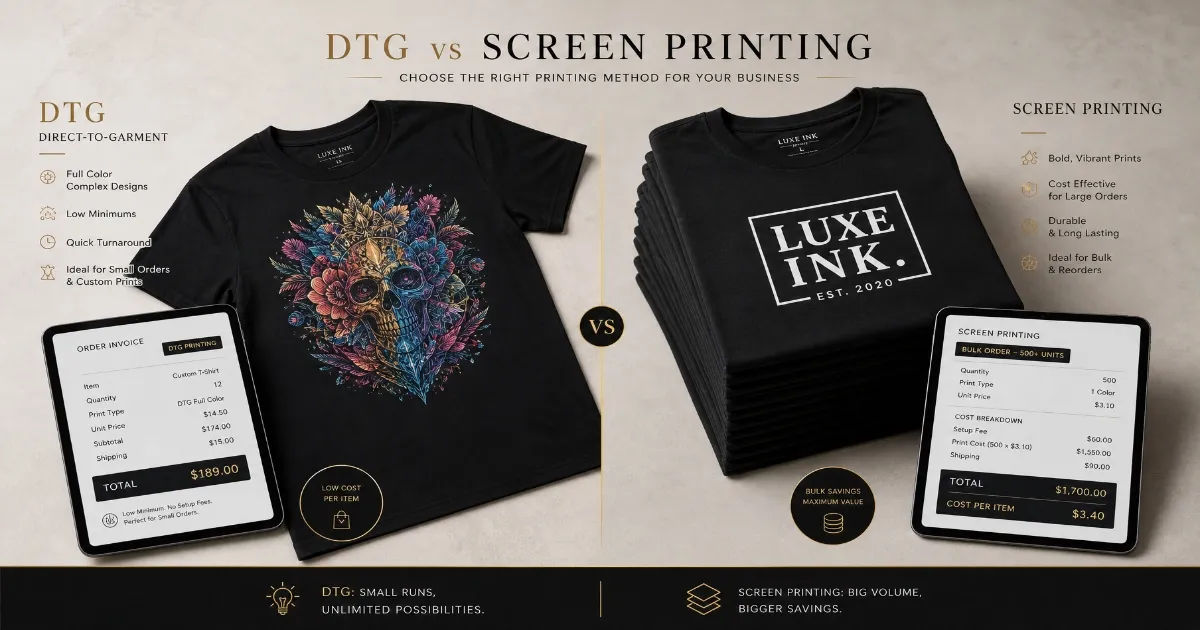
DTG is usually cheaper for small, complex orders. Screen printing becomes more cost-effective at higher quantities with simple designs. But the real answer depends on your order size, color count, fabric color, design complexity, and whether you plan to reorder.
Most people ask the wrong question. They ask: "Which one is cheaper?" But what they should ask is: "Which one gives me the lowest total cost for my specific situation?" Those are two very different questions, and the gap between them is where brands lose money. Let me walk you through how we think about this at our factory, after 21 years of producing garments for brands at every stage of growth.
DTG vs Screen Printing Cost: Quick Answer
You need a fast answer, and the options all look the same on paper. You pick the cheaper one, place the order, and hope for the best. That is how costly mistakes get made.
For orders under 50–100 pieces with multi-color or photo-quality designs, DTG is more cost-effective. For orders above 100–300 pieces with simple 1–3 color designs, screen printing almost always wins on total cost per unit.
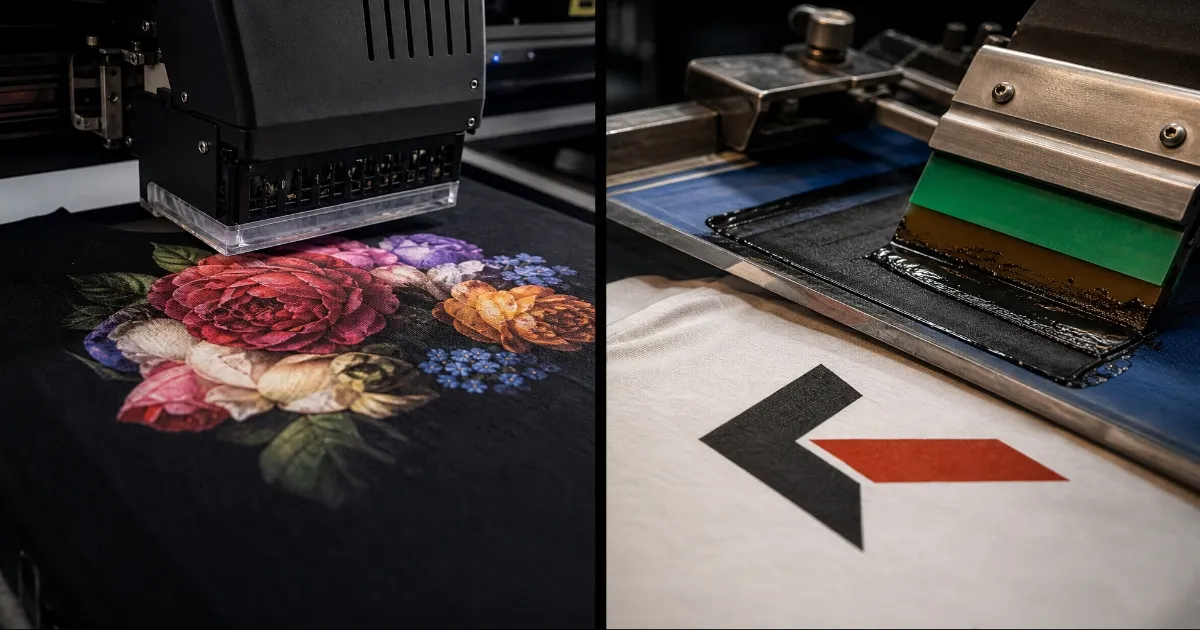
The word "almost" matters here. There is no single rule that works for every order. That quick answer above covers most situations, but as soon as you change one variable — fabric type, reorder frequency, design size — the math shifts. The sections below break down each variable so you can make the call with confidence.
What Makes DTG and Screen Printing Costs Different
Both methods print onto fabric. So why are their costs so different? The answer is in how each technology works.
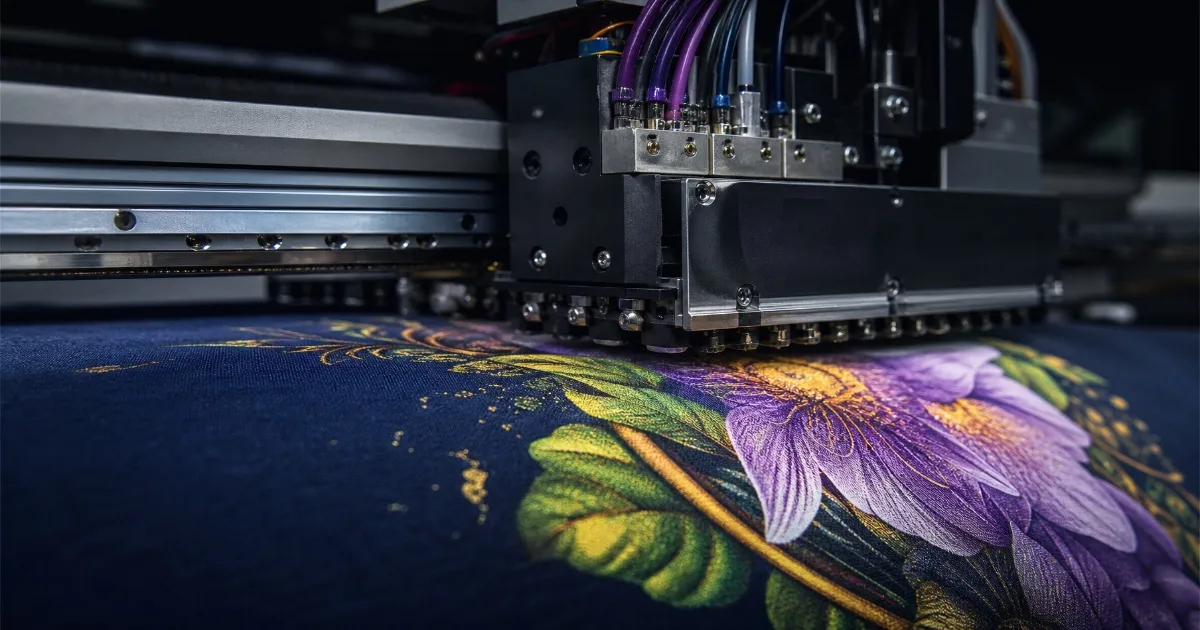
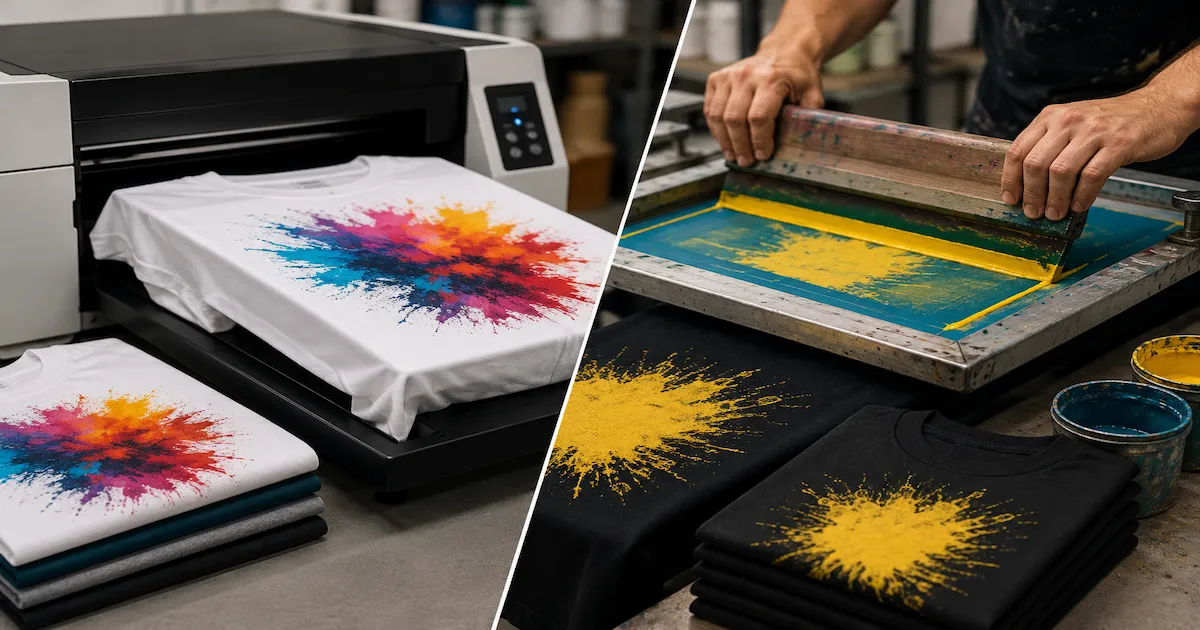
DTG (Direct-to-Garment) printing works like an inkjet printer. It sprays ink directly onto the fabric. There is almost no setup cost per design. You can print one piece as easily as one hundred. Screen printing works differently. Each color in your design needs a separate screen. Making those screens costs money. Setting up the machine costs money. Once setup is done, each additional piece is cheap to produce.
| Cost Factor | DTG | Screen Printing |
|---|---|---|
| Setup cost per design | Very low | High (per color, per screen) |
| Cost per unit (small order) | Low to medium | High |
| Cost per unit (large order) | Medium to high | Low |
| Number of colors | No extra cost | Each color adds cost |
| Design complexity | No extra cost | More colors = more screens |
| Reorder setup cost | Near zero | Setup cost repeats |
This table shows the core difference. DTG has a flat cost structure. Screen printing has a split structure: high fixed costs up front, low variable costs per unit. This means the two methods suit very different types of orders.
I want to be clear about one more thing. DTG quality depends heavily on fabric composition and garment color. A 100% cotton white tee will give you sharp, vibrant DTG results. A dark polyester blend? The result may disappoint you. The digital mock-up always looks perfect. The printed garment is a different story. At our factory, we always test fabric compatibility before we recommend DTG for any bulk run.
When Is DTG More Cost-Effective
You are launching a new brand and you want to test five different graphic designs. You do not know which one will sell. You order 30 pieces of each. Now ask yourself: which printing method makes sense here?
DTG is more cost-effective when your order is small, your design has many colors, and you are still testing the market.
Here is why. Screen printing charges you for every screen it makes. If your design has six colors, that is six screens. If you are ordering 30 pieces, those setup costs do not spread across enough units to make sense. DTG skips all of that. You pay a consistent per-unit price regardless of color count or design complexity.

The situations where DTG fits best:
You are testing designs or markets. If your brand does not yet know which graphic will sell, DTG lowers your risk.1 You can print small quantities across multiple designs without committing to large screen printing runs. The real value of DTG in this case is not a lower unit price. It is a lower mistake cost.
Your design is photo-quality or uses gradients. Screen printing can handle complex designs, but printing smooth gradients or photo-realistic images requires a technique called halftone printing.2 It adds cost and visual compromise. DTG handles this type of artwork natively, with no extra charge.
You need fast turnaround with no reorder plan. DTG has almost no setup time. If you need 50 custom pieces quickly for an event or a pop-up, DTG can deliver faster and with no minimum quantity pressure.
Your order is under 50–100 units. Below this threshold, the per-unit cost of DTG is usually competitive with or better than screen printing, once you factor in screen setup fees.
| Order Size | DTG Unit Cost | Screen Printing Unit Cost (incl. setup) |
|---|---|---|
| 20 pieces | Low | Very High |
| 50 pieces | Low | High |
| 100 pieces | Medium | Medium |
| 300 pieces | Medium-High | Low |
| 500+ pieces | High relative | Very Low |
Note: Actual numbers vary by factory, design complexity, and garment type. This table shows the general pattern.
When Is Screen Printing More Cost-Effective
Your brand has a signature logo. It is two colors. You know it sells. You want 500 pieces every quarter. Should you use DTG?
No. Screen printing is clearly the better choice here, and using DTG for this order would cost you significantly more per unit without any quality benefit.
Screen printing becomes more cost-effective when your order is large, your design is simple, and you plan to reorder.
The logic is simple. Screen printing front-loads its costs. You pay for screen-making and machine setup before a single piece is printed. But once those costs are paid, each additional piece is cheap to produce. The more pieces you print, the less each one costs. This is called cost amortization.
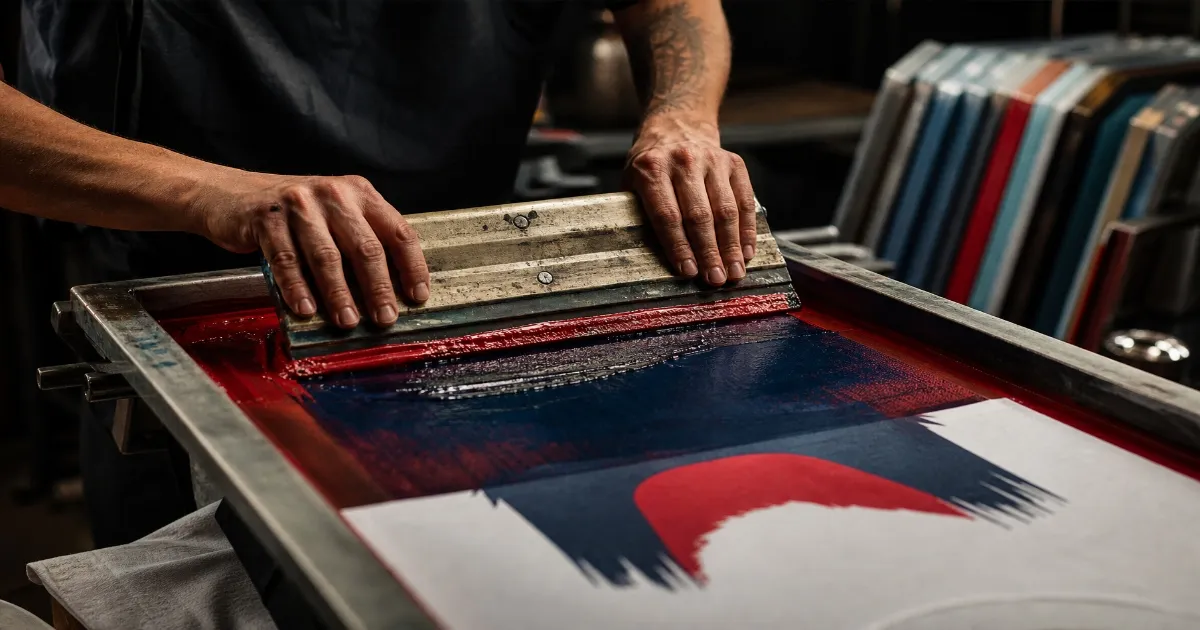
The situations where screen printing fits best:
You have a stable, proven design. If you are not going to change your design, there is no reason to keep paying DTG's consistent per-unit rate. Screen printing rewards consistency.3
Your design uses 1–3 colors. Fewer colors means fewer screens, which means lower setup costs. A two-color logo is one of the most cost-efficient things to screen print at volume.
You are ordering 100–300 pieces or more. This is the threshold where screen printing's amortized cost structure typically beats DTG. Some factories set this threshold lower, some higher. At our factory, we usually see the crossover point around 100–150 pieces for simple designs.
Your brand has a streetwear or large graphic aesthetic. Large area prints with solid colors are a natural match for screen printing. The ink sits on top of the fabric in a way that gives a bold, classic look that many brands want and customers recognize.
You plan to reorder the same design. This is an important point many brands miss. If you use DTG, every order starts from scratch at the same cost. If you use screen printing and keep your screens, reorders are cheaper because setup is faster.
DTG vs Screen Printing Cost by Order Quantity and Design Type
You have a specific design in mind. Which method suits it better?
The design itself is one of the most important cost factors. Two brands can order the same quantity and get very different cost outcomes based on their artwork alone.
Photo-realistic or gradient-heavy artwork favors DTG. Screen printing can approximate gradients, but it requires halftone dots and often loses detail. DTG prints exactly what the file shows.
Simple bold logos favor screen printing. A clean, two-color logo prints faster, cheaper, and with better color consistency on screen printing. The ink is thicker and more durable on the surface.
| Design Type | Better Method | Reason |
|---|---|---|
| Photo or gradient | DTG | Screen printing cannot replicate smooth color transitions easily |
| 1–3 color logo | Screen Printing | Low screen count, low setup cost |
| 4–6 color design | Depends on quantity | DTG for small runs, screen printing for large |
| Large area solid fill | Screen Printing | Consistent ink coverage at scale |
| Detailed line art | DTG (small run) | Fine detail at low quantity |
| Text-heavy design | Screen Printing | Sharp text at low color count |
Real Cost Scenarios for Clothing Brands
| Example Order | More Cost-Effective Choice | Why |
|---|---|---|
| 30 white T-shirts with full-color artwork | DTG | No screen setup cost, better for small test runs |
| 50 black hoodies with a large photo-style back print | DTG, but test first | Good for complex artwork, but dark fabric and hand feel need checking |
| 100 T-shirts with a 2-color chest logo | Depends | Screen printing may start to become competitive if the design is stable |
| 300 T-shirts with a 1-color logo | Screen Printing | Setup cost spreads across more units |
| 500 sweatshirts with the same repeated design | Screen Printing | Lower unit cost and better consistency for bulk production |
| 80 pieces across 4 different designs | DTG | Lower risk because each design quantity is small |
One thing I want to add from our factory experience. Fabric color matters as much as design complexity. DTG printing on dark garments requires a white ink underbase layer. This adds cost and can affect the feel of the print. Screen printing on dark garments also needs an underbase, but the process is more developed and the result is often cleaner at scale. If your brand focuses on dark-colored garments, this is a factor worth discussing with your manufacturer before you commit to either method.
The Hidden Cost: Why the Cheapest Printing Method Can Still Lose Money
Every brand wants the lowest unit price. That makes sense. But unit price is not the same as total cost. Confusing the two is one of the most common and expensive mistakes I see brands make.
Think about it this way. You choose screen printing because the unit price is lower. But your design has seven colors, your order is 80 pieces, and you are still testing whether this style will sell. The setup cost is high. If the design does not sell, you are sitting on inventory you paid a premium to produce. Was that low unit price actually cheap?
What "total cost" really includes:
Rework and rejection risk. If a method is not suited to your fabric or design, you face color mismatch, cracking, or bleeding. Rework costs money. Replacements cost money. Shipping problems back and forth cost money.
Inventory risk. Choosing screen printing too early in your brand's life to get a lower unit price means committing to higher quantities. If those units do not sell, your "savings" become losses sitting in a warehouse.
Time cost. Screen printing has a longer setup and production lead time. For time-sensitive drops or limited editions, that time cost is real money.
Reorder flexibility. DTG lets you adjust quantities and designs with no penalty. Screen printing locks you into a design.4 If your brand iterates quickly, that lock-in has a cost.
| Hidden Cost Factor | DTG Impact | Screen Printing Impact |
|---|---|---|
| Rework risk (wrong fabric) | Medium | Low (more predictable) |
| Inventory risk | Low (small MOQ) | Higher (larger runs needed) |
| Design change cost | Near zero | Screen remake cost |
| Turnaround time | Fast | Slower |
| Long-term reorder cost | Consistent | Decreases over time |
My view is this. A new brand needs low-risk testing, not the lowest unit price. A mature brand with stable products needs reliable large-run cost efficiency. The right printing method changes as your brand grows. What works at 50 units does not work the same way at 5,000.
Which Printing Method Should Your Brand Choose
You have read through the breakdown. Now you need a decision.
The answer starts with a set of honest questions, not a price list.
Ask yourself these before you contact any factory:
How many pieces are you ordering? Under 100, lean toward DTG. Over 300 with a simple design, lean toward screen printing. Between 100 and 300, it depends on the next questions.
How many colors does your design use? More than four colors and screen printing setup costs climb fast. For small and medium orders, DTG becomes the clear choice.
Is this a test run or a proven product? If you are testing, DTG protects you from inventory risk. If you have a proven seller, screen printing reduces your production cost at scale.
Will you reorder the same design? Yes means screen printing becomes more attractive over time. No means DTG's flexibility is worth more to you.
What color is the garment? Dark garments add cost to both methods but affect them differently. Ask your manufacturer to explain the underbase process for your specific fabric.
What is your fabric? DTG works best on 100% cotton or high-cotton blends.5 Synthetic fabrics limit DTG quality. Screen printing is more adaptable across fabric types.
We work with brands at every stage, from first-time founders ordering 30-piece test runs to established labels reordering 20,000 units per season. Our recommendation is never based on which method is generally cheaper. It is based on what that specific brand needs right now, with that specific design, for that specific order.
If you are choosing between DTG and screen printing for your next T-shirt or hoodie order, send us your artwork, garment type, fabric idea, quantity, and target price range. We can help you compare the realistic production route before you pay for sampling or bulk production.
Conclusion
DTG suits small, complex, or test orders. Screen printing suits large, simple, and repeat orders. The cheapest method is always the one that fits your actual situation.
FAQ
Is screen print or DTG cheaper?
Screen printing is cheaper per unit at high quantities, typically 300 pieces and above with simple designs. DTG is cheaper for small orders, complex artwork, or multi-design runs under 100 pieces. The total cost depends on your order size, color count, and whether you reorder.
What lasts longer, DTG or screen print?
Screen printing generally lasts longer. The ink is pressed into or heavily onto the fabric surface and bonds well with repeated washing. DTG ink sits within the fabric fibers and can fade faster, especially on dark garments or with improper washing. Proper care instructions extend both methods significantly.
Is DTG as good as screen printing?
For photo-realistic designs and small quantities, DTG delivers results that screen printing cannot easily match. For bold solid-color logos at high volume, screen printing produces more consistent and durable results. Neither method is universally better. The right choice depends on your design type and production needs.
What are the disadvantages of DTG printing?
DTG has four main disadvantages. First, it does not perform well on synthetic or low-cotton fabrics. Second, it requires a white underbase on dark garments, which adds cost and can affect hand feel. Third, the per-unit cost stays relatively flat and becomes expensive at high volumes. Fourth, color consistency across large batches can vary more than screen printing.
"Direct to Garment Printing is a Strong Growth Market", https://imagingspectrum.com/blogs/blog/direct-to-garment-printing-is-a-strong-growth-market. Case studies on DTG printing show its flexibility and low setup costs make it ideal for testing multiple designs with minimal financial risk. Evidence role: case_reference; source type: research. Supports: DTG's risk reduction for testing designs or markets.. Scope note: Risk reduction depends on order size and design complexity. ↩
"The Printing Press and the Halftone Process - Gallery", https://gallery.lib.umn.edu/exhibits/show/pre-separated-art/press-halftone. Educational materials on screen printing explain that halftone techniques are required for gradients, often leading to visual compromises compared to DTG. Evidence role: mechanism; source type: education. Supports: Screen printing's limitations with gradients and photo-realistic images.. Scope note: Effectiveness of halftone printing depends on equipment and operator skill. ↩
"Screen Printing Pricing: What Every Brand Needs to Know", https://nickroccanti.com/2025/11/22/screen-printing-pricing-what-every-brand-needs-to-know/. Industry guidelines note that screen printing reduces costs for repeat orders by reusing screens and minimizing setup time. Evidence role: general_support; source type: institution. Supports: Screen printing's cost benefits for repeat designs.. Scope note: Savings depend on screen storage policies and design stability. ↩
"How Much Does Custom Screen Printing Cost in 2026? Pricing Guide", https://www.frenchpresscustom.com/blog/how-much-does-custom-screen-printing-cost-in-2026-pricing-guide. Educational resources explain that screen printing requires new screens for design changes, increasing costs and reducing flexibility compared to DTG. Evidence role: mechanism; source type: education. Supports: Screen printing's rigidity for design changes.. Scope note: Flexibility depends on factory policies and screen reuse options. ↩
"Best Fabrics for DTG Printing | Cotton, GSM & Blend Guide (2026)", https://tshirtbakery.co.uk/blogs/news/best-fabric-for-dtg-printing?srsltid=AfmBOormz1oqECqkoyXDXv0gR2G5X4NAcXlhmyfgc1V76FoLzplqZGxZ. Research on DTG technology indicates that cotton-rich fabrics absorb ink better, resulting in sharper and more vibrant prints. Evidence role: mechanism; source type: research. Supports: DTG's optimal performance on cotton-rich fabrics.. Scope note: Performance may vary with ink formulations and printer models. ↩