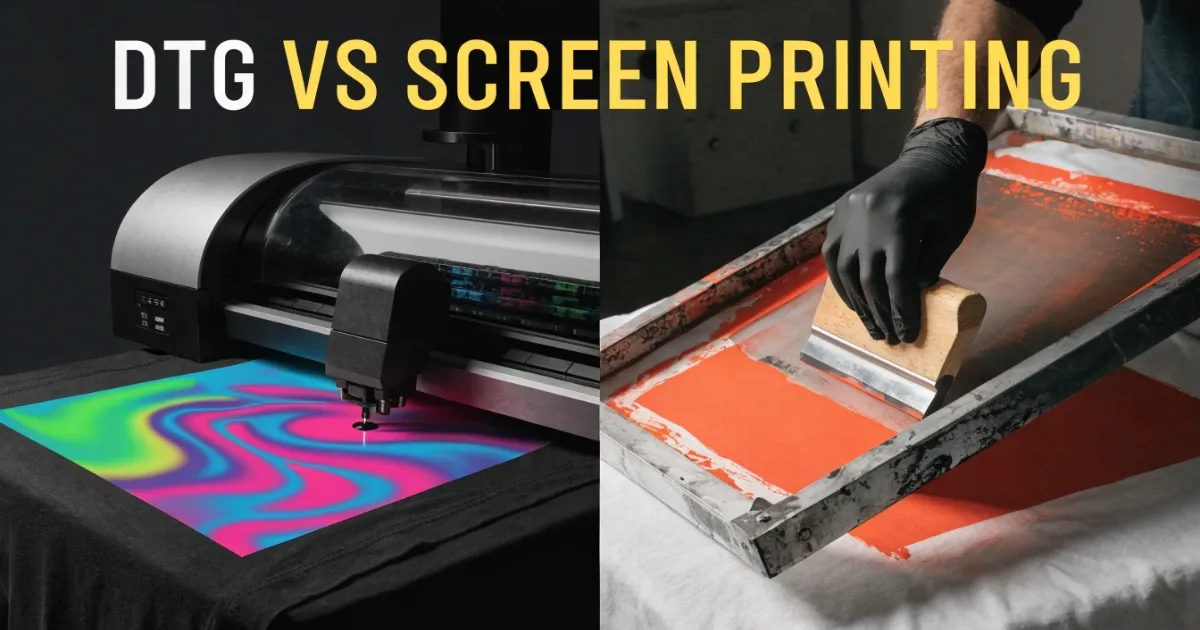
Every first-time brand founder asks the same question. Which printing method gives better quality? The answer they get is usually wrong — and it costs them.
DTG and screen printing can both produce durable, great-looking printed T-shirts. The quality difference between them is not about which process is superior. It is about whether you matched the right process to your fabric, your order size, and your design. Get that match wrong, and quality fails — regardless of which method you chose.
I have been running a garment factory in Dongguan for 21 years. We specialize in knit T-shirts and casualwear. Over that time, I have seen the same quality complaints come back again and again — faded prints, stiff hand feel, cracked designs after three washes. When we trace them back, the cause is almost never "the printing method failed." It is almost always "the wrong printing method was used for that fabric, that quantity, or that design." This article is about helping you avoid that mistake before you place your first order.
Does DTG or Screen Printing Last Longer After Washing?
You will read everywhere that screen printing lasts longer1. Most buyers take that as fact and move on. That assumption has caused more rework orders in our factory than almost any other single misconception.
Wash durability depends on the condition the print was applied under, not just the method. Properly cured DTG on 100% cotton washes well over repeated cycles. Incorrectly applied screen printing on a low-quality blank fades fast. The question is not which process lasts longer — it is whether the process was applied correctly to a compatible fabric.
Here is what actually drives wash durability in our production experience.
What determines how long a print survives washing?
Curing quality is the first factor. DTG ink must be heat-cured after printing to bond with the fabric. If the curing temperature or time is off, the ink sits on the surface rather than bonding into it. That print will start fading within the first five washes. We have received rework requests where clients blamed the method, but the real issue was under-curing at the printer's end.
Fabric compatibility is the second factor. Screen printing inks, especially plastisol-based inks, form a layer on top of the fabric.2 On a heavyweight, stable cotton blank, that layer adheres well. On a stretchy or fine knit, it can crack over time because the fabric moves but the ink layer does not flex as easily. DTG inks, when applied to 100% cotton, penetrate the fiber structure and move with the fabric. That is a durability advantage on soft, flexible knit garments — not a disadvantage.
Wash care is the third factor. This one is in the buyer's hands. Cold water, inside-out washing, no tumble dry on high — these instructions matter for both methods. Clients who ignore wash care and then report print failure are not comparing methods fairly.
| Durability Factor | DTG | Screen Printing |
|---|---|---|
| Curing required | Yes — heat cure after print | Yes — flash cure between colors |
| Best fabric match | 100% cotton | Cotton, poly-cotton, most blends |
| Risk if done wrong | Fading in early washes | Cracking, peeling at stress points |
| Wash care sensitivity | Moderate | Moderate to high (thick ink layers) |
| Order size relevance | Any size | More cost-effective at higher volumes |
The table above is only useful if you read it next to your actual order details. If you are ordering 80 pieces on 100% cotton blanks with a soft-hand design, curing quality and wash care matter far more to your outcome than which method you picked.
Why Does the Printed T-Shirt Feel Stiff?
Stiff hand feel is one of the most common complaints we hear from clients receiving their first DTG order. They assume the method caused it. That assumption is often wrong.
Stiff hand feel after printing comes from three places: the ink volume deposited on the fabric, the pre-treatment applied to prepare the surface, and the base fabric itself. DTG requires a pre-treatment spray on many fabric types before printing. On the wrong fabric or at the wrong volume, that pre-treatment is a major contributor to stiffness — not the ink itself.
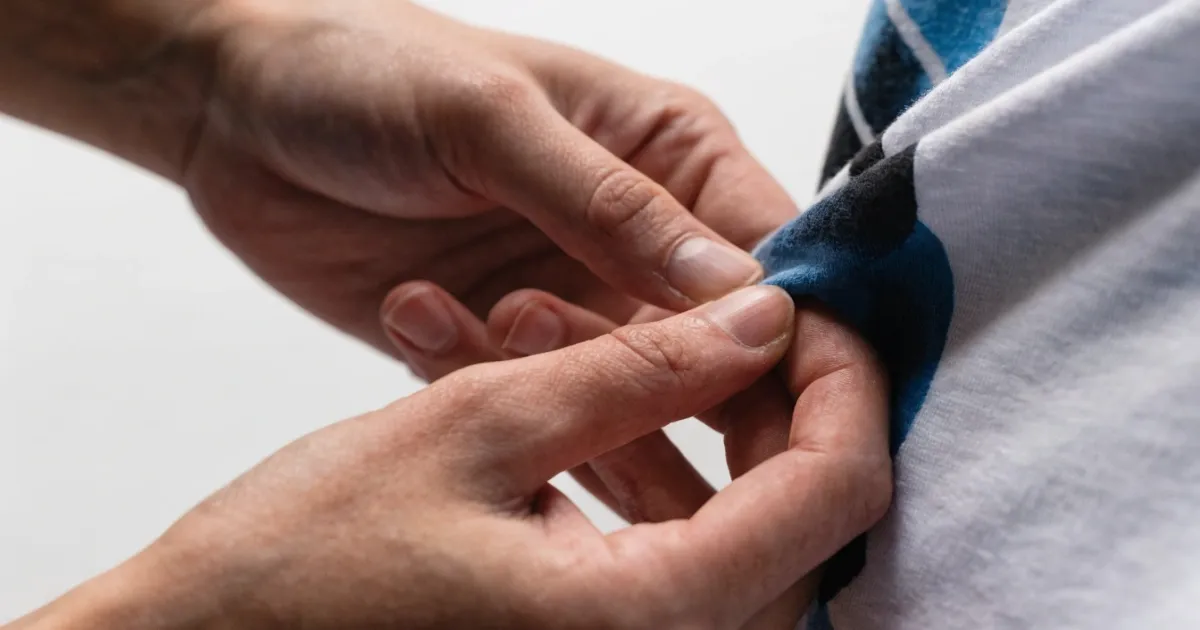
When clients come to us after a bad DTG experience and describe a stiff, almost plastic-like print area, the first thing I ask is: what fabric were they printing on?
What fabric factors affect how a printed T-shirt feels?
Fabric weight changes the outcome significantly. A 180gsm 100% cotton jersey will absorb DTG ink differently than a 130gsm fine-knit blend. Heavier cotton fabrics with an open knit structure take ink in more evenly and feel softer after curing. Light, tight-knit fabrics leave more ink sitting on the surface, which creates that stiff feeling clients report.
Polyester content changes everything. This is the point most first-time buyers miss entirely. DTG was designed to work on natural fibers, specifically cotton. When polyester content rises above around 50%, the ink does not bond well, colors print darker and muddier than the digital file shows, and the hand feel gets noticeably harder. We have had clients bring us a poly-cotton blend and ask why their DTG print looked nothing like the proof. The answer was in the fabric spec they had not checked.
Pre-treatment volume is adjustable, but not always adjusted. Some printers run a standard pre-treatment setting for all jobs. On high-cotton, medium-weight fabric, that is fine. On thinner fabric or fabric with any synthetic content, it results in over-treatment, and the garment feels stiff even before you print on it.
Screen printing hand feel is also fabric-dependent. A thick plastisol ink layer on a fine 140gsm T-shirt will feel heavy and raised. On the same design printed with a water-based ink on a 200gsm cotton tee, the feel is much softer. The variables are the same across both methods — the base fabric is always part of the result.
| Hand Feel Variable | What It Affects | What to Check |
|---|---|---|
| Fabric weight | Ink absorption | Aim for 180–220gsm for DTG softness |
| Polyester content | Ink bonding and surface feel | Keep cotton content above 80% for DTG |
| Pre-treatment | Surface stiffness | Ask printer about their pre-treatment settings |
| Ink type (screen) | Raised feel vs. soft feel | Water-based inks softer than plastisol |
| Design coverage | More ink = more feel | Large full-chest prints always feel heavier |
If you are sourcing your own blanks and sending them to a print vendor, check the fabric spec against this list before you confirm the method. This is where quality control starts — not at the printer, but at the fabric sourcing stage.
Does Fabric Type Actually Change Which Method You Should Use?
Most print method comparisons ignore the fabric question entirely. They compare output samples and make a judgment. That judgment only holds if both samples were printed on the same fabric. Change the fabric, and the comparison changes completely.
Fabric fiber content is the single biggest variable in print method selection. DTG performs best on 100% cotton or high-cotton blends. Screen printing is more tolerant of fabric variation and works across a wider range of fiber compositions. If your fabric is not confirmed before you choose a method, you are guessing.
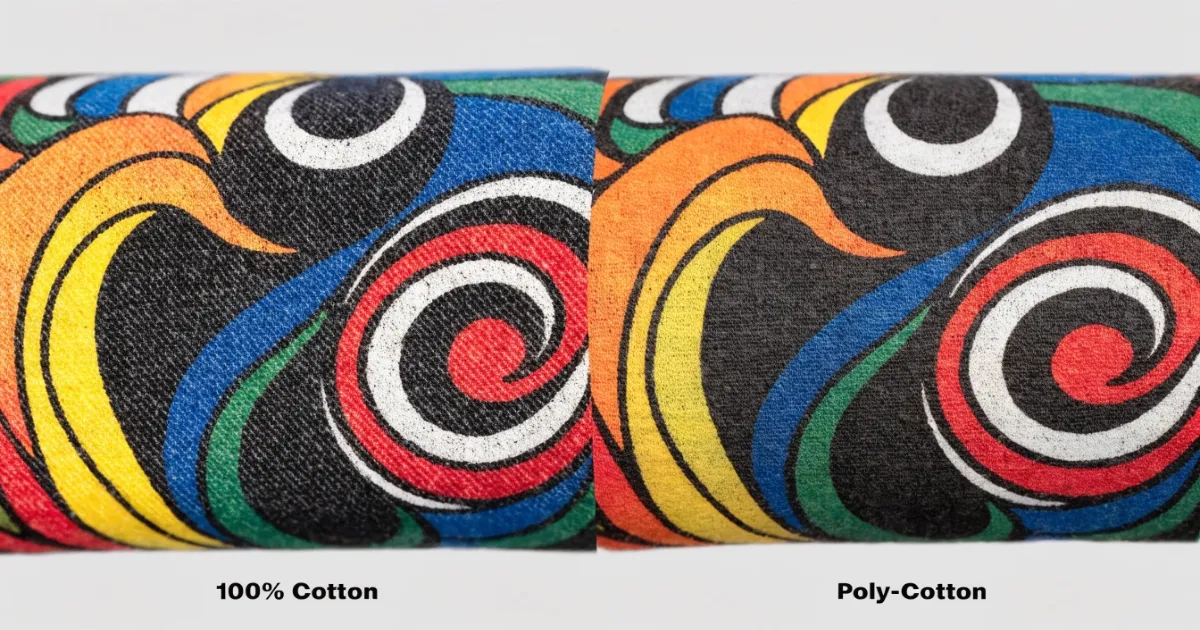
In orders we have processed and advised on, the most common mismatch we see is a buyer choosing DTG because of low MOQ, without knowing that their selected blank has 40% polyester content. The print comes back looking dark, slightly greenish on light colors, and stiff to the touch. The buyer blames the printer. The printer blames the method. Nobody mentions the fabric spec.
How does fiber content change the print outcome?
100% cotton is the DTG ideal substrate. Cotton fibers are hydrophilic — they absorb water-based inks readily. Pre-treatment bonds well, ink penetrates the fiber rather than sitting on top, and after proper curing the result is soft, vibrant, and wash-resistant. If you are building a T-shirt brand and your blanks are 100% ring-spun cotton, DTG is a legitimate option even for long-run production.
Poly-cotton blends above 50% polyester are DTG problem territory. The polyester component does not absorb the ink the same way. You get a phenomenon called dye migration — the polyester's own dye can bleed into the white ink areas over time or during curing, creating a gray or tinted appearance. Colors also look less saturated. We recommend that clients who want soft-hand, vibrant prints on poly-cotton blends switch to screen printing with a water-based or discharge ink system.
Performance fabrics with moisture-wicking or stretch finishes are usually screen printing territory. The surface finishes on these fabrics resist DTG pre-treatment adhesion. Even if the print looks fine immediately after production, wash resistance is poor. If you are printing on athletic or activewear blanks, screen printing with a compatible ink system is the more reliable path.
Tri-blend fabrics require extra conversation. Tri-blends (cotton, polyester, rayon) are popular with lifestyle brands because of the soft, vintage feel.3 DTG on tri-blends can produce a faded, worn look — sometimes intentionally, sometimes not. If your design brief calls for a vintage wash-down aesthetic, DTG on tri-blend can be a deliberate creative choice. If you want sharp, vibrant color, it is the wrong substrate for DTG.
| Fabric Type | DTG Suitability | Screen Print Suitability | Key Risk |
|---|---|---|---|
| 100% cotton (180–220gsm) | Excellent | Excellent | None if process is correct |
| 50/50 poly-cotton | Poor to moderate | Good | DTG color shift, dye migration |
| 80/20 cotton-poly | Good | Good | Monitor pre-treatment volume |
| 100% polyester | Not recommended | Use sublimation or specialty ink | DTG will not bond |
| Tri-blend | Creative use only | Good with water-based | DTG colors appear muted |
| Performance/wicking fabric | Not recommended | Use compatible ink system | Poor adhesion for DTG |
Before you finalize your blank, send the fabric spec to your print vendor. Ask them directly: "Is this substrate compatible with the method I am using?" Any experienced vendor will tell you the answer within minutes. That conversation is free. The rework order after ignoring it is not.
Is Screen Printing Worth It for Small Orders?
This is where a lot of first-time brand founders make an expensive process mistake. They hear that screen printing is higher quality or more durable, so they choose it for their launch order of 50 pieces across six designs. Then they see the invoice and the lead time.
Screen printing requires a physical screen to be made for each color in each design.4 That setup cost is fixed per design, regardless of how many pieces you print. For small orders with multiple designs, those setup costs often exceed the cost of the printing itself. DTG has no screens, no setup fees, and no minimum per design.
When clients come to us planning a brand launch with multiple colorways and designs, I ask one question first: how many pieces per design? That number determines the method before anything else does.
How should order quantity and design count affect your method choice?
Understand the screen printing cost structure first. Every color in your design requires a separate screen. A four-color design requires four screens. If you are printing six designs, that is potentially 24 screens, each with its own setup cost. Typical screen fees range from $20 to $50 per screen per design depending on the vendor. On a 50-piece order, those fees alone can add $2–$4 per unit before a single shirt is printed.
DTG pricing is per piece, not per setup. You pay the same unit price whether you are printing one design or twenty. There is no penalty for design variety. For a startup launching with a capsule collection — five to ten designs, 30–80 pieces each — DTG is almost always the more rational economic choice, assuming the fabric is compatible.
Screen printing becomes cost-effective at volume. Once you are printing 200 or more pieces of a single design, the screen setup cost gets diluted across enough units that it becomes negligible. At 500 pieces, screen printing is often cheaper per unit than DTG. The break-even point varies by vendor, number of colors, and ink system, but the principle holds consistently.
Design complexity affects the comparison further. A simple two-color logo print is inexpensive to screen print even at low quantities. A full-color photorealistic print requires more screens and more setup. That same photorealistic design on DTG is a single file — no extra cost for complexity. If your design is detailed and multi-colored, DTG absorbs that complexity at no additional charge.
| Order Scenario | Recommended Method | Reason |
|---|---|---|
| 50 pcs, 6 designs, multi-color | DTG | Setup costs make screen printing prohibitive |
| 200 pcs, 1 design, 2 colors | Screen printing | Setup cost diluted, faster per-unit production |
| 100 pcs, 1 design, full color photo | DTG | Screen count for full-color is impractical |
| 500 pcs, 1 design, brand logo | Screen printing | Volume justifies setup, lower unit cost |
| Mixed run, sizes S–2XL, 1 design | Screen printing | High total units across sizes reduce per-unit setup |
If you are reading this as you plan your first launch, write down your design count and your quantity per design before you contact any print vendor. Those two numbers will tell you more about which method to use than any quality comparison ever will.
Conclusion
DTG and screen printing are both capable of producing high-quality, durable printed garments. The real quality risk is choosing the wrong method for your fabric and your order — that decision happens before production starts, and it is yours to make.
"Screen Printing Conductive Inks on Textiles: Impact of Plasma ...", https://pmc.ncbi.nlm.nih.gov/articles/PMC12252473/. Studies comparing the wash durability of screen printing and DTG suggest that both methods can achieve long-lasting prints when applied correctly, though screen printing may have an edge on certain fabric types due to ink layer thickness. Results vary based on curing and fabric compatibility. Evidence role: statistic; source type: research. Supports: Durability comparisons between screen printing and DTG printing.. Scope note: Findings may depend on specific production conditions and fabric types. ↩
"Screen Printing Conductive Inks on Textiles: Impact of Plasma ...", https://pmc.ncbi.nlm.nih.gov/articles/PMC12252473/. Plastisol inks are known to form a rigid layer on fabric surfaces, which can crack over time on stretchy or fine-knit fabrics due to limited flexibility. Evidence role: mechanism; source type: research. Supports: The behavior of plastisol inks on stretchy or fine-knit fabrics.. Scope note: Cracking depends on ink thickness and fabric elasticity. ↩
"What is a Tri-blend shirt? What Are the Best Tri-blend Shirts for You?", https://merchize.com/what-is-a-tri-blend-shirt/. Tri-blend fabrics are widely used in lifestyle apparel for their soft texture and vintage aesthetic, appealing to casualwear markets. Evidence role: expert_consensus; source type: research. Supports: The popularity of tri-blend fabrics for lifestyle brands.. Scope note: Popularity may vary by region and brand positioning. ↩
"Screen printing - Wikipedia", https://en.wikipedia.org/wiki/Screen_printing. Screen printing requires individual screens for each color in a design, which increases setup costs for multi-color prints. Evidence role: mechanism; source type: education. Supports: The setup process for screen printing and its cost implications.. Scope note: Setup costs vary by vendor and design complexity. ↩