
I see many brands lose money because they assume polyester always stretches. The problem often starts with one small misunderstanding: a buyer sees “polyester” on a fabric sheet and thinks it means “elastic.”
Polyester can be stretchy, but 100% polyester is not always stretchy.1 I usually check the yarn, knit structure, fabric weight, and spandex content before I judge stretch. For sportswear, fitted T-shirts, joggers, and hoodies, brands should confirm stretch and recovery before bulk production.
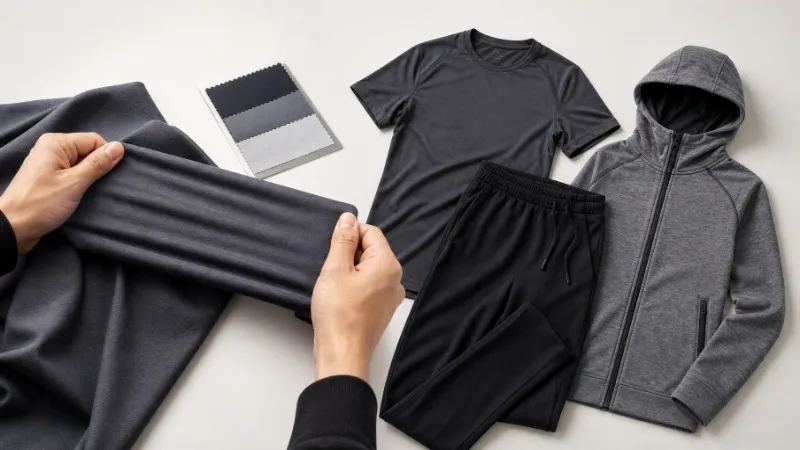
I have worked with knitted menswear for many years, and I have seen one simple mistake create many expensive problems. A buyer sees “Polyester” on a fabric sheet and thinks it means “elastic.” I understand why this happens. Many gym shirts, running tops, and performance hoodies use polyester. Many of them feel stretchy. But the stretch often comes from spandex, yarn texture, or knit construction. It does not come from the word polyester alone. If a brand wants good fit, stable size, clean printing, and lower inventory risk, the fabric choice must be made with more care. For brands developing polyester tops, choosing the right fabric is also part of working with a reliable custom T-shirt manufacturer, especially when fit, stretch, and print stability all matter. I will break it down in the way I explain it to buyers when we develop T-shirts, Polo shirts, hoodies, sweatshirts, and joggers in our factory.
Is 100% Polyester Stretchy?
I often meet buyers who think 100% polyester means high stretch. That mistake can turn a good design into a stiff garment.
I treat 100% polyester as a stable fabric first, not an elastic fabric. It may stretch a little if it is knitted or textured, but woven 100% polyester can feel firm and almost dead. I always test stretch by hand and by measurement before confirming fabric.
100% Polyester Is Not One Single Feeling
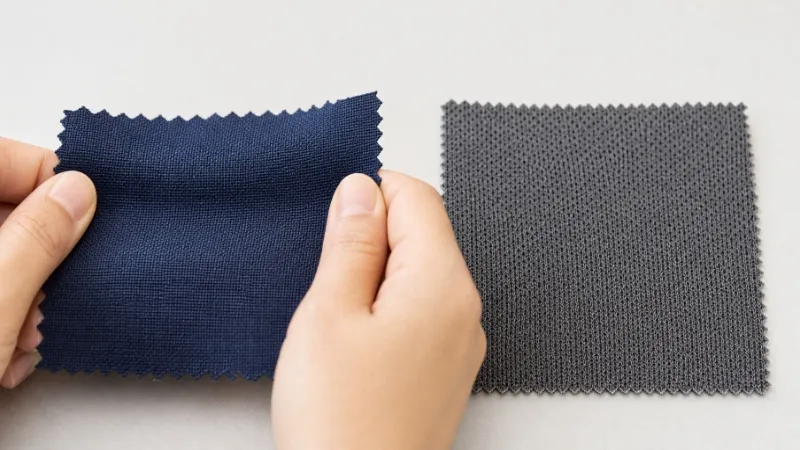
I do not judge polyester only by fiber content. I judge it by fabric type. 100% polyester woven trench fabric can feel stiff.2 A 100% polyester interlock knit can have mild mechanical stretch. A 100% polyester bird-eye mesh can feel flexible because the holes and loops move. These fabrics all say “100% Polyester,” but they do not behave the same way.
| Fabric Type | Common Use | Stretch Feeling | My Factory Note |
|---|---|---|---|
| Woven polyester | Jackets, windbreakers | Low | It can feel firm and paper-like |
| Polyester single jersey | T-shirts | Low to medium | It depends on yarn and gauge |
| Polyester interlock | Sports tops | Medium | It has more body and smoother surface |
| Polyester mesh | Training wear | Medium | The structure gives movement |
| Polyester fleece | Hoodies | Low to medium | Brushing changes hand feel |
I once checked a fabric for a buyer who wanted a fitted sports top. The swatch said 100% polyester, and the color was correct. But the hand feel was rigid. I told the buyer that the garment would not move with the body. If the buyer had approved it only by the composition label, the final goods could have felt hard and cheap.
What Makes Polyester Fabric Stretchy?
I see many new brands chase “stretch” without knowing the source. This creates wrong costs, wrong fit, and wrong expectations.
I look for three main stretch sources in polyester fabric: spandex blending, mechanical stretch from knit loops, and textured polyester yarn. Spandex gives strong stretch. Knit structure gives safer movement. Textured yarn improves comfort, but it does not replace spandex in tight garments.
Stretch Comes From Construction, Not From a Word
The first question in fabric development is how the fabric stretches. If the answer is “because it is polyester,” I know the answer is not enough. Real stretch must come from a clear source. If you are still comparing polyester, cotton, blends, and knit structures, our fabric guide for brands can help you understand how different materials behave before sampling.
| Stretch Source | How It Works | Best For | Risk |
|---|---|---|---|
| Spandex | Elastic fiber pulls back | Compression wear, leggings, tight tops | Aging, yellowing, recovery loss |
| Mechanical stretch | Knit loops move and return | Core basics, polos, hoodies, joggers | Limited stretch range |
| Textured polyester | Crimped yarn gives bulk and movement | Active T-shirts, mesh tops | May not hold tight fit |
| Fabric finishing | Softener or heat setting improves feel | Better hand feel | It cannot create true stretch alone |
When I develop polyester garments, I first ask the buyer about the wearing scene. A gym compression top needs stronger stretch. A casual hoodie does not need the same stretch. A basic training T-shirt may only need easy movement. This question saves money.
I also warn brands about overusing spandex. Spandex makes fabric feel good in the showroom. But it is sensitive to light, heat, storage time, and washing. If a new brand adds a high percentage of spandex to every style, the fabric cost rises, and the inventory risk rises too. I prefer controlled stretch for long-term products.
Stretch vs Recovery in Clothing
I have seen samples stretch beautifully, then fail after several wears. The problem was not stretch. The problem was recovery.
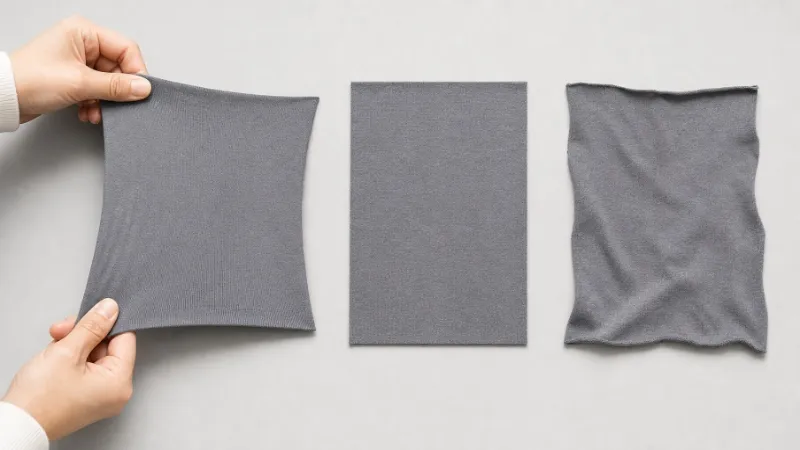
I define stretch as how far fabric can extend. I define recovery as how well it returns to its original shape. For apparel, recovery is often more important than stretch because poor recovery causes baggy knees, loose hems, and tired-looking garments.
A Fabric Can Stretch Well and Still Fail
I always test both movement and return. A buyer may pull a swatch and feel happy because it stretches far. But I look at what happens after release. If the fabric does not come back, the garment will lose shape.
| Test Point | What I Check | Why It Matters |
|---|---|---|
| Stretch percentage | How far the fabric extends | It affects comfort and fit |
| Recovery percentage | How much shape returns | It affects garment life |
| Growth after wear | Size change after stress | It affects knees, elbows, cuffs |
| Wash stability | Shape after washing | It affects customer reviews |
| Heat setting | Fabric memory after finishing | It affects production consistency |
I pay close attention to joggers and hoodies. Knees and elbows are easy failure points. If the fabric has poor recovery, the knee area can bulge after a few wears. The customer then thinks the whole product is low quality.
This problem is more serious with recycled polyester in some cases. I support recycled materials when the project is suitable. But I also tell buyers that recycled polyester yarn can show more fatigue if the yarn quality is not controlled. If a brand wants a clean eco message and long garment life, we need to test recovery before we use it in bulk.
Is Polyester Breathable for Activewear?
I hear buyers say polyester is breathable, then I hear other buyers say it feels hot. Both sides can be right.
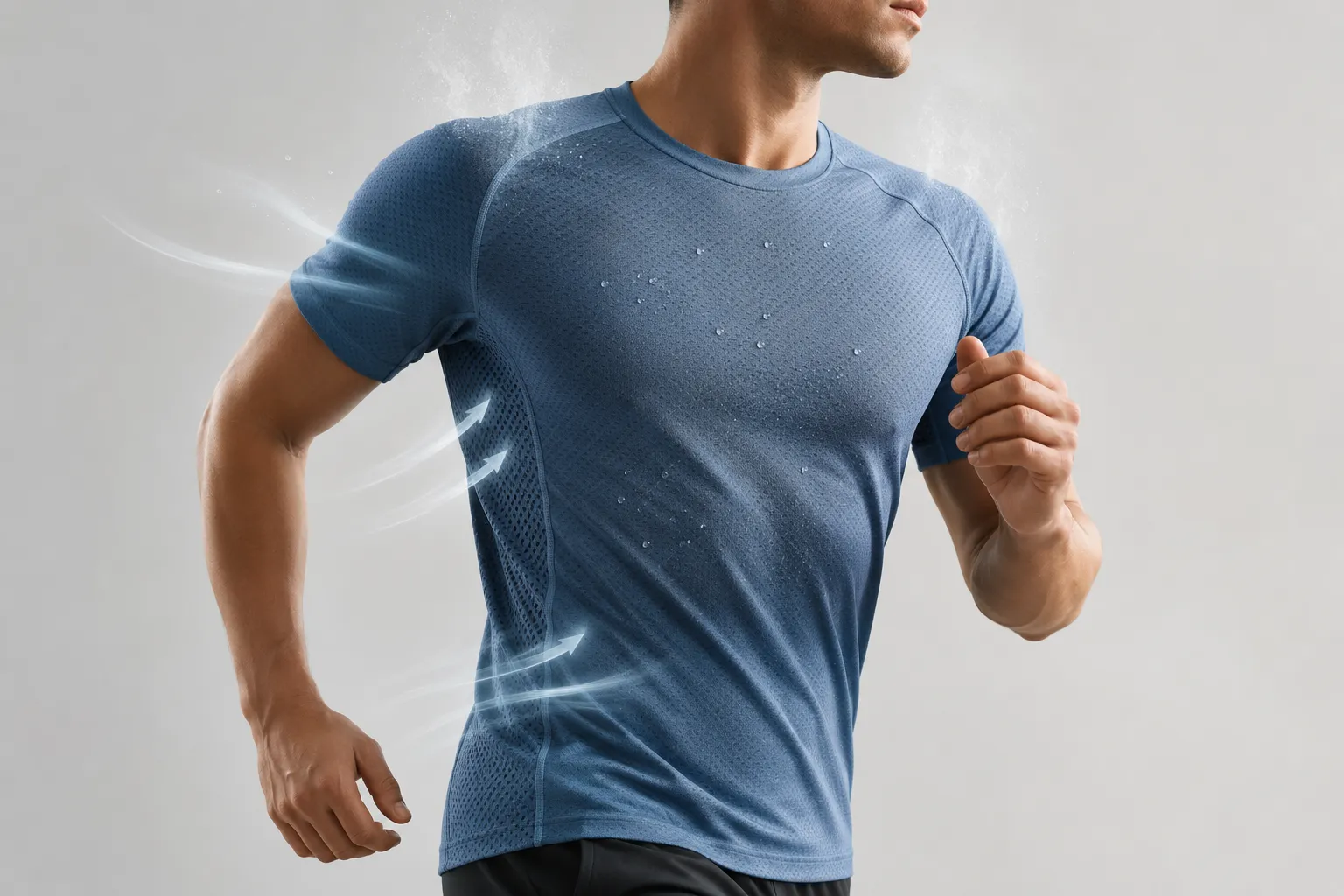
I do not call polyester breathable by default. I check fabric weight, knit structure, yarn shape, moisture-wicking finish, and garment design. Polyester can work very well for activewear when the fabric moves sweat and air in the right way.
Breathability Depends On Air and Moisture Movement
I explain polyester breathability in simple terms. Air must pass. Sweat must move away from the skin. The fabric must dry fast. Polyester absorbs little water, so it can dry faster than cotton. But if the fabric is too dense, too heavy, or poorly finished, the wearer may feel hot and sticky.
| Factor | Better Choice | Why I Care |
|---|---|---|
| Fabric weight | Light to medium GSM | Heavy fabric traps heat |
| Knit structure | Mesh, bird-eye, mini jacquard | Open structure improves airflow |
| Finish | Moisture-wicking finish | Sweat spreads and dries faster |
| Fit | Slight ease for training tops | Air can move better |
| Color | Dark colors need care | Heat and printing risks increase |
I often guide brands away from using one fabric for every activewear product. A running top, a gym hoodie, and a travel jogger have different needs. A running top may need light mesh. A hoodie may need polyester fleece with a soft back. A jogger may need stable double knit with moderate stretch.
I also remind buyers that breathability is not only a fabric issue. Pattern, fit, panel design, and print area also matter. A large rubber print can block airflow. A thick chest logo can feel uncomfortable during training.
Does Polyester Shrink When Washed?
I know brands fear shrinkage because one bad size chart can create returns. Polyester helps, but it is not magic.
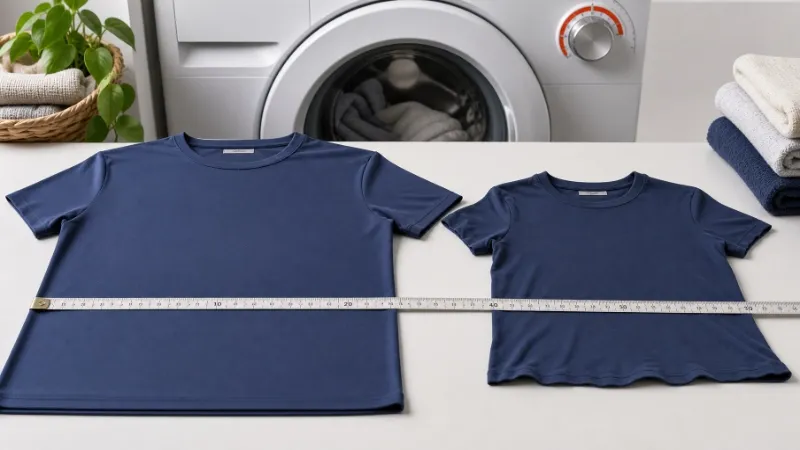
I expect polyester to shrink less than cotton, but I still test it before bulk. Polyester garments can shrink or change shape because of heat, fabric tension, poor heat setting, washing conditions, or mixed fibers like cotton and spandex.
Low Shrinkage Still Needs Real Testing
A polyester label does not mean zero shrinkage. I ask for shrinkage testing after washing and drying. In production, fabric may carry tension from knitting, dyeing, finishing, or rolling. Washing can release that tension. The garment can then become shorter, wider, twisted, or uneven.
| Cause | What Can Happen | My Control Method |
|---|---|---|
| Poor heat setting | Fabric changes after wash | I ask mill to set temperature correctly |
| High dryer heat | Garment may shrink or deform | I recommend clear care labels |
| Spandex blend | Recovery may change | I test after wash and rest |
| Cotton blend | Higher shrinkage risk | I pre-check fabric shrinkage |
| Cutting tension | Panels may distort | I relax fabric before cutting |
For T-shirts and polos, I care about body length, chest width, and shoulder width. For joggers, I care about inseam, outseam, waist, and knee shape. For hoodies, I care about sleeve length and rib recovery.
I also remind buyers that washing tests should match the real customer use. If the brand sells to the US or Europe, many customers use tumble dryers. A fabric that passes cold wash and hang dry may fail under high dryer heat. I would rather find the issue at sample stage than after shipment.
Polyester vs Cotton for Apparel
I often see brands choose between polyester and cotton as if one is always better. The better choice depends on the product.
I choose polyester when a brand needs quick drying, color stability, low shrinkage, and sport function. I choose cotton when the brand wants natural hand feel, everyday comfort, and a softer casual image. Blends can balance both needs.
The Best Fiber Depends On the Job
I do not sell one fiber as the answer to every problem. I start with the customer, the retail price, the design, and the sales channel. A streetwear T-shirt may need cotton or cotton-rich jersey. A gym training top may need polyester. A travel polo may use polyester, cotton, or a blend.
| Feature | Polyester | Cotton | My View |
|---|---|---|---|
| Drying speed | Fast | Slow | Polyester is better for sweat |
| Shrinkage | Lower | Higher | Cotton needs stronger control |
| Hand feel | Smooth or synthetic | Soft and natural | Cotton wins for natural touch |
| Color fastness | Usually strong | Good, but varies | Both need testing |
| Printing | Needs heat control | Easier for many prints | Polyester has migration risk |
| Eco story | Recycled options exist | Natural fiber story | Both need honest claims |
Printing is where polyester needs special care. I have seen bright polyester hoodies look perfect before printing, then fail after the logo is added. The problem is heat migration. If a white logo is printed on red polyester fabric, the dye can move into the white print during drying or later washing. Before confirming bulk production, brands should compare suitable printing and embroidery services and test whether the chosen method is safe for polyester fabric. The logo can turn pink. This accident can ruin a whole bulk order.
When I produce printed polyester garments, I ask about anti-sublimation base, curing temperature, ink system, and wash testing. A brand should not only approve the logo position. A brand must also approve print stability.
When Is Spandex Really Needed?
I know spandex feels attractive during sampling. The fabric stretches, the fit looks modern, and the buyer feels safe. But spandex has a cost.
I use spandex when the garment truly needs high stretch and strong body movement. I avoid high spandex content for core basics, long-storage inventory, and simple casual styles when mechanical stretch can do the job with less aging risk.
Spandex Solves Fit Problems but Creates Storage Risk
I treat spandex as a useful tool, not as a default ingredient. It helps tight T-shirts, yoga wear, compression tops, waistbands, cuffs, and fitted joggers. But it also has a shorter life than polyester. It can weaken under light, heat, sweat, chlorine, and long storage.
| Product Type | Spandex Need | My Usual Advice |
|---|---|---|
| Compression top | High | Use spandex and test recovery |
| Gym T-shirt | Medium | Use low spandex or mechanical stretch |
| Basic hoodie | Low | Avoid high spandex |
| Polo shirt | Low to medium | Use structure first |
| Joggers | Medium | Use spandex only where needed |
| Core basic tees | Low | Choose stable fabric |
This is a financial issue for start-up brands. I have seen new brands request high stretch because the sample feels premium. But if they produce too many pieces and the goods sit in a warehouse for two or three years, the spandex can age. The garment can become loose, pale, or weak. The brand then holds dead stock.
For long-running basics, I often suggest mechanical stretch polyester. It may not feel as elastic as high-spandex fabric, but it can stay stable for years. That stability protects cash flow. It also lowers customer complaints over time.
How Brands Should Choose Polyester Fabric
I believe most fabric mistakes happen because brands start with color and price. I prefer to start with function and risk.
I choose polyester fabric by checking the product use, stretch source, recovery, weight, breathability, printing method, shrinkage, color fastness, and inventory plan. I ask for lab dips, handloom or sample yardage, wash tests, and print tests before bulk approval.

A Simple Buying Checklist Reduces Bulk Risk
A clear development process can prevent many common fabric mistakes. The process is not complicated, but it prevents many common mistakes. First, I define the product. A T-shirt, polo, hoodie, sweatshirt, and jogger do not need the same fabric. Second, I define the wearing scene. Training, travel, office casual, and streetwear need different stretch and breathability. Third, I define the decoration method, because printing and embroidery change the fabric requirements.
| Decision Point | Question I Ask | Why It Matters |
|---|---|---|
| End use | Is it for sport or daily wear? | It sets stretch and breathability needs |
| Stretch source | Is it spandex or mechanical stretch? | It affects cost and garment life |
| Recovery | Will knees or elbows bag out? | It affects customer reviews |
| GSM | Is the weight right for season? | It affects comfort and shipping cost |
| Print method | Will dye migrate into the print? | It protects logo quality |
| Inventory plan | Will stock sit for years? | It affects spandex risk |
| Eco claim | Is it recyclable or recycled? | It affects brand message |
I also talk with buyers about eco claims. Many brands want recycled polyester, also called rPET. I understand this trend. Recycled polyester can support a useful story when the supply chain is real and traceable. But I also explain the trade-off. If a brand adds spandex to recycled polyester for stretch, the garment becomes much harder to recycle under current technology. A 100% polyester garment is much easier to recycle than a polyester-spandex blend.
If a brand wants a pure eco-friendly message, I suggest mechanical stretch instead of spandex when possible. The garment can keep a cleaner recycling path. It can also reduce long-term aging risk.
Conclusion
I do not ask “Is polyester stretchy?” alone. I ask how it stretches, how it recovers, and how it survives real production. If you are developing polyester T-shirts, hoodies, joggers, or activewear, do not choose fabric by composition alone. Ask for swatches, check stretch and recovery, test shrinkage after washing, and confirm print compatibility before bulk production.
At Easson Apparel, we help clothing brands choose suitable fabrics, develop samples, and control production details before bulk orders. If you already have a tech pack or reference sample, you can send it to us for fabric and production advice.
"Changes in Mechanical Properties of Fabrics Made of Standard and ...", https://pmc.ncbi.nlm.nih.gov/articles/PMC10708220/. According to the University of Georgia's Textile Science program, polyester's stretchability depends on its construction, such as knit patterns or added spandex, rather than the fiber itself. Evidence role: mechanism; source type: education. Supports: Explains why 100% polyester may not stretch and identifies factors like knit structure and spandex content that influence stretch.. Scope note: The explanation may not cover all fabric types or blends. ↩
"Polyester - Wikipedia", https://en.wikipedia.org/wiki/Polyester. A study published in the Journal of Textile Science highlights that woven polyester fabrics exhibit lower elasticity and a firmer texture due to their interlaced yarn structure. Evidence role: mechanism; source type: research. Supports: Confirms that woven polyester fabrics generally have less flexibility and a stiffer feel compared to knitted polyester fabrics.. Scope note: The findings may vary depending on fabric finishing treatments. ↩