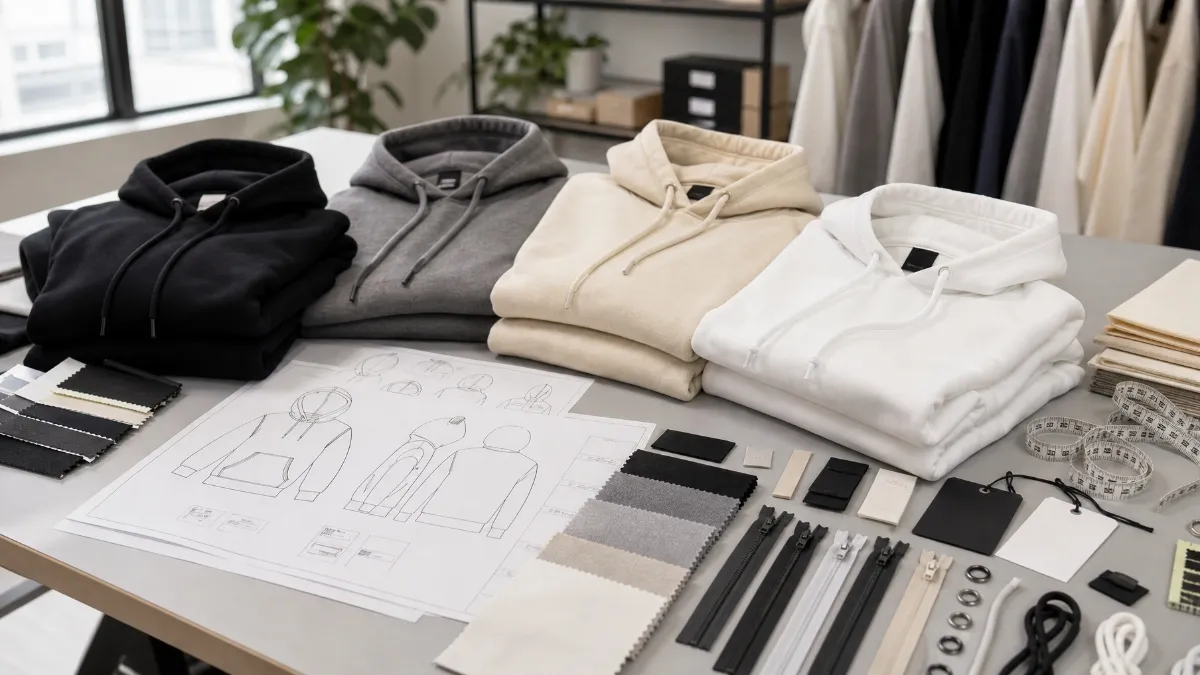
Many new clothing brands hear the term “private label hoodies” but are not always sure what it means in real production.
Private label hoodies are hoodies made by a manufacturer and sold under your own brand name, with customized details such as fabric, colors, labels, trims, decoration, and packaging. They usually use an existing or semi-developed hoodie pattern, which makes them more flexible than white label hoodies but faster and more affordable than fully custom hoodies.
For startup brands, private label hoodies are often the practical middle ground. You can create a branded hoodie line without developing every pattern, fabric, and construction detail from zero.
Instead of buying a generic blank hoodie and only adding a logo, private label production gives you more control over the final product. You can choose the fabric weight, fit, color, label, packaging, and decoration method, while the manufacturer helps turn those choices into a repeatable production specification. If you are still learning how private label production works, you can also explore our private label clothing resource hub for more guides on MOQ, branding, labeling, and supplier selection.
What Does Private Label Hoodies Mean?
Private label hoodies mean that a manufacturer produces hoodies for your brand, using your selected specifications, branding, and packaging, while the final product is sold under your brand name.
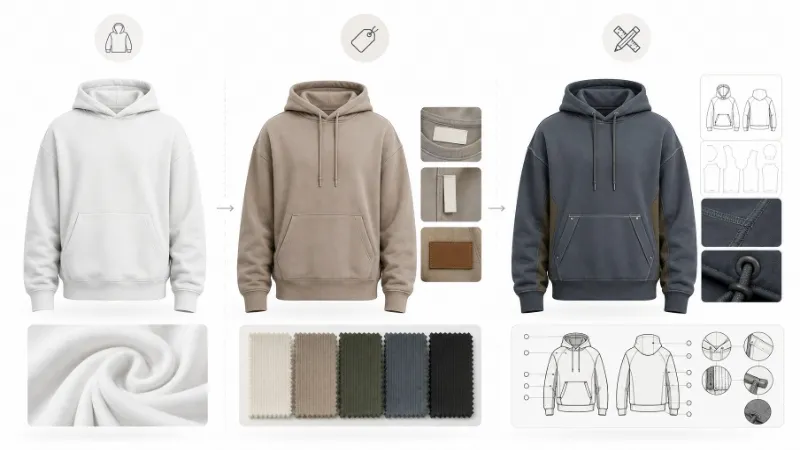
In apparel manufacturing, private label hoodies sit between white label hoodies and fully custom hoodies. For a broader business definition, Shopify’s private label guide1 explains private labeling as selling products under your own brand, while NetSuite’s private label overview2 explains the model from a business and supply chain perspective.
White label hoodies are usually generic ready-made products sold to many brands with limited changes, such as adding a logo or using different packaging. Fully custom hoodies are developed from scratch with a unique pattern, construction, fit, and fabric specification.
Private label hoodies are different. They often start from a proven base hoodie style or semi-developed pattern, but you can still customize important details, including:
- Fabric type and GSM
- Hoodie color
- Rib, drawcord, zipper, and eyelet details
- Screen printing, embroidery, puff print, or other decoration
- Inside neck label
- Care/content label
- Hang tag
- Branded packaging
For example, your brand chooses a boxy hoodie silhouette from a manufacturer, selects 350gsm cotton-poly fleece in two colors, adds a woven neck label, chooses matte black eyelets, and approves a pre-production sample. The factory then produces 300 units with your branding, labels, hang tags, and packaging.
That is a private label hoodie program.
The hoodie is not just a generic blank sold to everyone in exactly the same way. It is produced for your brand based on an agreed specification.
Private Label Hoodies Meaning: A Simple Example for Startups
For a startup clothing brand, private label hoodies usually mean starting with a reliable manufacturer’s base hoodie style, then customizing the fabric, fit, branding, labels, and packaging to create a product that feels like your own brand.
Imagine you are launching your first streetwear hoodie drop.
You do not want a basic blank hoodie with only a logo printed on the chest. But you also do not have the budget, time, or technical experience to develop a completely new hoodie pattern from scratch.
A private label manufacturer can help you choose a suitable base fit, such as regular fit, oversized fit, or boxy fit. Then you can adjust the fabric weight, color, pocket style, drawcord, logo placement, neck label, care label, and packaging.
For many new brands, this is a smarter starting point than full custom development because it reduces sampling risk and shortens development time.
At Easson Apparel, we often see startup brands begin with a private label hoodie run of around 100–200 pieces to test the market. Once the product proves stable, they may scale the same specification to 500–1,000 pieces for reorders or wholesale programs.
How Private Label Hoodie Manufacturing Works
Private label hoodie manufacturing usually follows a clear process: confirm the design direction, prepare the tech pack or reference sample, choose fabric and trims, develop samples, approve the PP sample, then move into bulk production and final inspection.
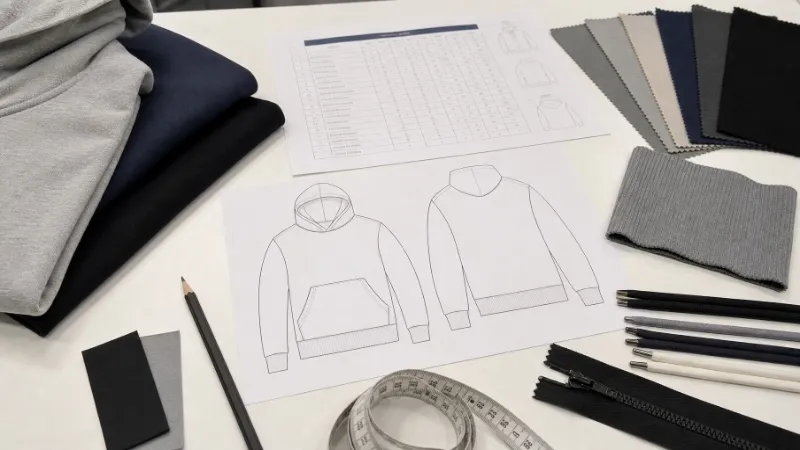
A good private label hoodie project is not only about adding a logo. It is about turning your brand idea into a repeatable product specification that a factory can produce consistently.
1. Start With a Design Direction
Many startup brands do not have a complete tech pack at the beginning. That is normal.
You can start with:
- A reference hoodie
- Product photos
- A rough sketch
- A preferred fit description
- Fabric handfeel references
- Logo artwork
- Target retail price
- Target quantity
The clearer your starting information is, the easier it is for the manufacturer to control sample cost, development time, and final quality.
2. Prepare a Basic Tech Pack
A tech pack is like a recipe for your garment. If important details are missing, the final hoodie may not match your expectations.
For hoodies, a basic tech pack should include:
- Flat sketches or reference images
- Fit description
- Measurement chart
- Fabric composition and GSM
- Rib fabric details
- Drawcord, eyelet, zipper, and trim details
- Logo artwork and placement
- Print or embroidery method
- Label and packaging requirements
- Care label information
For brands that are new to garment development, Techpacker’s tech pack guide3 gives a useful overview of how design details, measurements, materials, trims, and packaging notes are organized for production. For more detail, see our guide on how to prepare a clothing tech pack for manufacturing.
Factory note from Easson Apparel:
In real hoodie development, many delays are not caused by sewing. They usually happen because the fabric choice, artwork file, label content, or trim details are not confirmed early enough. Even a simple hoodie can become slow if the factory has to wait for Pantone colors, embroidery files, or packaging decisions.
3. Develop and Approve Samples
Private label hoodie sampling usually includes fabric confirmation, a first sample or fit sample, decoration testing, and a pre-production sample, often called a PP sample.
The PP sample is especially important. It is the final approved sample before bulk cutting and sewing. It should confirm the full product, including fabric, fit, decoration, label, trims, and packaging details.
Before approving the PP sample, check:
- Overall fit and measurements
- Fabric handfeel and weight
- Shrinkage after washing
- Print or embroidery placement
- Logo size and color
- Neck label and care label
- Drawcord, zipper, eyelet, and rib quality
- Packaging method
For standard hoodie samples using available fabrics and normal decoration, Easson Apparel usually estimates 8–12 days for sample development. More complex hoodie samples, such as heavy embroidery, special fabric, contrast panels, custom dyeing, or unusual trims, may take longer.
Private Label Hoodie MOQ and Lead Time
Private label hoodie MOQ and lead time depend on fabric availability, decoration method, custom trims, and order quantity. For many startup brands, a realistic starting MOQ is around 100–200 pieces, while standard bulk production often takes around 25–35 days after PP sample approval.
MOQ is one of the first questions new brands ask. The honest answer is that MOQ depends on how customized the hoodie is.
If you use available fabric, standard trims, and simple decoration, the MOQ can usually be more flexible. If you need custom-dyed fabric, special zippers, custom rib, or multiple colorways, the MOQ will usually increase.
| Project Type | Typical Quantity | Best For | Estimated Timeline |
|---|---|---|---|
| Sample Development | 1–2 samples | Fit, fabric, and branding confirmation | Around 8–12 days for standard samples |
| Startup Test Run | 100–200 pcs | First launch or market test | Around 25–35 days after PP approval |
| Small Brand Launch | 300–500 pcs | More stable size and color planning | Around 30–45 days depending on materials |
| Scaling Run | 500–1,000+ pcs | Reorders, wholesale, or stable SKUs | Depends on fabric, decoration, and season |
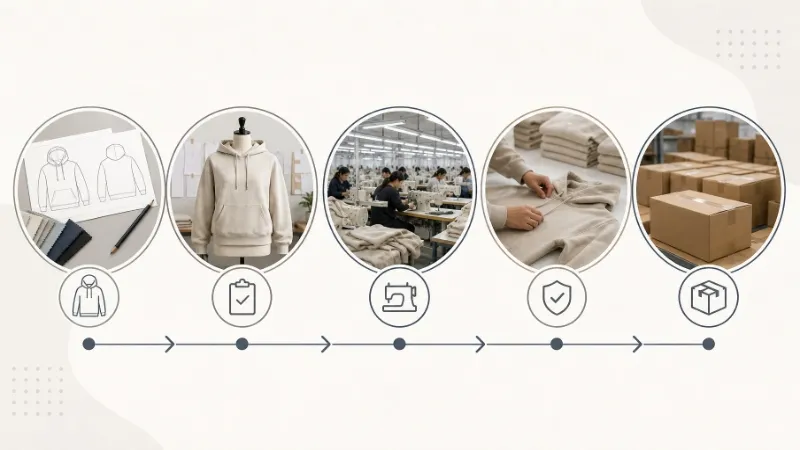
These are practical planning ranges, not fixed promises. A simple fleece hoodie with available fabric can move faster than a custom-dyed heavyweight hoodie with embroidery, puff print, custom labels, and branded packaging.
During bulk production, many apparel factories use inline checks and final inspections based on AQL sampling concepts. ASQ’s ANSI/ASQ Z1.4 and Z1.9 overview4 is a useful reference for understanding how acceptance sampling standards are used in quality control.
Factory note from Easson Apparel:
For startup hoodie orders, we usually suggest reducing the number of colors and sizes in the first run. For example, 150 pieces across two colors is easier to manage than 150 pieces across four colors and six sizes. Too many variations can make production less efficient and leave you with weak inventory depth in each size.
If you are planning a 100–300 pcs starter hoodie run, Easson Apparel can help review your fabric, GSM, label, and decoration options before sampling.
Hoodie Fabric, GSM, Trims, and Decoration Choices
The main hoodie choices that affect quality, cost, and lead time are fabric type, GSM, fit, trims, decoration method, labels, and packaging. These decisions should be confirmed before bulk production starts.
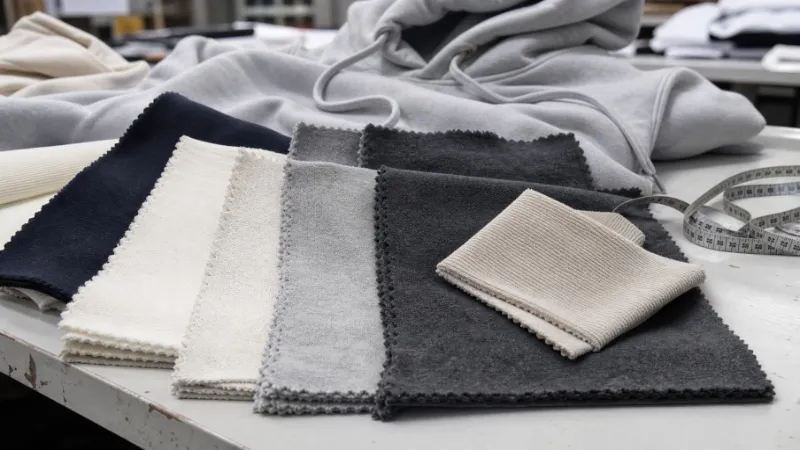
Private label hoodies may look simple from the outside, but small production decisions can change the final product significantly.
Fabric and GSM
Fabric is one of the biggest quality signals in a hoodie. The same design can feel completely different depending on fabric weight, composition, knitting density, and finishing.
| Fabric Type | Common GSM Range | Best For | Notes |
|---|---|---|---|
| French Terry | 280–350gsm | Spring, fall, lightweight streetwear | Breathable loopback fabric |
| Cotton-Poly Fleece | 300–420gsm | Everyday hoodies and brand launches | Balanced cost, comfort, and durability |
| Heavyweight Fleece | 420–500gsm+ | Premium streetwear and winter hoodies | More structure, higher cost, heavier shipping weight |
| Sherpa or Lined Fabric | Varies | Warm winter styles | Adds bulk and packing volume |
| Organic or Recycled Materials | Varies | Sustainability-focused brands | May require certification and longer sourcing time |
GSM is useful, but it is not the full story. A 350gsm fabric from one mill may feel different from another 350gsm fabric because of yarn quality, brushing, knitting density, and finishing. If you are still comparing fleece, French terry, and cotton blends, our guide to the best hoodie material can help you choose a fabric direction before sampling.
Factory note from Easson Apparel:
For most startup hoodie brands, we usually recommend testing fabrics in the 320–420gsm range first. This range is heavy enough to feel substantial but not so heavy that cost, shrinkage control, and shipping weight become difficult for a first launch.
Trims and Construction
Trims may look small, but they affect both appearance and durability.
Important hoodie trims include rib cuffs, hem rib, drawcords, aglets, eyelets, zippers, pocket construction, hood lining, neck tape, labels, hang tags, and packaging bags.
For example, cotton/spandex rib usually gives better recovery at cuffs and hem. Metal eyelets can create a more premium appearance, but they also add cost and require careful placement. A zipper hoodie needs zipper tape color, zipper puller shape, and zipper quality to be confirmed before production.
Construction details also matter. Bartacks at pocket openings, clean topstitching, and stable shoulder seams can help reduce early product failure.
Decoration Methods
Decoration method affects cost, MOQ, sample time, and production schedule.
| Decoration Method | Best For | Production Notes |
|---|---|---|
| Screen Printing | Solid logos, larger bulk orders | Efficient at volume, but setup is required |
| Embroidery | Premium logos, chest marks, patches | Stitch count affects price and time |
| Puff Print | Streetwear-style raised graphics | Needs testing to control texture and durability |
| DTG Printing | Complex multi-color artwork | Flexible but slower for bulk |
| Appliqué / Patch | Premium branding details | Needs extra development and sewing time |
For bulk private label hoodies, screen printing and embroidery are still common because they are stable, scalable, and familiar to most factories. However, artwork must be prepared correctly. Vector files, Pantone references, placement measurements, and print size should be confirmed before sampling. If your hoodie design depends heavily on logo application, compare different methods in our guide to screen printing vs DTG vs embroidery.
How Much Does Private Label Hoodie Manufacturing Cost?
Private label hoodie manufacturing cost depends mainly on fabric, GSM, order quantity, decoration method, trims, labels, packaging, and shipping weight. The more custom details you add, the more important it becomes to control the bill of materials before production.
There is no single fixed price for private label hoodies because every specification changes the cost.
A lightweight French terry hoodie with a small chest print will not cost the same as a 450gsm heavyweight fleece hoodie with custom dyeing, embroidery, branded drawcord tips, woven labels, hang tags, and custom packaging.
| Cost Factor | Why It Matters |
|---|---|
| Fabric Type | Cotton-poly fleece, French terry, heavyweight fleece, organic cotton, and recycled fabrics all have different costs |
| GSM | Heavier fabric usually increases material cost and shipping weight |
| Decoration Method | Embroidery, puff print, and multi-color screen printing add setup and production cost |
| MOQ | Larger orders usually reduce unit cost because cutting, setup, and production are more efficient |
| Custom Trims | Special zippers, drawcords, eyelets, and aglets increase sourcing time and cost |
| Labels | Woven neck labels, care labels, and size labels must be planned in advance |
| Packaging | Branded polybags, hang tags, stickers, and boxes add cost per unit |
| Shipping | Heavy hoodies can increase freight cost, especially for air shipping |
Many startup brands focus only on the garment unit price, but the real landed cost includes labels, packaging, quality inspection, shipping, duties, and possible storage or fulfillment costs.
A practical way to control cost is to simplify your first run:
- Use one or two colors
- Start with one core hoodie fit
- Avoid too many decoration placements
- Choose available fabric when possible
- Keep packaging clean but not overcomplicated
- Confirm label content early
This gives you a stronger chance of launching on time and protecting your margin.
Branding and Labeling for Private Label Hoodies
Private label hoodies usually include your brand neck label, care/content label, hang tag, and packaging. For U.S. sales, label information should be planned carefully because fiber content, country of origin, and care instructions are important compliance details.
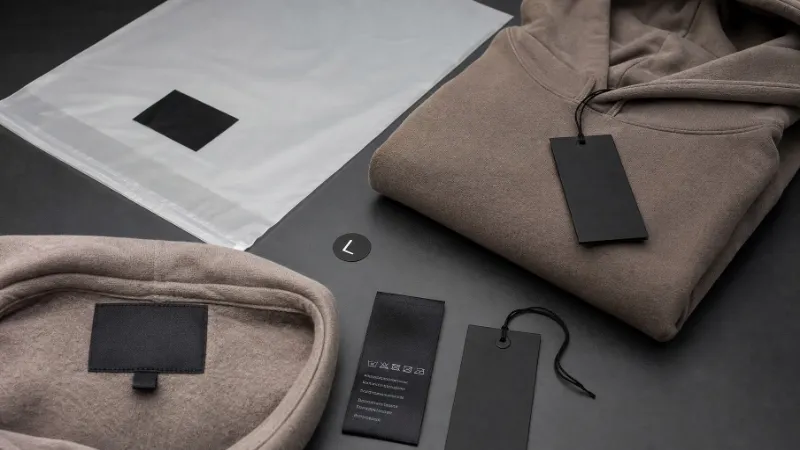
Branding is one of the main reasons brands choose private label manufacturing.
A typical private label hoodie branding package may include:
- Woven neck label
- Printed neck label
- Size label
- Care/content label
- Hang tag
- Barcode sticker
- Branded polybag
- Tissue paper
- Sticker seal
- Carton mark
For the U.S. market, the FTC’s Apparel and Labeling guidance5 explains that most textile and wool products need labels showing fiber content, country of origin, and the identity of the manufacturer or another responsible business. The FTC’s Care Labeling Rule6 is also important when preparing care instructions for hoodies.
In practice, you should prepare label information before bulk production, not at the last minute. If the care label is wrong after it has been woven or printed, fixing it can delay the order and increase cost.
Also be careful with sustainability claims. If you use recycled polyester, organic cotton, or other eco-related language, make sure your supplier can support the claim with proper material information or certification when needed.
Private Label vs White Label vs Custom vs OEM Hoodies
Private label hoodies are more customizable than white label hoodies but usually faster and less expensive than fully custom or OEM hoodie development. The best option depends on how much control, uniqueness, and development time your brand needs.
This is one of the most common areas of confusion for new brands.
For apparel brands, the key difference is the level of product control.
| Model | Customization Scope | Typical Use Case |
|---|---|---|
| Private Label Hoodies | Fabric, color, trims, labels, decoration, packaging within a base or semi-custom pattern | Startups, DTC brands, wholesalers, store brands |
| White Label Hoodies | Logo and packaging only, limited product changes | Fast testing, simple merch, low customization needs |
| Custom Hoodies | Full pattern, fit, fabric, construction, trims, and decoration | Brands needing a unique silhouette or technical features |
| OEM Hoodies | Factory produces according to your complete blueprint | Experienced brands with strong product development resources |
For most first-time hoodie launches, private label is often the most balanced option. It gives you more brand control than white label, but it avoids some of the cost and development risk of fully custom production. If your brand needs a unique fit, new pattern, or more complex construction, you may be better suited for a custom clothing manufacturer instead of a basic private label program.
Common Mistakes When Making Private Label Hoodies
The most common mistakes in private label hoodie production are treating private label as white label, skipping PP sample approval, using unclear artwork, choosing too many colors or sizes, and confirming labels too late.
Private label hoodies are easier than full custom hoodies, but they still require clear decisions.
Mistake 1: Thinking Private Label and White Label Are the Same
White label is usually closer to buying a generic blank and adding your logo. Private label gives you more control over the product specification, branding, and presentation.
If your brand cares about fabric, fit, trims, and packaging, private label is usually a better fit than white label.
Mistake 2: Skipping PP Sample Approval
The PP sample is the final checkpoint before bulk production. It should not be treated as a formality.
Before approving it, check measurements, fabric, color, decoration, labels, and packaging. Once bulk fabric is cut, changes become much more expensive.
Mistake 3: Using Low-Quality Artwork Files
Blurry PNG files, screenshots, and unclear logo references can lead to poor print or embroidery results.
For production, provide vector artwork when possible, Pantone color references, exact logo dimensions, placement measurements, clear mockups, and embroidery or print instructions.
Mistake 4: Ordering Too Many Variations in a Small Run
A 150-piece order split across four colors and six sizes can become inefficient. Each size and color may have too few units, making inventory planning and production control harder.
For first launches, it is better to focus on fewer colors and a cleaner size range.
Mistake 5: Confirming Labels Too Late
Labels are small, but they can delay the whole order. Neck labels, care labels, hang tags, and packaging should be confirmed early, especially if they require custom printing or weaving.
Who Are Private Label Hoodies Best For?
Private label hoodies are best for startup brands, growing DTC brands, wholesalers, and store-brand programs that want branded hoodies with more control than white label products but less complexity than fully custom development.
Private label hoodies are a strong option if you want:
- Your own brand label
- A more premium product than a generic blank
- Better control over fabric and trims
- Custom packaging
- Repeatable production for reorders
- A manageable first MOQ
- Faster development than full custom hoodies
They are especially suitable for startup clothing brands launching their first hoodie drop, growing DTC brands expanding from T-shirts or sweatshirts, wholesalers building store-brand programs, and creator brands moving from simple merch to a more serious apparel product.
Ask yourself one question:
Do you need a completely unique hoodie pattern on day one, or do you need a reliable branded hoodie that your customers will actually buy and wear?
For many first launches, private label is the practical answer.
Practical Example: A Typical Private Label Hoodie Run
A typical private label hoodie run starts with a reference style or tech pack, then moves through fabric selection, sample development, PP sample approval, bulk production, QC, packing, and shipping.
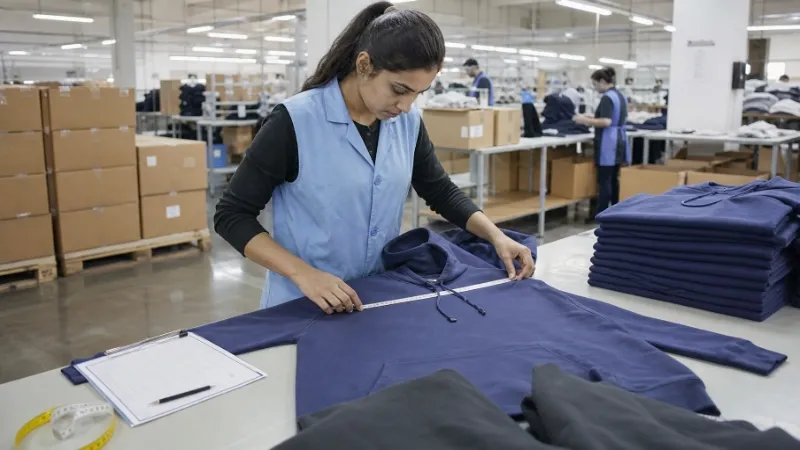
Here is what a realistic project may look like.
A startup brand contacts Easson Apparel with a reference hoodie, logo artwork, and a target order quantity of 200 pieces. The brand wants a premium everyday hoodie with a relaxed fit, medium-heavy handfeel, and simple chest embroidery.
Easson reviews the reference, suggests a cotton-poly fleece in the 350–400gsm range, and provides fabric swatches. The brand chooses two colors and confirms a woven neck label, care label, hang tag, and standard branded polybag. As an experienced hoodie manufacturer, Easson Apparel can support fabric sourcing, sample development, private labeling, bulk production, and packaging for growing apparel brands.
The first sample is made to check fit, fabric, logo placement, and overall appearance. After small corrections, a PP sample is produced with the final fabric, embroidery, labels, and trims.
Once the PP sample is approved, bulk production begins. During production, the factory checks measurements, stitching, decoration placement, and finishing quality. Before packing, the hoodies are inspected, folded, labeled, packed into polybags, and placed into cartons.
If the first drop performs well, the brand can reorder 500–1,000 pieces using the same specification. Reorders are usually easier because the fabric, measurements, labels, and decoration details have already been confirmed.
Private Label Hoodie Production Checklist
Before starting private label hoodie production, confirm your hoodie design, fabric, MOQ, artwork, labels, packaging, sample process, and bulk production timeline.
Use this checklist before contacting a manufacturer:
- Do you have a reference hoodie or tech pack?
- What fit do you want: regular, oversized, boxy, cropped, or athletic?
- What fabric type and GSM do you prefer?
- How many colors do you want?
- What is your target order quantity?
- Do you need screen printing, embroidery, puff print, or another decoration?
- Do you have production-ready artwork files?
- Do you need woven labels or printed neck labels?
- Do you know your care label information?
- Do you need hang tags or branded packaging?
- What is your target launch date?
- Are you planning a test run or a long-term reorder program?
If you are not sure about fabric, GSM, or MOQ, a good manufacturer should be able to guide you before sampling.
Next Steps: Working With a Reliable Private Label Hoodie Manufacturer
To work with a reliable private label hoodie manufacturer, prepare your design direction, target quantity, fabric preference, branding details, and expected launch timeline before sampling begins.
Private label hoodies can be a strong starting point for clothing brands that want more control than white label products but do not want the full cost and complexity of custom development.
The key is to work with a manufacturer that understands both production and brand-building needs. A reliable supplier should help you think through fabric, fit, trims, decoration, labeling, packaging, MOQ, sampling, and bulk production planning.
At Easson Apparel, we support private label hoodie production for startups, growing apparel brands, wholesalers, and brand owners who need flexible MOQ, custom branding, and scalable production.
If you are planning a hoodie line, you can start by sending us:
- Your reference hoodie or design idea
- Target quantity
- Fabric or GSM preference
- Logo artwork
- Label and packaging requirements
- Target market and launch timeline
From there, we can help you review the best production route, sampling plan, and realistic MOQ for your private label hoodie project. If you are ready to develop your own private label hoodie line, contact Easson Apparel through our custom clothing manufacturing service to discuss fabric, MOQ, sampling, labels, and bulk production.
[Shopify: What Is Private Label?](https://www.shopify.com/blog/what-is-private-label) — Explains the basic business meaning of private labeling. ↩
[NetSuite: What Is a Private Label?](https://www.netsuite.com/portal/resource/articles/erp/private-label.shtml) — Gives a broader business and supply chain overview of private label products. ↩
[Techpacker: What Is a Tech Pack?](https://techpacker.com/blog/design/what-is-a-tech-pack/) — Explains how a tech pack helps organize garment design, materials, measurements, trims, and production details. ↩
[FTC: Apparel and Labeling](https://www.ftc.gov/news-events/topics/tools-consumers/apparel-labeling) — Official U.S. guidance on textile labeling, including fiber content, country of origin, and responsible company identity. ↩
[FTC: Care Labeling Rule](https://www.ftc.gov/legal-library/browse/rules/care-labeling-textile-wearing-apparel-certain-piece-goods-text) — Official rule for care instructions on textile wearing apparel. ↩
[ASQ: ANSI/ASQ Z1.4 and Z1.9](https://asq.org/quality-resources/z14-z19) — Reference for acceptance sampling standards used in quality inspection. ↩